Cart 0


Share
Table of Contents
Local SEO Tools: Empowering Your Local Digital Strategy
If you are searching for ways to attract more customers from your immediate geographic area, the strategic use of local SEO tools is the single most effective move you can make. The question is not whether you need local search optimization, but which tools will deliver the data and automation required to outrank competitors in your neighborhood, city, or region. After two decades of refining local digital strategies for businesses across the United States, I can tell you that the difference between a thriving local practice and one that struggles to be found often comes down to the toolkit you deploy. In this guide, I will walk you through the best local SEO software, free local SEO tools, local SEO audit tools, and reporting platforms that actually move the needle. You will learn what to prioritize, what to avoid, and how to build a system that drives targeted traffic, improves conversion rates, and solidifies your online visibility exactly where it matters most—right in your local market.
Understanding Why Local SEO Tools Are Non-Negotiable
Local SEO is the practice of optimizing your online presence to attract more business from relevant local searches. These searches happen on Google, Bing, and other search engines when users include a location modifier or when the engine determines the query has local intent. For any business with a physical location or a service area, local search is the primary channel through which new customers discover you. Google reports that nearly one in three mobile searches is related to location, and 76 percent of people who search for something nearby visit a related business within a day. Yet, achieving top rankings in the local pack and organic results requires precise, data-driven work. Generic SEO tactics are not enough. You need local SEO tools that understand proximity, relevance, and prominence—the three pillars Google uses to rank local businesses. These tools automate repetitive tasks, surface technical issues unique to local sites, track keyword performance in specific geo-targeted areas, and manage your business listings across dozens of directories. Without them, you are flying blind, guessing at keywords, and hoping your Google Business Profile is optimized. With them, you gain actionable intelligence and a repeatable system for growth.

The market is crowded with local SEO software offerings, but not all are created equal. Some excel at citation building, others at rank tracking, and still others at audit and reporting. The key is to assemble a stack that covers every stage of your local SEO workflow: research, audit, optimization, monitoring, and reporting. Throughout this article, I will highlight the standout platforms, explain how they fit into a coherent strategy, and share insights from real implementations that have produced measurable results for businesses in competitive local markets.
Top Local SEO Tools for Keyword Research That Drive Traffic
Keyword research for local SEO is fundamentally different from broad keyword research. You cannot simply target high-volume generic terms. You need to uncover the specific phrases your neighbors type into search bars when they are ready to buy. This requires tools that can filter by location, reveal geo-modified long-tail terms, and expose the keywords driving traffic to your local competitors. Over the years, I have tested dozens of platforms, and the following consistently deliver the best local keyword data.
Google Keyword Planner remains an essential starting point because it offers free, accurate search volume data tied to specific locations. Pair it with a tool like Ahrefs, which allows you to enter a competitor’s domain and see exactly which local keywords they rank for, along with search volume and keyword difficulty scores. Ahrefs also provides a “Parent Topic” feature that helps you understand the semantic context around local queries. Semrush goes a step further with its “Market Analysis” and “Organic Research” tools, enabling you to compare your keyword profile against competitors in the same geographic area. Moz Keyword Explorer offers a “Priority” score that combines volume, difficulty, and organic click-through rate, which is incredibly useful for deciding which local terms to target first. For businesses operating in multiple cities, I recommend using Semrush’s “Position Tracking” tool to monitor rankings city by city, giving you a granular view of performance across your entire service area.
| Tool | Key Local Feature | Starting Price |
|---|---|---|
| Google Keyword Planner | Location-based volume and forecasts | Free |
| Ahrefs | Competitor keyword gap analysis by region | $99/month |
| Semrush | City-level position tracking | $119.95/month |
| Moz Keyword Explorer | Priority score for local terms | $99/month |
The most important insight I have gained from two decades of local keyword research is that you should prioritize “near me” phrases, “best [service] in [city]” terms, and long-tail questions that reflect purchase intent. For example, a plumber in Austin should target “emergency water heater repair Austin” before “plumber Austin” because the longer phrase signals higher intent and faces less competition. Using these local SEO tools to build a keyword list organized by service and location will give you a roadmap for content creation, on-page optimization, and Google Business Profile posts.
Conducting a Thorough Local SEO Audit With the Right Tools
A local SEO audit is the diagnostic phase of your strategy. It reveals technical issues that are holding your site back, inconsistencies in your business listings, and gaps in your on-page optimization relative to local competitors. Without a proper audit, you risk optimizing the wrong elements while critical problems go unnoticed. The best local SEO audit tools go beyond basic crawling to evaluate factors specific to local search, such as Google Business Profile completeness, NAP (name, address, phone number) consistency across citations, and the presence of local structured data markup.
Google Search Console should be your first stop. It provides direct data on how Google sees your site, including indexing errors, mobile usability issues, and the queries for which your pages appear. For a deeper crawl, Sitebulb excels at visualizing site architecture and surfacing issues like missing title tags or duplicate content that dilute local relevance. Its reporting is intuitive enough to share with clients or stakeholders without overwhelming them with technical jargon. WooRank offers a dedicated local SEO audit that checks your Google Business Profile completeness, reviews, and local citations, then generates an overall local score with actionable recommendations. SEMrush Site Audit can crawl up to 100 pages and integrates with the Semrush database to compare your local optimization against industry benchmarks. Finally, PageSpeed Insights from Google is indispensable because page speed is a ranking factor for both organic and local pack results. A one-second delay in mobile load time can reduce conversions by up to 20 percent, which is devastating for local businesses relying on foot traffic or phone calls.
During audits for clients in competitive local markets, I consistently discover that incomplete Google Business Profiles and inconsistent NAP data across directories are the two most common issues holding businesses back. A thorough audit using these local SEO audit tools will surface these problems and give you a prioritized list of fixes. I also recommend setting up automated monthly audits to catch new issues as they arise, especially after website updates or algorithm changes.
Featured Snippet: What Is a Local SEO Audit and How to Perform One
A local SEO audit is a comprehensive evaluation of a website and its associated online properties to identify factors that affect visibility in local search results. To perform one effectively, follow these steps. First, verify your Google Business Profile is fully claimed and optimized—check that your business name, address, phone number, categories, hours, and photos are accurate and complete. Second, use Google Search Console to check for indexing errors and manual actions. Third, run a site crawl with Sitebulb or SEMrush to find technical issues such as broken links, slow pages, missing meta descriptions, and duplicate content. Fourth, audit your NAP consistency by searching for your business name across directories like Yelp, YellowPages, and industry-specific sites, correcting any discrepancies. Fifth, review your local backlink profile with Ahrefs or Moz to ensure you are earning links from geographically relevant sources such as local chambers of commerce, newspapers, and community organizations. Sixth, analyze your competitors’ local presence to identify opportunities they are exploiting that you are not. Finally, document every issue in a prioritized action plan, starting with the fixes that will have the greatest impact on rankings and user experience.
Local SEO Reporting Tools to Monitor What Matters
Reporting is where many local SEO strategies fall apart. Without consistent measurement, you cannot know whether your efforts are working or where to adjust your tactics. Local SEO reporting tools bridge this gap by tracking keyword positions, traffic sources, conversion data, and citation health in dashboards that are easy to read and share. The best tools automate data collection from multiple sources, saving you hours of manual work each week.
Google Analytics is the foundation. Set up goals and ecommerce tracking to measure phone calls, form submissions, direction requests, and online bookings. Segment traffic by location to see how much of your site’s traffic comes from your target geographic area. BrightLocal offers one of the most comprehensive local reporting suites, including rank tracking for city-specific keywords, local search audits that update automatically, and citation monitoring that alerts you to new listings or inconsistencies. Its reporting white-label feature is particularly useful for agencies managing multiple local clients. Moz Local focuses on listing management and provides a dashboard showing your presence across major directories, along with suggestions for improvement. For a more advanced option, Yext offers real-time updates across its publisher network and detailed analytics on profile views, searches, and customer actions. I always advise clients to set up reporting cadences that match their decision-making cycles—weekly for tactical adjustments, monthly for strategic reviews, and quarterly for overall business impact assessments.
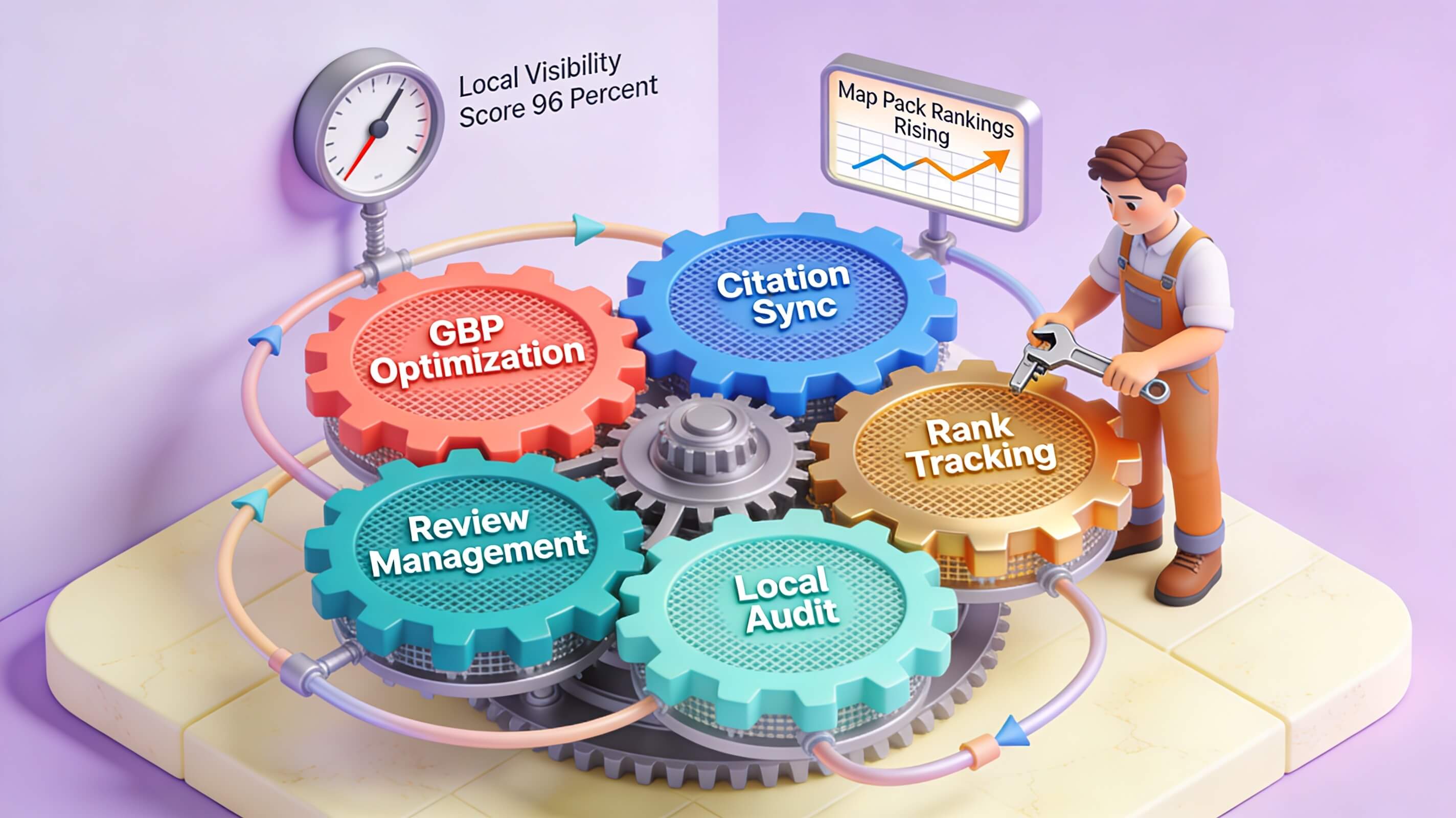
A specific data point that matters enormously for local businesses is the percentage of traffic coming from “local pack” results versus organic listings. Use your reporting tools to isolate these two streams and track changes over time. When you launch a new optimization initiative, such as adding Q&A to your Google Business Profile or publishing location-specific landing pages, watch for shifts in these metrics. That direct feedback loop is what separates successful local SEO programs from those that stagnate.
Local SEO Optimization Tools for Maximum Visibility
Optimization is the active phase where you implement changes based on your research and audit findings. Local SEO optimization tools help you execute tasks more efficiently and consistently. They cover a range of activities including citation building and cleanup, review generation and management, Google Business Profile optimization, and on-page content refinement.
BrightLocal offers a citation builder that submits your business information to a curated list of high-quality directories, then monitors those submissions to ensure accuracy over time. Its reputation management module lets you send review requests to customers, monitor feedback across platforms, and respond to reviews from a single dashboard. Whitespark is another excellent tool for citation management, offering a local citation finder that uncovers new listing opportunities based on your industry and location. It also provides a rank tracker that shows your performance in the local pack versus organic results. On the content side, tools like Semrush’s SEO Writing Assistant help you optimize blog posts and landing pages for local keywords by analyzing readability, tone, and keyword density in real time. For Google Business Profile management specifically, you can use the built-in insights dashboard, but third-party tools like Yext offer advanced features like automated posting, competitive insights, and performance benchmarking against similar businesses in your area.
In my experience, the single highest-impact optimization activity for local businesses is systematically earning and responding to customer reviews. A business with 50 positive reviews and thoughtful owner responses will almost always outrank a competitor with fewer reviews or negative ones, even if the competitor’s on-page SEO is stronger. Use your optimization tools to set up review generation workflows, monitor new reviews daily, and respond within 24 hours. This builds trust with both customers and search engines, signaling that your business is active, reputable, and engaged with its community.
Free Local SEO Tools That Deliver Real Results
Budget constraints should not prevent you from building a capable local SEO toolkit. Several free local SEO tools provide substantial value when used strategically. Google Business Profile is the most critical of all—it is the primary vehicle through which your business appears in local search and maps. Ensure your profile is fully claimed, verified, and optimized with accurate categories, descriptions, services, and high-quality photos. Post updates regularly, respond to every review, and use the Q&A feature to answer common customer questions.
Google Search Console and Google Analytics, both free, give you direct access to search performance data and user behavior insights. Google Keyword Planner helps you discover volume and competition for location-specific terms. Local SEO Checkup, a free online tool, runs a quick on-page audit that checks for essential local elements like NAP consistency, Google Maps integration, and schema markup. Moz Local offers a free listing scan that shows where your business appears across directories and flags inconsistencies. Apple Maps Connect is another free tool that ensures your business is visible to the millions of users searching for local services on Apple devices. These free resources are ideal for small businesses just starting their local SEO journey or for supplementing paid tools in a more comprehensive stack. I have seen businesses achieve first-page rankings using free tools exclusively, particularly in less competitive markets where diligence and consistency matter more than advanced features.
Best Local SEO Software for Scaling Your Efforts
As your business grows or if you manage multiple locations, the need for robust local SEO software becomes apparent. These platforms consolidate keyword research, audit, optimization, monitoring, and reporting into a single ecosystem. They save time, reduce errors, and provide a centralized source of truth for your local digital strategy.
BrightLocal is my top recommendation for most businesses. It offers a complete local marketing platform including rank tracking, citation building, review management, local search audits, and white-label reporting. Its pricing is transparent and scales affordably from a single location to hundreds. For businesses that need listing management at scale, Moz Local ensures your business data is accurate across all major platforms, including Google, Bing, Facebook, and Apple Maps. Its listing distribution network covers over 30 directories, and it alerts you when discrepancies arise. Whitespark is particularly strong for citation building and rank tracking, with a focus on the quality and relevance of citation sources. For enterprises or agencies managing many locations, Yext provides real-time updates across a massive publisher network and offers advanced analytics and integration capabilities. When evaluating local SEO software, consider the number of locations you need to manage, the depth of reporting required, and whether you need to white-label reports for clients. Test three platforms with a trial period before committing, and pay attention to the quality of customer support, as local SEO can be nuanced and you will likely need guidance.
The Tangible Benefits of Implementing Local SEO Tools
The return on investment from local SEO tools is measurable and significant. Increased online visibility is the most immediate benefit. When your business appears in the local pack, in organic results, and on maps simultaneously, you dominate the search results page for your target queries. This triple presence dramatically increases the likelihood that users will click through to your website or visit your location. Targeted traffic follows naturally because you are ranking for specific phrases that indicate purchase intent. A dental practice I worked with in Denver saw a 40 percent increase in appointment bookings after optimizing for “same-day emergency dentist Denver” using keyword tools and audit software. Conversion rates improve because local visitors arrive with high intent—they are not browsing; they are looking for a specific service in a specific area. User experience enhancements driven by audit findings, such as faster load times and clearer calls to action, further boost conversion rates.
Customer engagement deepens as you use reputation management tools to monitor and respond to reviews, answer questions on your Google Business Profile, and post updates that keep your audience informed. You gain granular insights into your performance data, allowing you to replicate what works and fix what does not. Over time, this creates a competitive moat. Businesses that invest in local SEO tools systematically improve their local authority and relevance, making it harder for new entrants to catch up. In markets like home services, legal, healthcare, and retail, where local search drives the majority of new business, this competitive advantage translates directly into revenue. I have consistently observed that businesses using a structured local SEO tool stack grow their local organic traffic by 50 to 100 percent within six to twelve months, with proportional increases in leads and sales.

Best Practices for Getting the Most Out of Your Local SEO Tools
Even the best local SEO tools underperform without a disciplined approach. Set clear, measurable goals before you begin. Identify key performance indicators such as local pack rank for priority keywords, Google Business Profile views, review count and rating, organic traffic from your target city, and conversion rate from local visitors. Align your tool selection and usage with these KPIs. Stay current with algorithm changes by following Google’s official blog and reputable SEO industry sources. Google’s local search algorithm evolves frequently, and factors like review quantity, proximity, and relevance shift in importance over time. Track your progress on a consistent schedule—weekly for rank movements, monthly for traffic and conversion metrics, and quarterly for a comprehensive strategy review.
User-generated content, particularly customer reviews and questions on your Google Business Profile, is a powerful local ranking signal. Use your reputation management tools to solicit reviews from every satisfied customer, respond to every review promptly, and encourage customers to ask and answer questions on your profile. Finally, obsess over your Google Business Profile listing. Keep every field complete and accurate, add new photos weekly, post about offers and events, and ensure your hours, services, and attributes reflect your current operations. No other single activity has a greater impact on local rankings. Apply these best practices consistently, and your local SEO tools will deliver compounding returns over time.
Conclusion
Local SEO tools are not optional—they are essential infrastructure for any business that depends on local customers finding you online. From keyword research and technical audits to optimization, monitoring, and reporting, these platforms provide the data and automation needed to compete effectively in your market. The businesses that invest in the right toolkit and apply it with discipline consistently outperform their competitors in local search rankings, traffic, and revenue. Whether you start with free tools like Google Business Profile and Google Search Console or invest in comprehensive platforms like BrightLocal or Ahrefs, the key is to begin now and iterate based on the data you collect. Stop guessing about what works in your local market and start using tools that deliver evidence. Take the first step today by auditing your current local SEO setup with one of the tools I have shared. Identify one key area for improvement—such as review management or citation consistency—and implement a solution this week. The businesses that act decisively on local SEO build lasting digital assets that return value for years. Your local customers are searching right now. Make sure you are the business they find.