
Cart 0


Share
Table of Contents
Local Citation: The Key to Local SEO Success
When a potential customer searches for a service in your area, search engines like Google rely on a complex web of signals to determine which businesses deserve to appear in the coveted local pack. Among those signals, few carry as much weight as the humble local citation. A local citation is any online mention of your business’s name, address, and phone number — commonly referred to as NAP — on a public platform. These mentions can appear on directory sites, social media profiles, review platforms, or even local blogs and news articles. For businesses targeting local customers, mastering local citation strategy is not optional; it is the foundation upon which durable local search visibility is built. Without accurate and widespread citations, your business essentially remains invisible to search engines when local queries are processed. Search engines treat each consistent mention as a vote of confidence, reinforcing that your business is legitimate, established, and relevant to the geographic area you serve. Conversely, inconsistent or conflicting citation data — such as a wrong phone number on one directory or an old address on another — sends confusing signals that can tank your rankings. This article will walk you through every facet of local citation strategy, from the fundamental components of a proper citation to advanced techniques for auditing, scaling, and future-proofing your local SEO efforts. Whether you manage a single brick-and-mortar location or oversee multiple storefronts, understanding how to build, manage, and leverage citations will give you a decisive edge in your local market. Let us dive into the mechanics of local citation and explore how this foundational element can transform your local search performance.

What Exactly Is a Local Citation?
A local citation, in its simplest form, is any online reference to your business’s name, address, and phone number (NAP) on a website or platform that is not your own. This definition is critical because it distinguishes citations from the content on your official business website. When third-party sources — whether directories, review sites, or local media — publish your NAP data, search engines interpret these mentions as independent verification of your business’s existence and location. Each citation acts like a digital breadcrumb that search engines follow to confirm that your business is real and operating where you say you are. The quality and consistency of these breadcrumbs directly influence how prominently you appear when someone searches for businesses like yours in your area. To optimize for featured snippets in local search results, think of a citation as a structured data point: your business name plus your full street address plus your local phone number, all presented identically across every platform where it appears. Google’s local algorithm places substantial trust in citation consistency because it reduces the risk of serving users incorrect or outdated information. Therefore, a proper citation is not merely a listing; it is a verified signal of business legitimacy that search engines use to reward visibility. For the featured snippet, you can quote this concise definition: A local citation is an online mention of a business’s name, address, and phone number on a third-party website, used by search engines to verify business accuracy and location.
The Core Components of an Effective Local Citation
Not all citations carry equal value. Search engines evaluate several qualitative factors when weighing citation strength. The single most important component is NAP consistency — the exact and uniform repetition of your business name, physical address, local phone number across every single citation source. Even minor discrepancies, such as writing “Street” instead of “St.” or omitting a suite number, can degrade the signal. Beyond NAP consistency, the completeness of your listing matters deeply. A citation that includes your business category, hours of operation, website URL, high-quality photos, and a compelling description ranks higher in utility for both users and search engines. The authority of the citation source itself also plays a role. A listing on a well-established, high-domain-authority directory like Yelp for Business carries more weight than an obscure, spam-ridden directory that Google may even penalize. Furthermore, citations that include structured data or schema markup — especially LocalBusiness schema — provide machine-readable context that helps search engines understand your business details with greater precision. Location-specific signals, such as embedding your city or neighborhood name naturally within your description, also strengthen geographic relevance. Reviews attached to a citation listing add another layer of trust; listings with recent, positive reviews often perform better in local rankings. In essence, the best citations are accurate, complete, authoritative, and rich with contextual data that helps search engines confidently associate your business with a specific location and service category. Maintaining this level of detail across dozens of directories requires diligent management, but the payoff in search visibility is substantial.
Why Local Citations Are Critical for Local Search Visibility
The relationship between local citations and search visibility is both direct and measurable. Research published by Moz Local consistently identifies citation signals as one of the top three local ranking factors in Google’s algorithm. When Google evaluates which businesses to show in the local pack for a query like “plumber near me,” it cross-references the consistency and volume of your citation data against competing businesses in the same geographic radius. A business with 50 high-quality, consistent citations will almost always outrank a competitor with only 10 sloppy, inconsistent mentions. But the value goes beyond algorithmic scoring. Citations also drive direct referral traffic; users browsing directories like Yelp or Yellow Pages often click through to your website or call your business directly. This dual benefit — improved organic rankings plus direct customer acquisition — makes citation building one of the highest-ROI activities in local SEO. Consider a small case study: a regional HVAC contractor with three locations spent six months systematically cleaning up old citations and building new ones on industry-specific directories. Within four months, their local pack impressions increased by 42 percent, and their phone call volume from Google Business Profile rose by 28 percent. This is not an outlier; it reflects what happens when citation data becomes a true asset rather than a neglected chore. The challenge is that citation building is not a one-and-done task. Listings can drift as directories update their formats, as businesses move or change phone numbers, or as new citation sources emerge. Treating citations as an ongoing maintenance project rather than an initial setup will protect and grow your local search visibility over the long term.
Strategic Citation Building for Maximum Impact
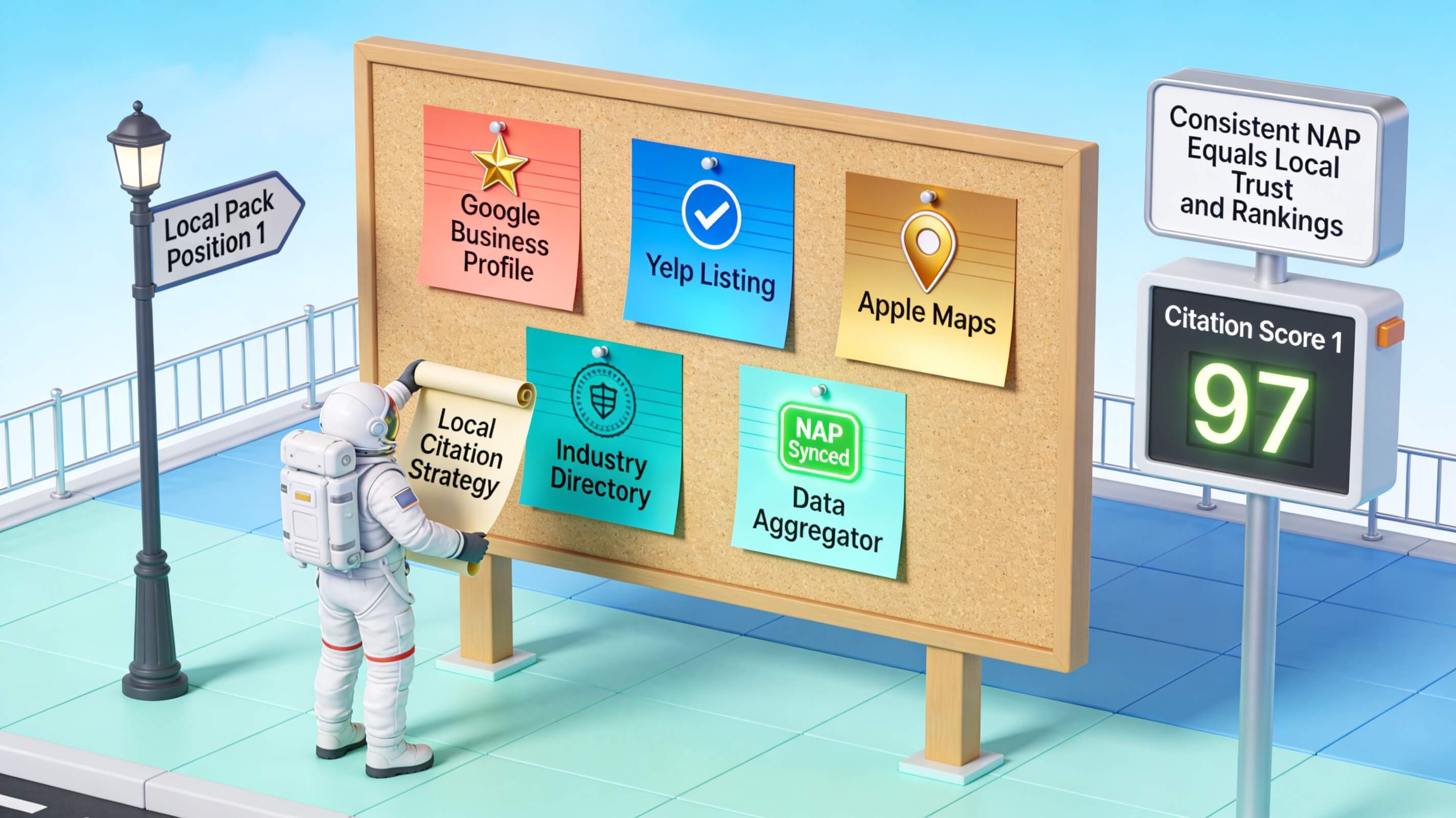
Building citations effectively requires a strategic approach that prioritizes quality over sheer quantity. The first step is identifying your core citation sources — the directories and platforms where your ideal customers are most likely to look for services like yours. For nearly every local business, the foundational citation starts with Google Business Profile, which is the single most influential local listing for search visibility. Beyond Google, prioritize top-tier general directories such as Yelp, Bing Places, Apple Maps, Facebook, and Yahoo Local. These platforms command high domain authority and are frequently crawled by search engines. Next, layer in industry-specific directories relevant to your niche. A dentist, for example, should be listed on Healthgrades, Zocdoc, and 1-800-Dentist, while a restaurant should prioritize TripAdvisor, OpenTable, and Zomato. Location-specific directories like local chamber of commerce sites, city guides, and regional business associations also carry strong geographic relevance that can boost local rankings. Below is a comparison of citation sources by their typical impact and effort requirements:

| Citation Source Tier | Examples | Impact on Rankings | Effort to Secure |
|---|---|---|---|
| Tier 1: Foundational | Google Business Profile, Yelp, Bing Places | Very High | Moderate: requires verification |
| Tier 2: Major Directories | Yellow Pages, Superpages, Citysearch, Foursquare | High | Low: manual submission or tool |
| Tier 3: Industry-Specific | Healthgrades, Avvo, TripAdvisor, Houzz | Medium to High | Variable: depends on verification |
| Tier 4: Local/Regional | Chamber of Commerce, local news, city guides | Moderate | Medium: often requires outreach |
| Tier 5: Niche/Data Aggregators | Neustar, Factual, Localeze | Medium | Low to Medium: centralized submission |
When building citations, never sacrifice accuracy for speed. Use a centralized spreadsheet or citation management tool to track every listing, the exact NAP used, and the date of submission or audit. Tools like BrightLocal and Whitespark offer bulk citation building features and automated auditing that can save dozens of hours while reducing human error. For businesses with multiple locations, this systematic approach is non-negotiable. Each location needs its own distinct citation profile, with local phone numbers and addresses properly differentiated. Creating duplicate listings for the same location across multiple categories on the same directory can also confuse search engines, so consolidate where possible. The end goal is a citation profile that is wide enough to signal relevance, precise enough to build trust, and clean enough to avoid any conflicting signals that could undermine your efforts.
Managing Citations at Scale and Preventing Inconsistencies
As your business grows or undergoes changes — a move to a new address, a rebranding, a phone system upgrade — the risk of citation inconsistencies multiplies. A single outdated listing can create a domino effect, eroding the trust Google places in your entire citation profile. This is why ongoing citation management is as important as initial construction. The first defense against drift is conducting a comprehensive citation audit at least twice per year. An audit involves pulling every known citation for your business, comparing the NAP data against your official current information, and flagging any mismatches. Tools like Semrush’s local SEO toolkit can scan hundreds of directories automatically and produce a prioritized list of citation errors to fix. When you discover a duplicate listing — two profiles for the same business on the same directory — contact the directory’s support team to merge or remove the duplicate. For large-scale inconsistency problems, data aggregators such as Neustar, Factual, and Localeze act as central clearinghouses. Many directory platforms pull their business data from these aggregators, so correcting your information at the aggregator level can cascade fixes across dozens of downstream citations. However, not all directories rely on aggregators, so manual cleanup on major platforms like Yelp and Google Business Profile remains essential. Another important practice is to standardize your NAP format internally before you begin any citation work. Decide on exact abbreviations: will you use “Avenue” or “Ave.”? Will you include your suite number on the same line as the street address? These decisions matter because consistency is measured character by character. Document your chosen format and use it everywhere — on your website, on your social media profiles, and in every directory submission. This discipline transforms citation management from a reactive firefight into a proactive, controlled process that protects your local rankings year after year.
Measuring Citation Performance and Demonstrating ROI
To justify continued investment in citation building and management, you must measure its impact on your local SEO performance. The most direct metric is your local pack ranking for target keywords. Track your position in Google’s local 3-pack before and after major citation cleanup efforts. A jump from position 8 to position 3 for a high-volume term like “emergency plumber Austin” translates directly into more calls and leads. Beyond rankings, monitor citation traffic using UTM parameters on the URLs you submit to directories. Many citation tools and directories allow you to include a tracking parameter; use this data in Google Analytics to see which directories are driving the most clicks, phone calls, and form fills. Search Engine Journal has published multiple case studies showing that referral traffic from quality directories often converts at rates comparable to organic search traffic, because users on directories are already in a high-intent buying mode. Another critical measurement is your Google Business Profile Insights data. Track changes in “Search queries used to find your business” and “Calls” over time. If you observe a sustained increase after citation improvements, you have a clear causal link. A more advanced measurement involves tracking citation consistency scores provided by tools like Moz Local or BrightLocal. These platforms assign a percentage score to your citation accuracy — aim for 98 percent or higher across all monitored sources. Finally, tie citation efforts to revenue where possible. If your local ranking for top keywords improves and your monthly tracked calls increase by 30 percent, estimate the value of those incremental calls based on your average close rate and ticket size. This revenue-focused reporting will secure buy-in from stakeholders and justify the resources needed for ongoing citation maintenance. Without measurement, citation work remains invisible; with proper tracking, it becomes a data-backed driver of local business growth.
Common Pitfalls in Local Citation Management
Even seasoned SEO professionals make mistakes with citations that can undermine their results. One of the most common pitfalls is neglecting to claim and verify listings on major directories before submitting NAP information. Unverified listings can be overwritten by users or directory editors, leading to inaccuracies that you may not catch until rankings drop. Always claim ownership first, then verify your data. Another frequent error is keyword stuffing in the business name field. Some practitioners try to add location keywords like “Austin Plumber — Best 24/7 Plumbing Services” to the business name field, hoping to rank for more terms. Google penalizes this aggressively, often by suppressing the listing or applying a manual action. Your business name should match exactly what appears on your storefront and legal documents. A third issue is ignoring geo-specific pages on your own website. While external citations matter, the NAP information on your own website — particularly in the footer, the contact page, and your site-wide schema markup — serves as the authoritative source. If your website NAP contradicts your citation NAP, search engines may distrust both. Conduct an internal audit to ensure your own site is flawless before tackling external directories. Additionally, many businesses focus exclusively on high-authority directories and ignore local data aggregators. This is a mistake because aggregators supply data to hundreds of smaller directories; if your aggregator profile is wrong, it propagates errors at scale. Finally, avoid the trap of building citations on every directory you find. Some directories are spam farms that exist solely to monetize backlinks; listing your business there can harm your reputation and dilute your citation quality. Curate your citation list using trusted directories vetted by reputable SEO communities. Steering clear of these common errors will keep your citation profile clean, authoritative, and effective.
Adapting Your Citation Strategy for Emerging Search Trends
The landscape of local search is evolving, and citation strategy must evolve in parallel. One of the most significant emerging trends is the rise of voice search. When users ask Siri, Alexa, or Google Assistant for “the best pizza place near me,” the assistant pulls from local citation data to provide an answer. This means that citation accuracy has become even more critical for voice queries, as voice assistants rely on clean, structured data to deliver results quickly. Optimizing your citations for voice search involves using natural language in your business descriptions and ensuring that your categories and attributes are as specific as possible. Another trend is the increasing importance of reviews as a signal within citation ecosystems. Platforms like Google Business Profile and Yelp now integrate review data directly into the citation profile, and search engines appear to weigh review quantity and sentiment alongside traditional NAP signals. Actively managing your review pipeline and responding to feedback — positive and negative — should be part of your citation strategy. A third shift involves the growing role of social media profiles as citation sources. Facebook, Instagram, and LinkedIn business pages are now crawled and indexed as location signals. Ensure that your NAP on these platforms matches your directory citations exactly. Additionally, structured data markup on your website, particularly LocalBusiness schema, should be updated whenever your citation data changes. Schema provides a direct, machine-readable feed of your business information to search engines, complementing your external citations. Finally, keep an eye on Google’s evolving guidelines for local content. The Helpful Content Update and similar algorithm changes emphasize authenticity and user value. Your citation profiles and associated content — descriptions, posts, photos — should be original and helpful, not generic boilerplate. Ahrefs research indicates that businesses with unique, locally focused content on their citation profiles see better engagement and higher rankings. By anticipating these trends and adjusting your approach, you ensure that your citation strategy remains effective as search behavior continues to change.
Conclusion
Local citation is not a technical side note in the world of SEO; it is the structural foundation on which trustworthy local search presence is built. When you commit to building accurate, consistent, and strategically placed citations across authoritative directories, you give search engines clear and reliable signals about who you are, where you operate, and what you offer. The result is a stronger local pack ranking, higher organic visibility, and a steady stream of high-intent traffic from users actively seeking your services. But as this article has demonstrated, citation success does not end with initial setup. It demands ongoing auditing, proactive inconsistency correction, and adaptation to new search behaviors such as voice queries and review integration. Every citation you manage is a touchpoint that either reinforces or undermines your business’s digital credibility.


Comments are closed.