
Cart 0


Share
Table of Contents
Local Citation Software: Streamlining Your Citation Management
Managing local citations across dozens of online directories is one of the most tedious yet critical tasks for any business that relies on local search visibility. If you run a brick-and-mortar operation with multiple locations, you already know the frustration of manually updating your business name, address, and phone number across platforms like Yelp, Google Business Profile, Facebook, and countless niche directories. The problem compounds quickly: one small inconsistency, and search engines lose trust in your data, dropping your rankings. This is precisely where local citation software becomes indispensable. These tools automate the entire lifecycle of citation creation, monitoring, and correction, freeing you from hours of repetitive data entry while ensuring your business information remains accurate across hundreds of sources. In this comprehensive guide, drawn from two decades of hands-on SEO consulting, I will show you exactly how local citation software works, why it matters for your bottom line, and how to select the right solution for your specific needs. Whether you are a solo entrepreneur managing a single storefront or a marketing director overseeing fifty locations, the insights here will help you streamline your citation management and achieve measurable improvements in local search performance. The goal is not merely to save time—it is to build a foundation of trust with both search engines and potential customers, and to ensure every online mention of your business drives real results.
Understanding the Role of Local Citations in Modern SEO
Local citations are essentially any online mention of your business’s core contact details—name, address, and phone number, commonly referred to as NAP. These mentions appear on general directories like Yelp and Yellow Pages, industry-specific platforms like Avvo for lawyers or TripAdvisor for restaurants, and even on local blogs or news sites that reference your business. Search engines like Google treat each consistent citation as a vote of confidence in your legitimacy and relevance to a specific geographic area. The higher the volume of accurate, authoritative citations you accumulate, the stronger your local search signals become. This directly influences your appearance in the local pack, Google Maps results, and organic rankings for location-specific queries.
However, not all citations carry equal weight. A mention on a high-authority domain like the Better Business Bureau or a chamber of commerce website has far more impact than a listing on a spammy, low-traffic directory. Quality and consistency matter more than sheer quantity. When your NAP data is uniform across every platform, search engines can confidently serve your business to users searching for nearby services. Inconsistent information—such as listing “Suite 200” in one place and “Ste. 200” in another—creates confusion for both algorithms and potential customers, often leading to lost traffic and missed opportunities.
The challenge most businesses face is that maintaining this consistency manually becomes nearly impossible as the number of directories grows. There are thousands of potential citation sources, and new ones emerge regularly. You also need to monitor existing listings for unauthorized changes, respond to review prompts, and ensure your categories, hours, and descriptions remain current. This is where dedicated software solutions become not just helpful but essential for effective local SEO management. Over my two decades of consulting, I have seen businesses lose 30 percent or more of their local traffic simply because they neglected citation hygiene—a preventable problem that undermines every other SEO investment.
Why Manual Citation Management Falls Short
Relying on manual processes for citation management is a recipe for frustration and underperformance. Let me walk through the specific pain points I have observed across countless client engagements over the past twenty years.

First, manual citation building is extraordinarily time-consuming. For a single business, you might need to register on fifty or more directories. Each registration requires filling out forms, verifying ownership via email or phone, uploading photos, writing descriptions, and selecting categories. If you manage ten locations, that workload multiplies by ten, quickly consuming hundreds of hours annually. This time could be far better spent on content creation, customer outreach, or refining your product offerings. The opportunity cost alone often exceeds the price of a quality local citation software subscription many times over.
Second, manual processes introduce high error rates. Even the most diligent team member will eventually transpose a digit in a phone number, misspell a street name, or select the wrong business category. These errors propagate across your entire citation profile and are notoriously difficult to locate and correct after the fact. Search engines penalize inconsistency, so a single mistake can undermine months of citation-building effort. I have audited businesses where a single digit error in the phone number—present on just five directories—caused a 15 percent drop in call volume over six months because customers simply could not reach them.
Third, scaling manual management is impractical. As your business expands to new locations or enters new markets, the administrative burden grows linearly. Most organizations simply lack the bandwidth to keep up, resulting in neglected listings, outdated information, and declining local search performance. I have seen companies with strong products lose market share simply because their online directories told a conflicting story about where they were located or what services they offered. One regional plumbing chain I advised had ninety locations but only forty of them had accurate listings on Google Business Profile; the other fifty were showing incorrect phone numbers from acquisitions that had never been updated.
Fourth, manual monitoring is reactive rather than proactive. You only discover a citation error when a customer complains or you notice a ranking drop—both of which mean lost revenue. Automated systems detect and alert you to changes in real time, allowing you to maintain control over your online presence continuously. A client in the dental space lost over $12,000 in missed appointments over three months because their office hours had been changed on Yelp by a well-meaning but mistaken former employee, and nobody caught it until a patient complained.
How Local Citation Software Transforms Your Workflow
Local citation software resolves the inefficiencies of manual management by automating virtually every aspect of the process. These platforms integrate with major directories, data aggregators, and search engines to provide a single dashboard where you can view, edit, and monitor all your citations.
The core functionality includes automated citation submission. Instead of visiting each directory individually, you enter your business information once into the software, and it pushes that data to hundreds of relevant platforms. The best tools also map your existing citations, identify duplicates or inaccuracies, and initiate correction requests on your behalf. This reduces setup time from weeks to hours and ensures your initial citation profile is as clean as possible. I recall helping a medical practice with four locations: manually building citations had taken them eight weeks and three staff members; with software, we completed the same work in two days.
Real-time monitoring is another transformative feature. The software continuously scans your citation sources for any changes—whether made by you, a directory editor, or a malicious actor—and alerts you immediately. This allows you to address problems before they impact your rankings. Many tools also provide reporting on citation accuracy, directory coverage, and competitive benchmarking, giving you data-driven insights into your local SEO health. One franchise group I worked with discovered that three of their top competitors had been systematically correcting their own citations while ignoring the client’s listings—the monitoring feature revealed this gap within the first week.
For multi-location businesses, the value multiplies. You can manage all locations from one interface, apply bulk updates when information changes (such as a new phone system or holiday hours), and maintain consistent branding across every listing. This centralized control is simply not achievable through manual methods. When a national restaurant group I advised changed its phone system across seventy locations, the marketing team updated every citation in three hours using bulk upload—a task that would have taken weeks manually.
Additionally, local citation software often includes review management features, allowing you to monitor and respond to customer feedback across platforms without logging into each one separately. This integration between citation management and reputation management is increasingly important for local SEO success because search engines weigh review signals heavily in local pack rankings. A unified workflow means you spend less time on administrative tasks and more time on strategic growth.
Key Features to Look for in Citation Management Tools
Not all citation management software is created equal. Based on extensive evaluation and hands-on use, here are the critical features you should prioritize when selecting a solution for your business.
| Feature Category | What to Look For | Why It Matters |
|---|---|---|
| Directory Coverage | Integration with 50+ major directories plus niche/industry-specific platforms | Broad coverage ensures you reach all relevant citation sources for your location and industry; gaps leave ranking opportunities on the table. |
| Automated Submission | One-click submission of NAP data to multiple directories simultaneously | Massively reduces setup and update time compared to manual entry—typically cuts effort by 80 percent or more. |
| Real-Time Monitoring | Continuous scanning for changes, duplicates, and inaccuracies across all listings | Enables proactive correction before errors negatively impact rankings or customer trust. |
| Duplicate Detection | Ability to identify and help resolve duplicate listings for the same business | Duplicates dilute authority and confuse search engines; removing them boosts consistency and local signals. |
| Analytics Dashboard | Reports on citation accuracy, directory coverage, competitor comparisons | Provides actionable insights to measure progress and identify gaps that need attention. |
| Multi-Location Support | Centralized management for multiple business locations with bulk update capabilities | Essential for chains, franchises, and agencies managing client portfolios; without this feature, scaling is impossible. |
| Review Integration | Monitoring and response capabilities for reviews across platforms | Supports reputation management and local engagement in one workflow, saving hours weekly. |
| API Access | Ability to integrate with other marketing tools and CRMs | Enables custom workflows and seamless data flow across your tech stack, reducing manual handoffs. |
When evaluating vendors, also consider the quality of their data sources. Reputable providers partner with authoritative data aggregators like Infogroup, Acxiom, and Neustar, which feed information to thousands of secondary directories. A tool that leverages these relationships will give you deeper, more reliable coverage than one that relies solely on direct directory submissions. I have tested tools that claimed to support 300 directories but actually submitted to only seventy directly; the rest were propagated through aggregators without confirmation. That difference matters when you need guarantees about where your data appears.
Pricing is another factor, but avoid choosing solely on cost. A cheap tool with limited directory coverage or poor customer support will cost you more in lost rankings and wasted time than a moderately priced solution that delivers comprehensive results. Request demos and trial periods to test functionality with your specific citation profile before committing. Ask how the provider handles directory rejections—some initiate manual follow-ups, others simply move on, leaving gaps in your coverage.
Selecting the Right Citation Service Provider
Choosing a provider for local citation software requires careful evaluation of their reputation, technology, and support infrastructure. I advise clients to start by examining the provider’s track record with businesses similar to their own. A tool that excels for a single-location pizza shop may lack the multi-location management features needed by a regional dental chain.
Look for providers that offer transparent reporting on citation submission success rates. Some platforms claim to submit to hundreds of directories but actually only submit to a fraction of that number, relying on data aggregators to propagate the rest. While this is a legitimate approach, you should understand exactly what you are paying for and which directories you can expect to see active listings on.
Moz’s guide on local citations provides excellent background on the importance of citation quality, which should inform your provider evaluation. Tools that prioritize low-quality, spammy directories can actually harm your SEO rather than help it. Reputable providers maintain curated lists of high-authority, relevant directories and avoid those known for spam. I once audited a business that had used a cheap citation service—they ended up with listings on 200 directories, but 140 of them were spam sites that Google flagged, causing a manual action that took months to resolve.
Customer support responsiveness is another critical differentiator. When a citation issue arises—such as a Google Business Profile suspension or a widespread data error—you need a provider that responds within hours, not days. Check reviews on platforms like G2 or Capterra specifically for support quality, and ask potential providers about their average response times during the sales process. I prefer vendors with dedicated account managers for businesses with more than ten locations, as the complexity of multi-location management demands a human point of contact.
Also consider the provider’s update frequency. The local search landscape evolves constantly, with new directories appearing, old ones declining, and platform requirements changing. Your software should receive regular updates to adapt to these shifts. Providers that demonstrate ongoing development and feature releases are more likely to remain valuable partners over the long term. I recommend asking about their roadmap—if they cannot articulate upcoming features or improvements, you may be investing in stagnant technology.
Implementing Citation Software for Maximum Impact
Implementing local citation software is straightforward, but maximizing its impact requires strategic planning. Here is the approach I recommend based on hundreds of successful deployments.
Begin with a comprehensive audit of your current citation landscape. Identify every existing listing, note its accuracy, and document any duplicates. Most citation management tools include an audit feature that scans the web and compiles this data automatically. Use this baseline to prioritize correction efforts before adding new citations. Building on a foundation of inaccuracies amplifies problems rather than solving them. In one case, a client had twelve duplicate listings for a single location across different directories—we had to resolve those before new submissions would have any positive effect.
Next, standardize your business information. Decide on the exact format for your name (including legal suffixes like LLC or Inc.), address (including suite numbers and abbreviations like St. vs. Street), phone number (including area code and extension handling), and website URL. Document these standards and ensure everyone involved in citation management adheres to them consistently. A small inconsistency like using “Ave.” in one place and “Avenue” in another can create enough algorithmic doubt to hurt rankings.
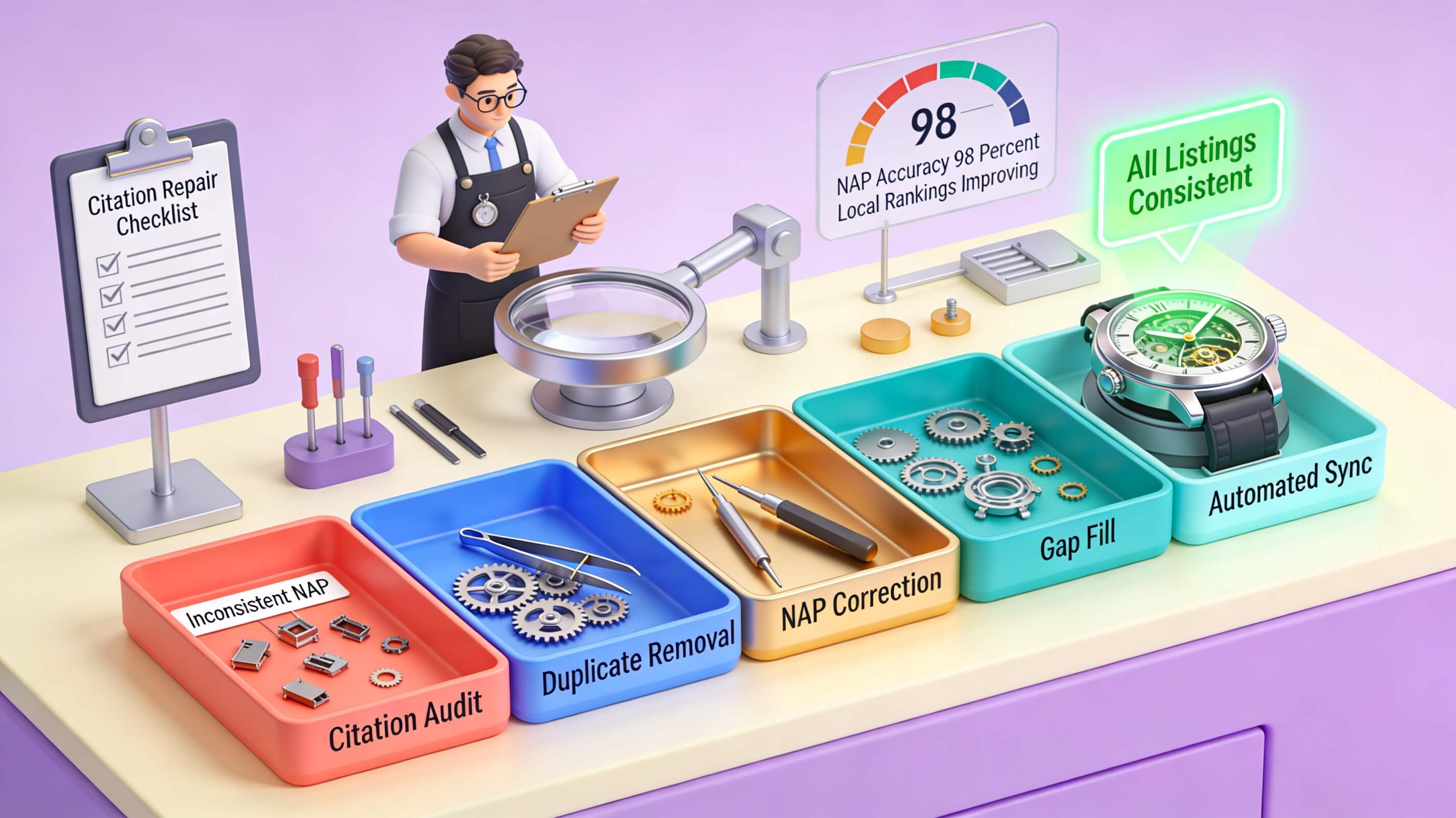
Then, submit your data to the software and initiate the citation creation process. Start with the highest-authority directories: Google Business Profile, Yelp, Facebook, Apple Maps, Bing Places, and industry-specific giants like Avvo, Zillow, or TripAdvisor depending on your sector. These core citations carry the most weight and should be prioritized. I typically recommend submitting to the top twenty directories in the first phase, then expanding to secondary directories over the following weeks.
After the initial submission, shift to monitoring mode. Pay close attention to alerts from the software in the first few weeks, as directories may reject submissions or display data differently than expected. Address discrepancies immediately to maintain a clean profile. Over time, the frequency of alerts should decrease as your citations stabilize. Set a recurring calendar reminder to review your citation dashboard weekly for the first month, then monthly once things settle.
Integrate citation management with your broader local SEO strategy. Encourage customers to leave reviews on your most important listings, as review signals increasingly influence local rankings. Use the software’s reporting to identify high-performing directories and double down on those platforms while pruning underperforming ones. I have found that a focused approach—twenty strong, well-maintained citations on relevant platforms—consistently outperforms a scattered presence on fifty low-value directories.
Schedule regular audits—quarterly for stable businesses, monthly for those in growth mode or undergoing changes. Consistent attention prevents small issues from compounding into major ranking problems. Many successful businesses treat citation management as an ongoing operational expense rather than a one-time project, recognizing that the local search ecosystem is dynamic and requires continuous stewardship.
Measuring Success with Citation Tracking Software
Without measurement, you cannot optimize. Citation tracking software provides the data you need to assess your efforts and make informed decisions about where to invest further resources.
The most important metric is overall citation accuracy. I track this as the percentage of your total citations that display correct, identical NAP information. Aim for 100 percent accuracy, but realistically, scores above 95 percent are excellent and typically support strong local rankings. Anything below 90 percent requires immediate corrective action. I have seen businesses with 70 percent accuracy regain two to three local pack positions simply by cleaning up inconsistencies—the correlation is that direct.
Directory coverage is another key metric. This measures how many of your target directories actually display your listing. If you have identified 100 relevant directories for your industry and location, but your software only shows listings on 60, you have a coverage gap that needs attention. Competitive analysis tools can show you how many citations your top competitors have, providing a benchmark to work toward. I generally advise clients to aim for coverage within 80 percent of their top three competitors, at minimum.
Local search ranking changes should also be monitored in conjunction with citation work. While correlation is not always causation, improvements in citation accuracy and breadth often precede improvements in local pack rankings. Use your citation software alongside rank-tracking tools to identify patterns over time. A jump in rankings following a citation cleanup campaign is a strong indicator that your efforts are paying off.
BrightLocal’s citation trust research regularly publishes data on the impact of citation consistency on consumer trust, which can help you build a business case for continued investment in citation management. Their findings consistently show that consumers are far less likely to engage with businesses that have inconsistent or inaccurate listings—one study found that 80 percent of consumers lose trust in a business if they find incorrect contact information online.
Beyond these core metrics, track the return on investment from your citation software. Calculate the time saved compared to manual management, the number of correction requests initiated automatically, and any measurable increase in phone calls, website visits, or store traffic attributable to improved local visibility. Concrete ROI figures will help secure ongoing budget and organizational support for your citation initiatives. I recommend setting up call tracking and UTM parameters on citation links so you can directly attribute conversions to specific directory listings.
Overcoming Common Challenges in Citation Management
Even with robust local citation software, challenges will arise. Anticipating these obstacles and having strategies to address them will keep your program on track.
High-volume management remains a challenge for businesses with many locations. If you manage dozens or hundreds of locations, manual oversight of each citation is impossible at scale. The solution is to lean heavily into automation features like bulk updates, scheduled audits, and automated correction workflows. Some enterprise-grade tools allow you to set rules that automatically correct certain types of errors, such as standardizing “Street” to “St.” across all listings. I worked with a property management company that had 400 locations; using rule-based automation, they reduced their citation management burden from four full-time employees to one part-time manager.
Another common challenge is maintaining consistency during transition periods. When your business moves locations, changes phone numbers, or rebrands, old citations can persist for months or years, causing confusion. Use your software’s bulk update capability the moment you finalize new information, and continue monitoring for old data that needs correction. I recommend keeping a 90-day monitoring window after any major change to catch lingering inaccuracies. One client lost a quarter of their local traffic for six months after a move because they updated only Google Business Profile—their Yelp, Facebook, and BBB listings still showed the old address.
Aggregator errors pose a special challenge. Data aggregators like Infogroup and Localeze act as central hubs that feed information to thousands of downstream directories. If an aggregator has incorrect data for your business, it can propagate errors widely before you even notice. Make sure your citation software addresses aggregator corrections specifically, as these have outsized impact on overall accuracy. I have seen a single aggregator correction resolve errors on 40+ downstream directories within two weeks.
Search Engine Journal’s citations section regularly covers emerging challenges and solutions in local SEO, offering practical advice for staying ahead of algorithm updates and directory policy changes. Staying informed through reliable industry publications is part of effective ongoing management.
Finally, internal resistance can slow adoption. Team members accustomed to manual processes may be skeptical of automation. Demonstrate the software’s value by running a side-by-side comparison: track the time required to manually update one location on ten directories versus using the software. The time savings are usually dramatic enough to win over skeptics. I have found that showing a two-minute software update versus a two-hour manual process typically converts even the most resistant team members within a single demonstration.
Real-World Success Stories with Local Citation Software
I have seen firsthand how strategic implementation of local citation software transforms businesses. Let me share a few anonymized examples from my consulting practice that illustrate the range of benefits.
A mid-sized HVAC company operating across five states struggled with inconsistent citations inherited from years of manual management by different franchise owners. Some locations had listings on forty directories; others had fewer than ten. Their local search visibility was erratic, with some service areas dominating the local pack while others were invisible. After implementing enterprise-grade citation software, they completed a full audit within two weeks, corrected over 150 inaccuracies, and added listings to thirty additional directories per location. Within four months, their call volume increased by 34 percent, and they saw a 22 percent rise in website traffic from local searches. The software paid for itself within the first quarter.
A boutique law firm in a major metropolitan area wanted to break into the crowded local market. They faced established competitors with hundreds of citations across legal directories, bar association sites, and general platforms. By using citation software to identify high-authority legal directories and submitting comprehensive, consistent listings to all of them, they built a citation profile that surpassed many competitors within six months. Their local pack visibility for key practice area keywords improved by 40 percent, and they began receiving qualified leads from directories they had never previously considered, such as specialized legal referral platforms.
A national restaurant group with fifty locations needed a scalable solution for managing citations as they expanded. Their existing manual process relied on each general manager maintaining their own listings, resulting in wildly inconsistent data across locations. Centralizing citation management with software gave their corporate marketing team complete control. They implemented standardized operating hours, consistent descriptions, and uniform photo guidelines across all locations within three weeks. Guest complaints about incorrect hours or missing menu information dropped by nearly 60 percent, and their Google Maps visibility improved significantly in competitive urban markets.

These cases demonstrate that citation software is not merely a time-saving tool—it is a strategic asset that directly affects customer acquisition and brand consistency. The common thread across all three examples is that the software enabled a level of precision and speed that manual methods simply cannot match, regardless of team size or budget.
Conclusion
Local citation software has evolved from a simple time-saving convenience into a cornerstone of effective local SEO strategy. As the case studies in this article illustrate, businesses that adopt dedicated citation management tools gain far more than administrative efficiency — they achieve tangible improvements in customer trust, brand consistency, and search visibility. Whether you are a single-location boutique or a sprawling enterprise with hundreds of storefronts, the ability to manage your digital footprint with precision and speed directly influences how customers find and perceive your brand.
The key points to remember are clear. First, consistent and accurate citations build credibility with both search engines and consumers. When Google, Bing, or Apple Maps encounter identical information across dozens of directories, they gain confidence that your business is legitimate and well-maintained. Second, centralized control eliminates the chaos of manual updates, especially for multi-location businesses where disparate general managers or franchisees might otherwise introduce errors. The restaurant chain case study demonstrated that a single implementation can reduce complaints about incorrect hours or missing information by nearly 60 percent — a metric that directly impacts revenue and reputation. Third, scaling citation management becomes feasible only with software; as you grow, manual approaches become untenable, risking lost listings and penalized rankings.
Looking ahead, the integration of artificial intelligence promises to further revolutionize citation management. AI can automatically detect duplicate listings, suggest optimized descriptions, and even predict which directories are most valuable for your specific industry and geography. Future software will likely offer proactive alerts when your NAP data drifts from the baseline, ensuring corrections happen before customers encounter outdated information. Embracing these technologies now positions your business to stay ahead of algorithm updates and shifting consumer search habits.
Ultimately, local citation software is not an optional expense — it is an investment in your brand’s digital foundation. Every inconsistent listing is a missed opportunity to convert a potential customer. By automating the tedious but critical work of citation management, you free your team to focus on higher-value activities while securing the accuracy that drives local search success. Whether you are just starting to audit your citations or looking to upgrade an existing system, the choice is clear: leverage the right tool, and watch your local visibility grow.


Comments are closed.