Cart 0

Share
Table of Contents
Data Analytic: Insights into the World of Data Analysis
Data analytic is the systematic process of transforming raw information into actionable insights that drive smarter decisions, improve operational efficiency, and create competitive advantage. In today’s business environment, data analytic is not merely a technical function—it is a strategic discipline that separates market leaders from followers. When you ask the right questions and apply rigorous analysis, you uncover patterns that instinct alone cannot reveal. You identify customer behaviors before they become trends, detect operational bottlenecks before they become crises, and allocate resources with precision rather than guesswork. According to McKinsey, organizations that embed data-driven decision-making into their core operations are 23 times more likely to acquire customers, six times more likely to retain them, and 19 times more likely to achieve above-average profitability. These numbers are not theoretical—they reflect real outcomes from companies that have mastered the art and science of data analysis. However, the path to these results is not automatic. It requires a clear understanding of what data analytic truly means, how it works in practice, and what pitfalls to avoid. This article provides a comprehensive, expert-level exploration of data analytic, covering its foundations, implementation strategies, real-world applications, ethical considerations, and future trajectory. Whether you are a business leader, a marketing professional, or an operations manager, the insights here will help you turn data into a reliable engine for growth.
Understanding Data Analytic and How It Works
Data analytic begins with a fundamental shift in mindset: moving from reporting to questioning. Reporting tells you what happened. Data analytic tells you why it happened, what is likely to happen next, and what you should do about it. This distinction is critical because it changes how you approach every dataset. Instead of asking, “What were last month’s sales?” you ask, “Why did sales decline in the Midwest region, and which customer segments were most affected?” The quality of your analysis is directly proportional to the quality of your questions.
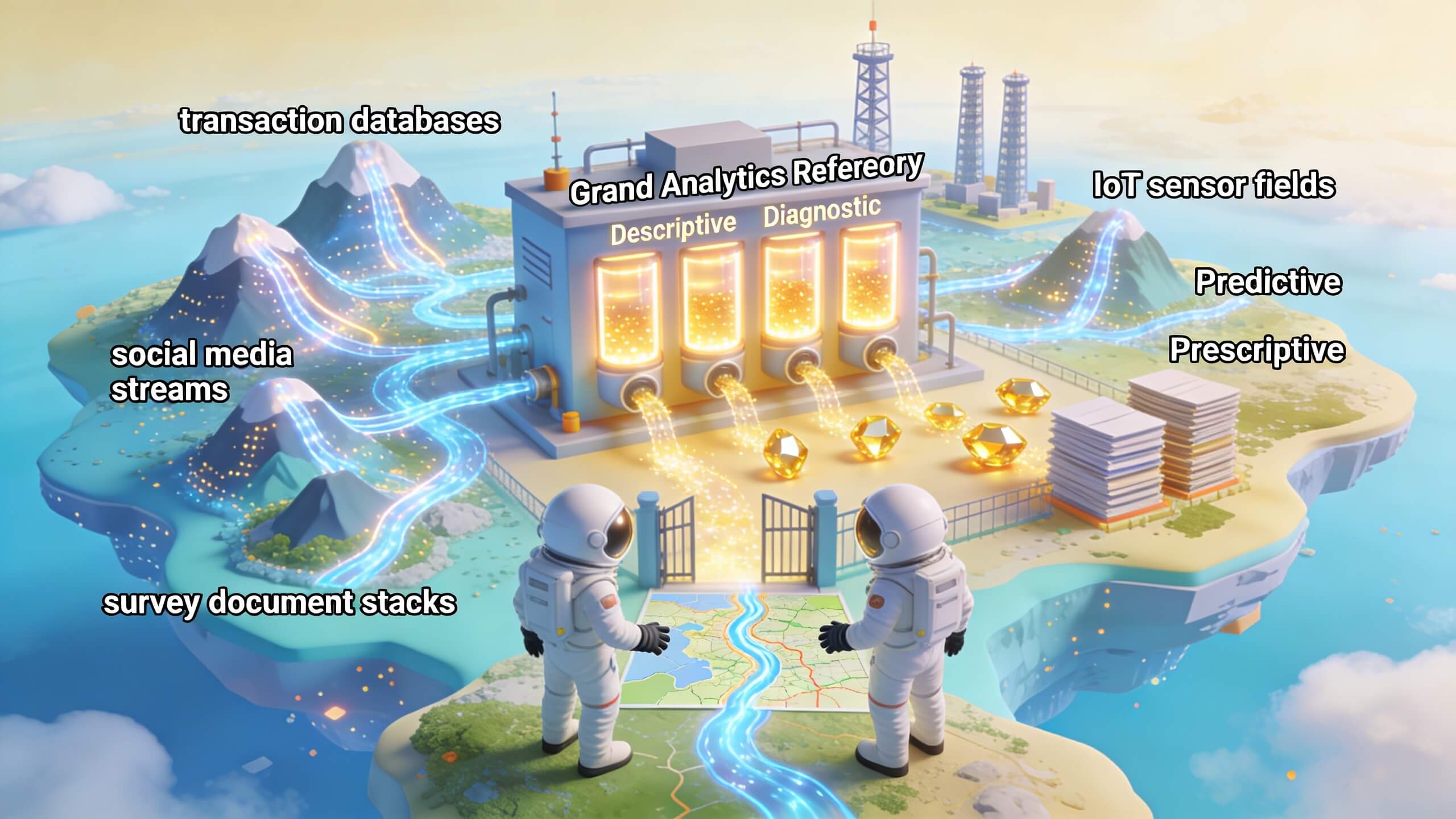
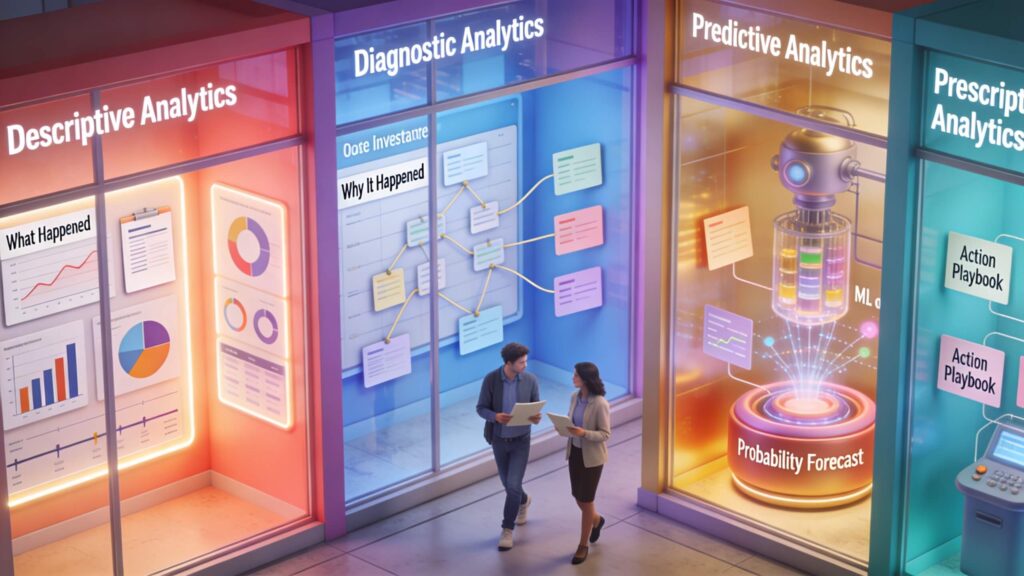
There are four distinct levels of analysis, each building on the previous one. Descriptive analytics answers the question, “What happened?” It summarizes historical data through metrics, dashboards, and visualizations. Diagnostic analytics goes deeper to answer, “Why did it happen?” by exploring relationships and root causes. Predictive analytics uses statistical models and machine learning to estimate, “What is likely to happen?” based on historical patterns. Prescriptive analytics recommends specific actions, answering, “What should we do?” Mature organizations use all four levels in an integrated fashion, moving seamlessly from hindsight to insight to foresight.
The tools and methods supporting this work are diverse. Data visualization, for instance, transforms complex datasets into intuitive charts that reveal trends and outliers at a glance. Data mining uncovers hidden correlations that would otherwise remain buried in spreadsheets. Statistical analysis tests hypotheses and measures the significance of observed differences. Machine learning algorithms detect patterns that are too subtle or too complex for manual analysis, and they improve over time as more data becomes available. However, none of these methods matter without a solid data management foundation. If your data is incomplete, inconsistent, or inaccessible, even the most sophisticated algorithms will produce misleading results. Resources from IBM and SAS provide excellent technical definitions, but the real value emerges when you apply these methods to specific business problems with clear objectives.
Featured Snippet: What Is Data Analytic?
Data analytic is the process of collecting, cleaning, examining, and interpreting data to uncover meaningful patterns, answer specific questions, and support evidence-based decision-making. It combines statistical methods, computational tools, and domain expertise to transform raw information into strategic advantage.
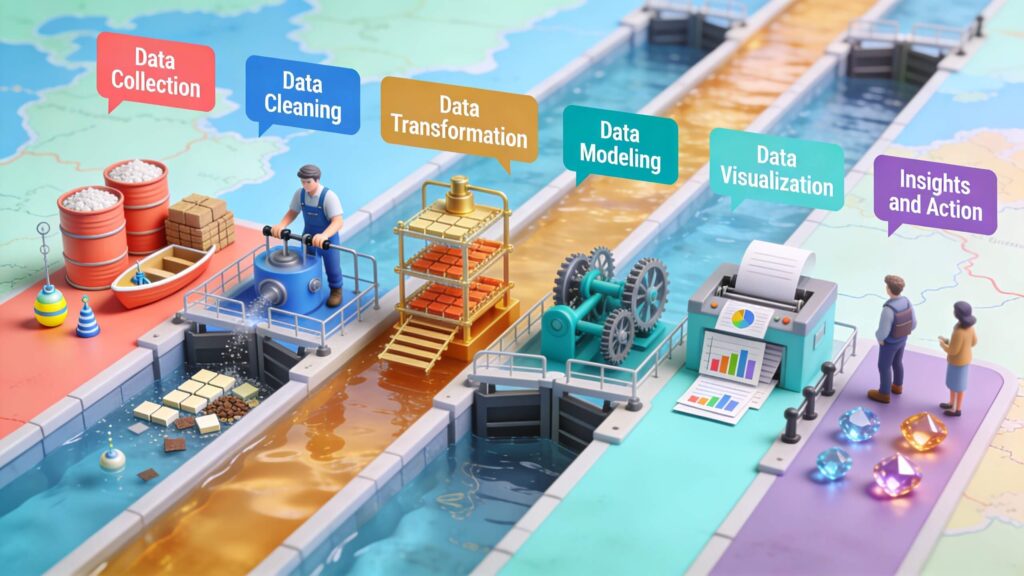
The Process Unfolds in Five Steps
- Define the business question: Start with a decision that needs support. Avoid beginning with data; begin with a problem such as “Why is customer retention dropping in Q3?” or “Which marketing channel delivers the highest lifetime value?”
- Gather the right data: Pull information from relevant sources—CRM systems, website analytics, transaction records, customer surveys, operational logs, and third-party datasets. Ensure the data scope matches the question.
- Clean and structure it: Remove duplicates, correct errors, standardize formats, handle missing values, and ensure consistency across sources. This step is labor-intensive but non-negotiable for reliable results.
- Analyze for insight: Apply appropriate methods—descriptive statistics, regression analysis, clustering, time-series forecasting, or machine learning—to identify patterns, correlations, and anomalies that address the original question.
- Act and measure: Translate findings into concrete decisions or actions. Then track outcomes to validate the analysis and refine the approach for the next cycle.
This sequence appears straightforward, but execution separates high-performing teams from average ones. Experienced analysts know that clarity of purpose and data quality matter far more than the sophistication of the tools used.
The Business Value of Data Analytic
The core value proposition of data analytic is simple: it reduces uncertainty. When leaders rely solely on intuition, they often overlook hidden costs, weak signals, and shifting customer behaviors. Data-driven organizations make decisions with stronger evidence and typically move faster because they can prioritize with confidence. This is not about eliminating human judgment—it is about augmenting it with factual grounding.
In marketing, data analytic reveals which channels generate the highest return on ad spend, which messages resonate with specific segments, and where customers drop off in the conversion funnel. Instead of guessing whether a campaign worked, you can measure its precise impact. In sales, it helps identify high-value leads, forecast pipeline health, and determine the optimal follow-up cadence. Sales teams that use lead scoring models based on historical conversion data consistently outperform those that rely on gut feel alone.
Operations benefit immensely from data analytic as well. By analyzing production workflows, supply chain data, and inventory levels, companies can identify bottlenecks, reduce waste, and optimize cycle times. In finance, analytics improves budgeting accuracy, detects fraudulent transactions in real time, and models the financial impact of different scenarios. Customer service teams use analytics to predict churn, prioritize support tickets, and identify the root causes of dissatisfaction before they escalate.
One of the most underappreciated benefits is organizational alignment. When different departments share the same data definitions and metrics, debates shift from subjective opinions to objective evidence. Marketing and sales can agree on what constitutes a qualified lead. Finance and operations can reconcile cost data without endless meetings. This alignment accelerates decision-making and reduces friction across the organization. Research from Harvard Business Review consistently shows that companies with strong analytical cultures outperform their less data-oriented competitors on both revenue growth and profitability. In my two decades of experience, I have observed the same pattern: organizations that treat data analytic as a management discipline, not just a reporting function, consistently make better strategic calls and adapt more quickly to market changes.
Core Components of an Effective Data Analytic Strategy
Building a successful data analytic program requires more than purchasing software or hiring a data scientist. It rests on several foundational elements that must be in place before meaningful insights can emerge. The first and most critical is data quality. If your records contain duplicates, outdated entries, inconsistent naming conventions, or missing fields, even the most advanced models will produce flawed conclusions. Data quality is not a one-time cleanup project; it requires ongoing governance, validation rules, and ownership at the source. Every team that generates data must understand its responsibility for accuracy.
The second component is governance. Clear rules about data ownership, definitions, access permissions, and compliance are essential. Without governance, different departments may use different definitions for the same metric—for example, “active customer” might mean one thing to sales and another to marketing. This leads to conflicting reports and eroded trust in the data. Governance also covers data privacy and security, which are increasingly regulated by frameworks such as GDPR and the NIST Privacy Framework.
Infrastructure is the third pillar. Data must be stored, processed, and accessed in ways that support speed, scale, and reliability. Cloud-based platforms like Google Cloud and Microsoft Azure offer scalable solutions, but the architecture must be designed with the specific use cases in mind. A data warehouse optimized for structured reporting may not serve real-time streaming analytics well. The key is to match infrastructure to the analytical demands of the business.
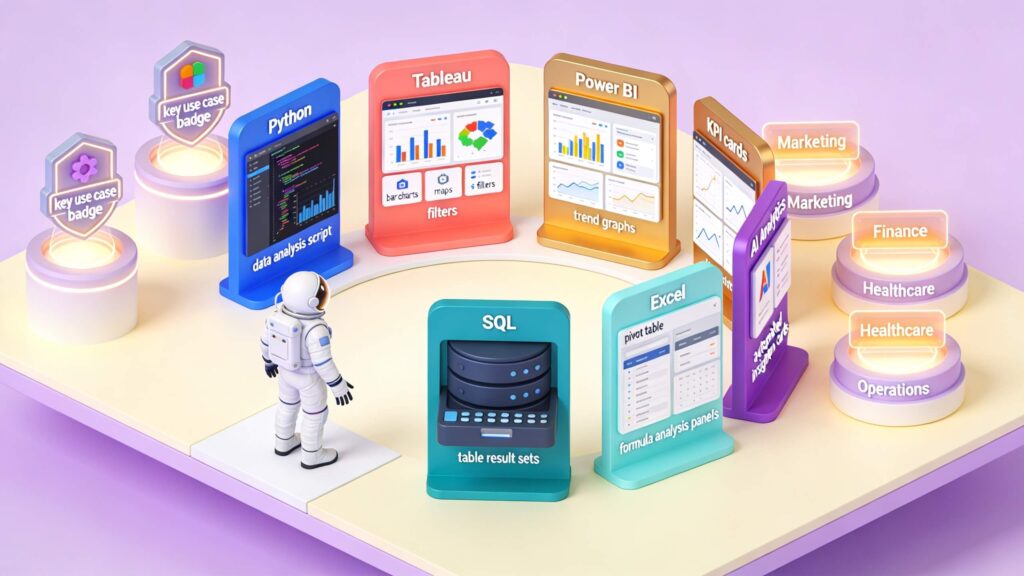
Visualization is another essential element. A well-designed dashboard can reveal trends, outliers, and relationships in seconds. A poorly designed one can bury critical signals under visual noise. Effective visualizations emphasize comparison, movement, and exception. They allow executives to grasp what matters without needing to decode technical details. Tools like Tableau and Power BI are powerful, but they are only as good as the design principles applied to them.
Predictive analytics and machine learning add a forward-looking dimension. These techniques can forecast demand, estimate customer lifetime value, detect fraud, optimize pricing, and personalize recommendations. However, they work best when paired with strong business context. Models should support human decision-making, not replace it. A model that predicts churn with 90% accuracy is useless if the business does not have the operational capability to intervene with at-risk customers. The final component is data management—the pipelines, metadata standards, and integration processes that ensure data flows reliably from source to insight. Without strong data management, teams end up working from conflicting numbers, which destroys trust and slows progress.
Implementing Data Analytic in a Real Business Environment
Implementation is where most data analytic initiatives stumble. The most common mistake is buying tools before defining objectives. Companies invest in expensive platforms, hire analysts, and then struggle to generate value because they have not clarified what problems they are trying to solve. The smarter approach is to start with a short list of high-value use cases. Focus on business problems where better insight can directly increase revenue, reduce cost, improve customer retention, or lower risk. This creates early momentum and makes it easier to secure ongoing executive support.
Once you have identified the use cases, map the data sources required for each one. Customer data may reside in a CRM system, a website analytics platform, an advertising account, a customer support tool, and a billing system. Operational data may be spread across an ERP system, production logs, and supplier databases. Bringing these sources together is often the most difficult phase of implementation, but it is also where much of the long-term value is created. Data integration requires technical skill, cross-departmental collaboration, and a willingness to invest in data cleaning and standardization.
Cross-functional collaboration is critical throughout the implementation process. Analysts need input from marketing, sales, finance, operations, and compliance to ensure that analyses address real business needs and that recommendations are actionable. Without this context, reports can be technically correct but commercially useless. I have seen many expensive analytics projects fail because business users were brought in too late, after the analytical work was already complete. The most successful implementations treat analytics as a partnership between technical teams and business stakeholders.
Training and change management are equally important. Not everyone in the organization needs to become a statistician, but employees at all levels should understand basic concepts such as metrics, baselines, correlation versus causation, and statistical significance. A data-driven culture grows when people know how to question data intelligently and use it in their daily decisions. This requires ongoing education, clear communication, and leadership that models data-informed behavior.
| Department | Best Use of Data Analytic | Primary KPI |
|---|---|---|
| Marketing | Campaign attribution, audience segmentation, channel optimization | ROAS / CAC |
| Sales | Lead scoring, pipeline forecasting, territory planning | Conversion rate |
| Operations | Process efficiency, inventory planning, supply chain optimization | Cycle time |
| Finance | Risk monitoring, profitability analysis, fraud detection | Margin |
| Customer Service | Churn prediction, response optimization, sentiment analysis | Retention rate |
Common Challenges in Data Analytic and How to Solve Them
Every organization faces similar obstacles when implementing data analytic, and recognizing them early is the first step to overcoming them. Poor data quality is the most pervasive issue. Duplicate records, missing fields, inconsistent naming conventions, and disconnected systems can distort findings and erode trust. The solution is disciplined data governance: establish standard definitions, implement validation rules at the point of entry, conduct regular audits, and assign ownership for data quality at the source. This is not glamorous work, but it is the foundation upon which everything else rests.
Privacy and security present another major challenge. Businesses now operate under tighter regulations and higher customer expectations regarding data use. Sensitive information must be collected transparently, stored securely, and used only for stated purposes. Strong access controls, encryption, data anonymization, and documented policies are no longer optional—they are legal and reputational necessities. Frameworks such as GDPR and the NIST Privacy Framework provide practical guidance for building compliant data practices.
Scale is a third challenge that often catches growing companies off guard. As data volumes increase, legacy systems can become overwhelmed, leading to slow query times and unreliable reporting. Cloud-based platforms, automation, and modern data warehousing solve much of this problem, but only if the data models are designed efficiently. Bigger data is not automatically better data. Without careful design, scaling can amplify existing problems rather than solving them.
Misinterpretation of results is another frequent issue. Many teams confuse correlation with causation, overreact to small changes without testing for statistical significance, or cherry-pick data that supports a preconceived conclusion. This is where experienced analysts add real value. They know when a pattern is meaningful and when it is simply noise. They apply rigorous testing and communicate uncertainty honestly. Finally, there is the adoption problem: reports and dashboards that nobody uses create no value. To make data analytic effective, outputs must be timely, relevant, and directly tied to decisions people actually make. If a dashboard does not influence a single decision in a given week, it is probably not serving its purpose.
Best Practices to Maximize Results from Data Analytic
The strongest analytics teams share several habits that consistently produce better outcomes. First, they tie every analysis to a specific business objective. Before any work begins, they ask: “What decision will this analysis inform?” If the answer is unclear, the analysis is deprioritized. Second, they define metrics clearly and avoid vanity metrics—those that look impressive but do not correlate with business outcomes. For example, page views matter less than conversion rate; social media followers matter less than engagement rate.
Third, they review data quality continuously rather than treating cleanup as a one-time task. Data degrades over time as systems change, people leave, and processes evolve. Ongoing quality checks prevent small errors from compounding into major problems. Fourth, they communicate findings in plain language, avoiding jargon and technical complexity. The best analysis in the world is worthless if the decision-maker cannot understand it. Visual aids, executive summaries, and clear recommendations are far more important than many technical teams realize.
Another best practice is to combine historical analysis with forward-looking models. Looking backward explains what happened and why. Looking forward improves what will happen next. This is where predictive analytics, scenario planning, and machine learning create measurable advantage. Testing should also be part of the process. If data suggests a new pricing strategy, a different campaign message, or a process change, validate it with controlled experiments where possible. A/B testing, randomized trials, and pilot programs provide the strongest evidence for causal relationships.
One expert rule I have relied on for years is simple: if a dashboard does not change a decision, it is probably not the right dashboard. Useful data analytic is concise, decision-oriented, and connected to accountability. Every report should have a clear audience, a specific purpose, and a defined action that follows from it.
Case Studies: How Leading Brands Use Data Analytic
Real-world examples illustrate what effective data analytic looks like in practice and provide actionable lessons for any organization. Google has long used data to refine its advertising ecosystem. By analyzing audience signals, search intent, click patterns, and conversion data, the company can match advertisements to users with remarkable precision. This data-driven approach transformed digital advertising from a mass-market broadcast model into a highly targeted, measurable channel. The lesson for marketers is clear: invest in understanding your audience through data, not assumptions.
General Electric Aviation applied predictive analytics to aircraft engine maintenance. By continuously analyzing sensor data from engines in flight, the company can identify patterns that signal likely component failures before they occur. Instead of waiting for a breakdown and performing reactive repairs, engineers can schedule proactive maintenance during planned downtime. The result is less unscheduled downtime, lower maintenance costs, and improved safety and reliability. This is a textbook example of data analytic creating direct operational value by shifting from reactive to predictive decision-making.
American Express strengthened its fraud detection capabilities by analyzing transactions in real time. The company’s models evaluate hundreds of variables—transaction amount, location, time, merchant category, and historical spending patterns—to flag potentially fraudulent activity within milliseconds. Crucially, the system balances sensitivity with specificity, reducing false positives that frustrate legitimate customers while still catching sophisticated fraud schemes. In financial services, this balance is critical for maintaining both security and customer trust.
Netflix is perhaps the most famous example of personalization at scale. Its recommendation engine analyzes viewing behavior, search queries, rating history, time of day, device type, and even the artwork a user clicks on to surface content that each individual is more likely to enjoy. According to company reports, this personalization saves the company over $1 billion annually in reduced churn and increased engagement. For any business that serves customers, the lesson is clear: relevance drives response. When you use data to understand individual preferences and deliver tailored experiences, customers reward you with loyalty and spending.
These cases span different industries—technology, manufacturing, financial services, and entertainment—but they share a common principle. Data analytic works best when it is tied to a specific business decision, supported by high-quality data, and embedded in daily operations rather than treated as a periodic reporting exercise.
The Future of Data Analytic and Ethical Responsibility
The future of data analytic will be shaped by several converging trends: automation, real-time processing, artificial intelligence, and stronger governance. More companies are moving from static, periodic reporting to continuous intelligence, where systems update insights automatically and trigger actions in near real time. This shift will make analytics faster and more accessible across the organization, but it also raises the stakes. When decisions are automated, errors can propagate at digital speed.
Artificial intelligence will accelerate pattern recognition, anomaly detection, forecasting, and natural language querying. Tools will become easier for non-technical users, lowering the barrier to entry for data-driven decision-making. However, this ease of use creates a new risk: if people trust outputs they do not fully understand, poor decisions can scale quickly. This is why ethics must be treated as a core component of any analytics strategy, not an afterthought.
Businesses must address bias in models, fairness in targeting, transparency in data use, and consent in collection practices. Algorithms trained on historical data can perpetuate existing inequalities if not carefully audited. Models that optimize for short-term engagement may encourage addictive behaviors. The OECD AI Principles and responsible AI frameworks increasingly shape how advanced analytics should be governed. In my view, the next competitive advantage will not come from having more data. It will come from combining speed, accuracy, and trust. Companies that can deliver all three will lead their markets. Those that sacrifice trust for speed will face regulatory backlash, customer churn, and reputational damage.
Conclusion
Data analytic is no longer a specialist function reserved for large enterprises with deep technical teams. It is now a practical, high-impact discipline that helps organizations of every size make smarter decisions, improve customer experience, strengthen operations, and uncover growth opportunities earlier than competitors. When done well, it brings clarity to uncertainty. It shows what is happening, explains why it is happening, and points to what should happen next. The most effective approach is not to chase every tool or trend. It is to begin with clear business questions, build trustworthy data foundations, apply the right analytical methods, and turn insight into action. That means improving data quality, aligning teams around shared metrics, using visualization carefully, and adopting predictive models where they create real value. It also means taking privacy, security, and ethics seriously. Insight without trust is a short-lived advantage.
If your business wants better marketing performance, sharper forecasting, stronger customer retention, or more efficient operations, data analytic should be part of your strategy now, not later. Start with one high-value use case, prove the return, and scale from there. The organizations that win in the next decade will not be those with the most data, but those that use it with the most discipline. If you are ready to turn data into measurable business growth, partner with a digital marketing team that understands analytics, attribution, and performance strategy at a deep level. The right expertise can help you move from reports to revenue, from guesswork to confidence, and from data to decisions that drive real results.