
Cart 0

Share
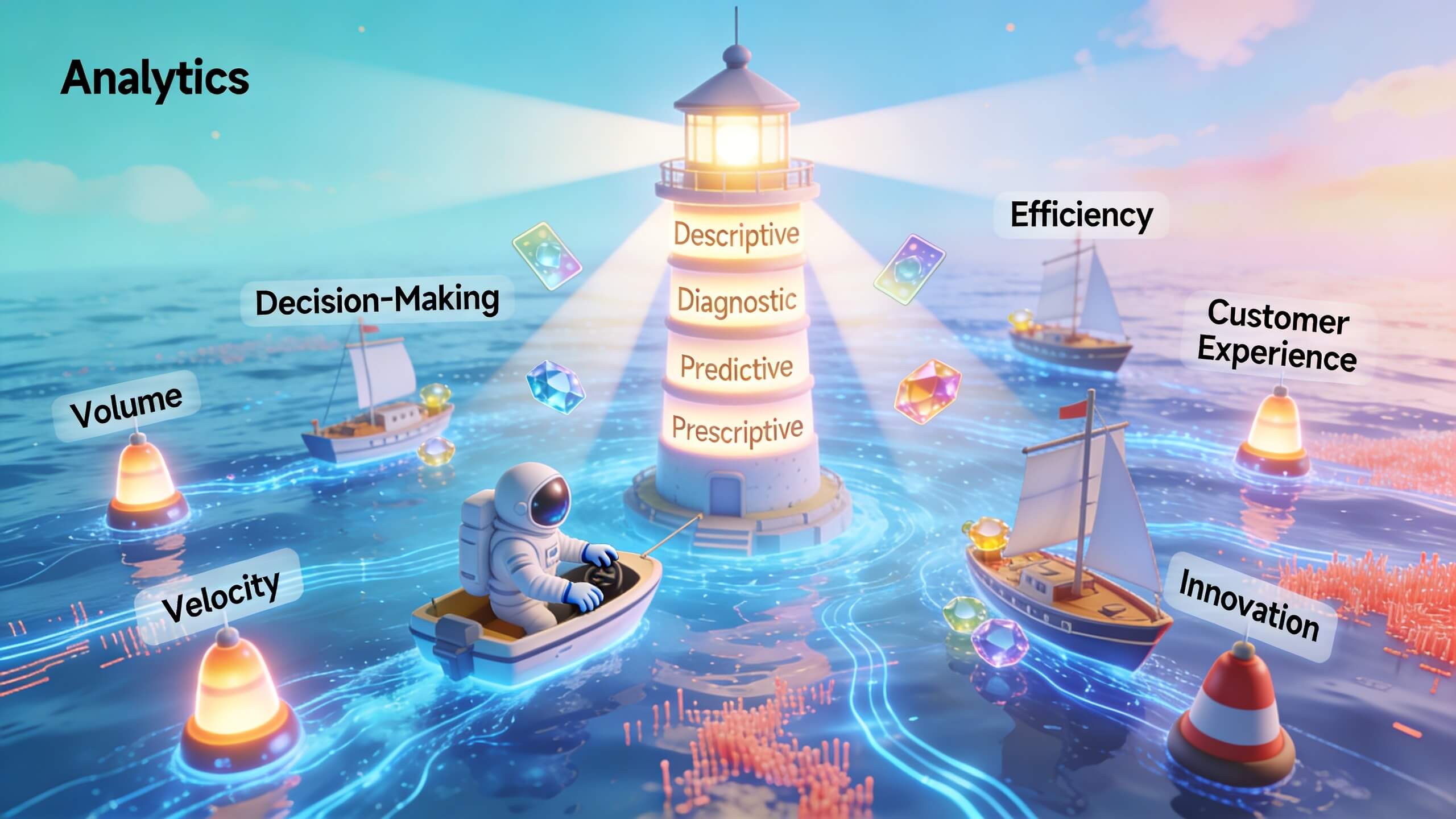
In the modern enterprise, information is abundant, but wisdom is scarce. The true competitive differentiator in 2025 is no longer merely possessing vast datasets, but possessing the capability to interrogate them with precision and extract decisive, actionable intelligence. This is the core mission of big data and data analytics, a symbiotic discipline that transforms raw, voluminous information into a strategic compass. Big data constitutes the immense, often chaotic, fuel—generated from every transaction, sensor, social interaction, and machine log. Data analytics is the sophisticated engine—the methodologies, tools, and expertise—that refines this fuel into kinetic insight. Together, they empower organizations to move beyond hindsight, through diagnosis, and into foresight, answering the critical sequence: What happened? Why did it happen? What will happen next? And what should we do about it? This intersection of sheer scale and profound insight is now the operational bedrock for leaders in finance, healthcare, manufacturing, and beyond, who understand that in a world of uncertainty, the most reliable strategy is one informed by evidence.

Table of Contents
Demystifying the Core: Data at Scale Meets Analytical Rigor
While frequently mentioned in tandem, big data and data analytics represent distinct, interconnected phases in the value-creation pipeline. Conceptualizing them separately is the first step toward effective implementation.
Big Data: The Characteristics of Modern Information
Big data is defined not just by its size, but by its challenging characteristics that overwhelm traditional database systems. The classic “3 Vs” framework has evolved to encompass five critical dimensions that define the modern data landscape. It’s the relentless flow from IoT devices, the unstructured text of customer reviews, the high-velocity clickstreams, and the petabytes of video surveillance. This isn’t data that sits quietly in rows and columns; it’s dynamic, diverse, and demands new architectural paradigms like data lakes and scalable cloud storage to even be housed effectively.
Data Analytics: The Disciplined Pursuit of Meaning
If big data is the quarry, data analytics is the process of mining, refining, and shaping the raw material into something of immense value. This discipline spans a spectrum of sophistication, from the foundational business intelligence of descriptive dashboards to the advanced algorithmic predictions of machine learning models. Analytics is the applied science of asking a question of your data and employing the correct methodological toolkit—whether statistical analysis, data mining, or machine learning—to receive a reliable, actionable answer. The ultimate goal is to reduce uncertainty and guide decision-making with empirical evidence.
| Dimension | Description | Practical Implication |
|---|---|---|
| Volume | The sheer scale of data, often in petabytes or exabytes. | Requires distributed storage (e.g., Hadoop, cloud object storage) beyond traditional servers. |
| Velocity | The speed at which data is generated and must be processed. | Necessitates real-time or near-real-time processing engines like Apache Kafka or Spark Streaming. |
| Variety | The mix of structured, semi-structured (JSON, XML), and unstructured (text, video) data. | Demands flexible schemas and tools capable of handling diverse formats simultaneously. |
| Veracity | The quality, accuracy, and trustworthiness of the data. | Introduces the need for robust data governance, cleansing, and validation pipelines. |
| Value | The measurable business worth derived from the data. | Forces alignment between data initiatives and core business outcomes to ensure ROI. |
The Analytical Spectrum: From Description to Prescription
Organizations extract maximum value from big data and data analytics by applying the right type of analysis to the right business question. This progression forms a maturity model, with each layer building upon the last to create a comprehensive decision-support framework.
Descriptive Analytics: Establishing the “What”
This is the foundational layer, concerned with summarizing historical data to describe what has already occurred. It turns raw data into intelligible information through dashboards, standard reports, and key performance indicator (KPI) trackers. Think of monthly sales reports, website traffic summaries, or operational efficiency metrics. A 2023 study by the Gartner group noted that over 70% of corporate reporting needs are still met by descriptive analytics, as it creates the essential common factual baseline from which all further investigation launches. Without accurate description, diagnosis and prediction are built on sand.
Diagnostic Analytics: Uncovering the “Why”
When a KPI deviates from the norm, diagnostic analytics takes over. This involves drill-down, data discovery, and correlation analysis to identify root causes. Techniques like cohort analysis, segmentation, and contribution analysis are key. For instance, if customer churn spikes in a particular region, diagnostic analytics can isolate whether the cause was a recent price change, a competitor’s campaign, or localized service issues. It transforms a business question into a data-driven investigation.
Predictive Analytics: Forecasting the “What Next”
Here, big data and data analytics shift from a rear-view mirror to a telescope. Predictive analytics uses historical data, statistical algorithms, and machine learning techniques to identify the likelihood of future outcomes. It’s about probabilistic forecasting, not certainty. Common applications include predictive maintenance (forecasting equipment failure), customer lifetime value modeling, demand forecasting, and fraud detection scoring. The accuracy of these models is paramount, which is why institutions like NIST publish frameworks for AI and model risk management, emphasizing the need for rigorous validation and continuous monitoring.
Prescriptive Analytics: Recommending the “How”
The most advanced layer, prescriptive analytics, not only forecasts what will happen but also suggests actionable recommendations to affect desirable outcomes. It evaluates the possible consequences of different decisions based on predictive models, constraints, and business rules. Optimization algorithms and simulation are hallmarks of this stage. For example, a global shipping company uses prescriptive analytics to dynamically reroute fleets in real-time, balancing fuel costs, port fees, delivery deadlines, and weather patterns to prescribe the optimal course. It represents the pinnacle of turning data into direct, automated decision support.
The Indispensable Value Proposition for the Modern Enterprise
In an economy characterized by volatility, complexity, and heightened customer expectations, intuition alone is a perilous guide. The strategic application of big data and data analytics delivers concrete, measurable advantages that separate market leaders from laggards.
Operational efficiency sees dramatic gains through process mining and optimization, identifying bottlenecks and automating routine decisions. Customer experience is transformed via hyper-personalization, where analytics drive tailored product recommendations, content, and support interactions, increasing loyalty and lifetime value. Risk management is fortified through real-time anomaly detection in financial transactions or network security, enabling proactive mitigation. Furthermore, analytics uncovers latent growth opportunities—identifying underserved market segments, optimizing pricing strategies, and accelerating R&D through analysis of experimental data. A longitudinal analysis by McKinsey & Company consistently shows that data-driven organizations are 23 times more likely to acquire customers, 6 times as likely to retain them, and 19 times more likely to be profitable. The value proposition is not theoretical; it is quantifiable and transformative.
Architecting the Foundation: Data Management and Governance
The most sophisticated analytics model is worthless if built upon flawed data. Robust data management is the non-negotiable foundation for any successful big data and data analytics initiative. This extends far beyond technology to encompass people, processes, and policies.
Effective data governance establishes clear ownership, standardized definitions (a single “source of truth” for core metrics like “active customer”), quality standards, and security protocols. It ensures that when the sales department reports “revenue,” it aligns with the finance department’s definition. Modern architectural approaches like the data lakehouse, which combines the flexibility of a data lake with the management and ACID transactions of a data warehouse, are gaining traction, as noted by proponents like Databricks. However, the technology is an enabler, not a solution. A disciplined practice of data profiling, cleansing, enrichment, and lineage tracking must be institutionalized. Without this foundation, organizations risk “garbage in, gospel out,” eroding trust in analytics and leading to costly missteps.
The Critical Bridge: Data Visualization and Interpretation
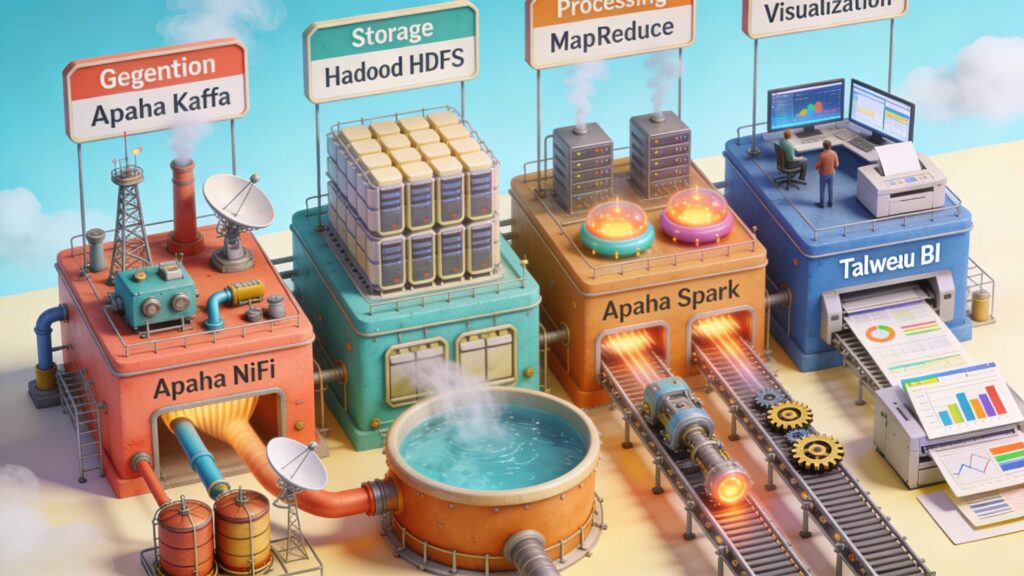
Insight that cannot be communicated is insight wasted. Data visualization serves as the critical bridge between complex analytical outputs and human decision-making. It translates multivariate findings, trends, and outliers into intuitive visual metaphors—charts, graphs, heat maps, and interactive dashboards.
The art lies in selecting the right visual for the narrative. A time-series forecast demands a line chart; a part-to-whole relationship calls for a stacked bar or treemap; geospatial analysis requires a map. Tools like Tableau, Microsoft Power BI, and Looker have democratized access to powerful visualization, but the principle of cognitive fit remains paramount. A dashboard should be designed to answer a specific set of business questions in under 30 seconds, minimizing clutter and highlighting key drivers. In practice, excellent visualization fosters a data-literate culture, enabling stakeholders at all levels to explore, question, and understand the story the data tells, thereby closing the loop from analysis to action.
Predictive Power: Machine Learning and AI in Analytics
The integration of machine learning (ML) and artificial intelligence (AI) represents the most dynamic frontier in big data and data analytics. These technologies supercharge predictive and prescriptive capabilities by automatically detecting complex, non-linear patterns within vast datasets that would elude traditional statistical methods.
Supervised learning algorithms, such as random forests and gradient boosting, are used for classification (e.g., spam detection) and regression (e.g., sales forecasting). Unsupervised learning, like clustering, helps in customer segmentation and anomaly detection. Deep learning, with its neural networks, drives breakthroughs in image recognition, natural language processing for sentiment analysis, and advanced time-series forecasting. The operationalization of these models—known as MLOps—is a critical discipline, ensuring models are reliably deployed, monitored for drift, and retrained as new data arrives. Companies leveraging AI at scale, as detailed in reports from Google Cloud, report significant improvements in forecast accuracy and automated decision-making, moving analytics from a support function to an embedded, intelligent automation layer.
Business Intelligence and Data Mining: The Operational Workhorses
While AI captures headlines, Business Intelligence (BI) and data mining remain the indispensable operational workhorses that deliver daily value. BI platforms aggregate data from across the enterprise to provide a unified, real-time view of performance through reports, dashboards, and ad-hoc query tools. It’s the system of record for operational health.
Data mining, a subset of analytics, involves exploring large datasets to discover previously unknown patterns and relationships. Descriptive data mining might reveal that a specific combination of products is frequently purchased together (market basket analysis), informing cross-selling strategies. Predictive data mining builds models to, for instance, score leads on their likelihood to convert. Together, BI and data mining transform raw data into accessible knowledge, empowering line managers and executives alike to monitor performance and uncover hidden opportunities. As platforms like Microsoft Power BI continue to integrate advanced AI capabilities, the line between traditional BI and predictive analytics is productively blurring.
Industry-Specific Transformations: From Theory to Practice
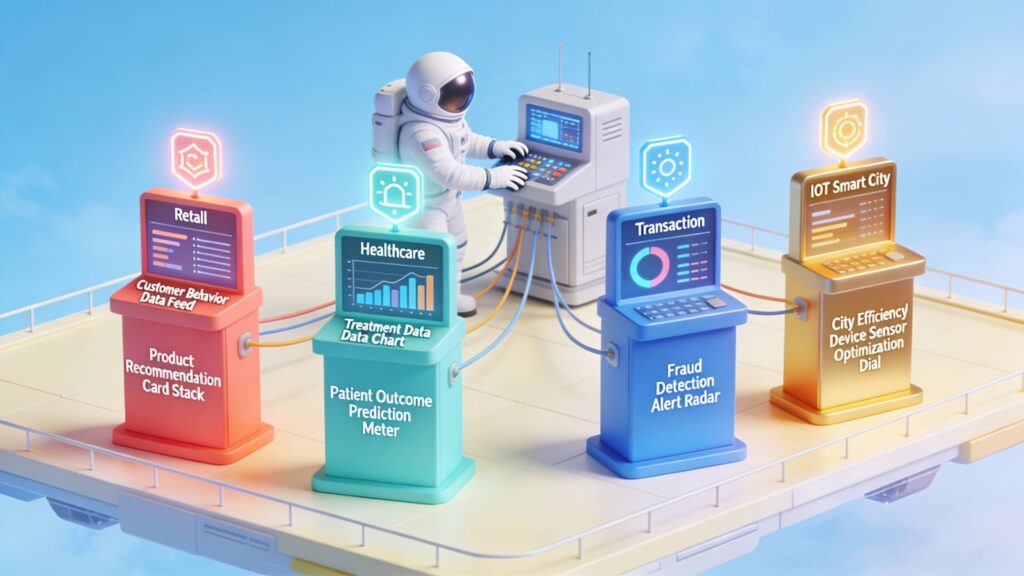
The abstract power of big data and data analytics crystallizes in its industry-specific applications. Each sector applies core principles to solve its unique challenges, offering clear mini-case studies of value creation.
In healthcare, predictive analytics models patient readmission risks, while prescriptive analytics helps optimize staff scheduling and operating room utilization. Retail and e-commerce rely on real-time analytics for dynamic pricing, personalized recommendation engines, and supply chain optimization, with giants like Amazon Web Services providing the scalable backbone. Financial services use complex ML models for real-time fraud detection, algorithmic trading, and regulatory compliance (RegTech). Manufacturing leverages sensor data from the Industrial Internet of Things (IIoT) for predictive maintenance, dramatically reducing unplanned downtime and improving quality control. In the public sector, analytics optimize traffic flow, allocate emergency resources, and model public health initiatives. These applications share a common thread: starting with a high-impact, well-defined use case to demonstrate ROI and build organizational momentum for broader transformation.
Navigating the Inevitable Challenges and Risks
The journey to becoming data-driven is fraught with technical, organizational, and ethical hurdles. Acknowledging these is the first step toward mitigating them.
The technical complexity of integrating siloed legacy systems, ensuring data quality at scale, and selecting the right technology stack can be daunting. The talent gap is acute; there is fierce competition for data scientists, ML engineers, and—critically—analytical translators who can bridge technical and business domains. Data privacy and security are paramount, with regulations like GDPR and CCPA imposing strict requirements on data handling. Ethical considerations around algorithmic bias, transparency, and the appropriate use of personal data must be proactively addressed through frameworks like those proposed by the Electronic Frontier Foundation. Furthermore, cultural resistance and a lack of data literacy among decision-makers can stall adoption, leading to “dashboard fatigue” where tools are built but not used to drive change. Success requires a holistic strategy that addresses people and process with the same vigor as technology.
Blueprint for Success: Building a Future-Proof Analytics Strategy
Crafting an effective analytics program is a strategic exercise, not a tactical IT purchase. The following blueprint, distilled from two decades of industry observation, prioritizes sustainable value over flashy technology.
First, anchor to business outcomes. Begin by identifying the top three business decisions that need improvement and work backward to the data and analytics required. Second, invest relentlessly in data foundation. Implement a governance council, establish a master data management program, and prioritize data quality as a KPI. Third, cultivate talent and literacy. Upskill existing staff, hire for hybrid business-technical roles, and mandate data fluency training for leadership. Fourth, adopt a phased, agile approach. Start with a pilot project with a clear ROI, learn, iterate, and then scale. Use cloud platforms from providers like IBM Cloud for elasticity and speed. Fifth, design for ethics and privacy from the start. Conduct bias audits on models, maintain transparency in automated decisions, and embed privacy-by-design principles. Finally, foster a culture of experimentation, where data is used to test hypotheses and failure is viewed as a learning opportunity. This comprehensive approach ensures that big data and data analytics evolve from a cost center to the central nervous system of the intelligent enterprise.
Conclusion
The evolution of big data and data analytics marks a fundamental shift in how organizations operate and compete. We have moved from an era of information scarcity and intuitive decision-making to one of abundance and empirical strategy. The intersection of massive, complex datasets and sophisticated analytical techniques is no longer a niche advantage but a commercial imperative. It enables a clear progression from understanding the past to diagnosing its causes, predicting the future, and ultimately prescribing optimal actions. The organizations that will thrive are those that recognize data as their most valuable non-human asset and build the disciplined infrastructure, governance, and culture to harness it. This journey demands investment in robust data management, ethical AI practices, and continuous literacy. It requires leaders to ask sharper questions and demand evidence-based answers. In the final analysis, the goal is not merely to collect or even analyze data, but to create a pervasive capability for smarter, faster, and more confident decision-making at every level. For businesses looking to navigate the complexities of the digital age, mastering this intersection is the definitive path to resilience, relevance, and growth. To explore how a tailored data and analytics strategy can transform your specific business outcomes, reach out to our team of experts for a comprehensive consultation.
Comments are closed.