Cart 0


Share
Table of Contents
Natural Language Processing Algorithms: Decoding the Patterns of Language
Every time you ask a voice assistant a question, receive a personalized email subject line, or get a near-instant translation of a foreign-language document, you are experiencing the output of natural language processing algorithms operating invisibly in the background. These algorithms are the computational engines that bridge the gap between the structured logic of machines and the beautifully messy, contextual, ambiguous complexity of human language. The NLP market reached $76.90 billion in 2025 and is projected to grow at a compound annual growth rate of approximately 26% to reach $778.70 billion by 2035, according to market analysis from Metatech Insights’s natural language processing market size and forecast report. That explosive growth trajectory reflects how thoroughly NLP has embedded itself into the software products, business processes, and digital infrastructure that modern organizations depend on. This guide examines how natural language processing algorithms work, traces their evolution from rule-based systems to transformer architectures, explores the key techniques that power real-world applications, and looks at where this technology is heading as large language models continue to redefine what machines can do with language.
What Are Natural Language Processing Algorithms?
Natural language processing algorithms are computational methods that enable machines to read, understand, interpret, and generate human language in ways that are useful and meaningful. Language is not simply a string of words—it carries syntax (grammatical structure), semantics (meaning), pragmatics (contextual intent), and affect (emotional tone). For a machine to process language effectively, it must navigate all four dimensions simultaneously, handling the ambiguities, idioms, sarcasm, cultural references, and evolving vocabulary that humans absorb effortlessly through years of social experience. NLP algorithms provide the mathematical and statistical frameworks for doing exactly that, operating on text and speech data to extract structured information, generate coherent responses, and classify language according to meaning rather than mere surface form.
The discipline draws on three foundational scientific traditions working in concert. Computational linguistics contributes formal models of grammatical structure and meaning. Computer science provides the algorithmic frameworks for parsing, searching, and transforming text data efficiently at scale. Machine learning and statistics provide the training methodologies that allow models to learn language patterns from data rather than relying solely on hand-crafted rules. As the foundational overview from IBM’s authoritative natural language processing explainer describes, NLP enables computers and digital devices to recognize, understand, and generate text and speech by combining computational linguistics with rule-based and statistical modeling—a combination that has become dramatically more powerful as the scale of training data and computing resources available to NLP researchers has grown.
The Algorithmic Architecture: How NLP Models Work
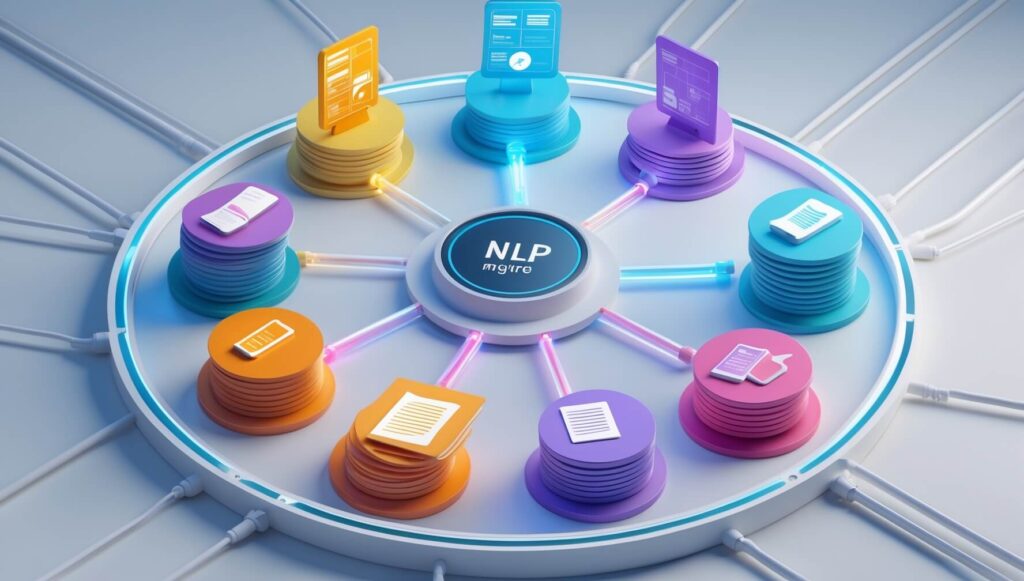
Understanding how NLP algorithms function requires familiarity with the pipeline of processing stages that raw text passes through before a machine can extract meaning from it. No single algorithm handles the entire process—instead, a sequence of specialized algorithms transforms raw text progressively from unstructured strings into rich, structured representations of meaning.
| Processing Stage | What It Does | Example Algorithm or Technique |
|---|---|---|
| Tokenization | Splits raw text into individual units (words, subwords, sentences) | WordPiece, SentencePiece, whitespace tokenizers |
| Morphological analysis | Identifies root forms and grammatical inflections of words | Stemming (Porter algorithm), Lemmatization |
| Part-of-speech (POS) tagging | Labels each token as noun, verb, adjective, etc. | Hidden Markov Models, conditional random fields, BERT-based taggers |
| Syntactic parsing | Builds a grammatical tree structure showing how words relate | Context-free grammar, dependency parsers |
| Named entity recognition | Identifies people, places, organizations, dates in text | CRF, BERT-based NER models |
| Semantic analysis | Determines meaning, resolves word sense ambiguity | Word embeddings (Word2Vec, GloVe), transformer attention |
| Discourse and pragmatic analysis | Understands context, co-reference, implied meaning across sentences | Large language models, coreference resolution algorithms |
Modern transformer-based NLP models have partially collapsed this traditional pipeline by learning many of these representations simultaneously during pre-training on massive text corpora—but the underlying linguistic concepts each stage addresses remain relevant for understanding why certain types of language understanding remain harder for machines than others. As the comprehensive algorithm taxonomy from Lumenalta’s guide to 13 essential natural language processing algorithms confirms, the shift from rule-based to statistical to deep learning approaches in NLP has not eliminated these processing challenges—it has changed how they are addressed, with modern transformer architectures handling many tasks implicitly through learned representations rather than explicit rule systems.
From Rules to Machine Learning: The Evolution of NLP Approaches
The history of natural language processing algorithms is a story of progressive paradigm shifts, each one enabling more accurate, more scalable, and more generalized language understanding than the one before it. Understanding this evolution is essential context for appreciating why today’s transformer architectures represent such a significant advance over what preceded them.
Rule-Based Systems (1950s–1980s)
Early NLP systems were entirely rule-based: linguists and engineers hand-crafted explicit grammar rules, dictionaries, and logic conditions that defined how machines should parse and interpret language. These systems worked well in narrow, well-defined domains—a system designed to answer questions about train schedules, for instance, could be highly accurate—but they failed catastrophically when encountering language outside their predefined rule sets. Building comprehensive rule sets for even a single language was enormously labor-intensive, and the combinatorial complexity of language meant that edge cases constantly defeated even the most carefully designed systems. Rule-based systems also had no mechanism for handling statistical regularities or learning from examples—every new language phenomenon required a new handcrafted rule.
Statistical and Classical Machine Learning (1990s–2010s)
The statistical revolution in NLP began in earnest in the 1990s, as researchers shifted from hand-crafted rules to probabilistic models trained on large corpora of real text. Hidden Markov Models (HMMs) became the backbone of speech recognition and part-of-speech tagging. Naive Bayes classifiers and Support Vector Machines (SVMs) enabled effective text classification—spam detection, topic categorization, and sentiment analysis. N-gram language models calculated the probability of word sequences based on observed frequencies in training data, enabling more natural-sounding text generation than rule-based approaches. These methods were more robust, more scalable, and produced better real-world performance than their rule-based predecessors. However, as the algorithm comparison data from Perma Technologies’s key AI algorithms for NLP in 2025 notes, by 2024 only approximately 6% of NLP practitioners were still using HMMs or n-gram models for production-level tasks—reflecting how comprehensively deep learning methods have displaced the statistical era’s dominant tools.
Deep Learning and Neural Networks (2013–2017)
The introduction of word embeddings—particularly Word2Vec in 2013 and GloVe in 2014—represented a conceptual breakthrough by encoding semantic relationships between words as vectors in continuous mathematical space, allowing machines to capture the meaning proximity between words like “king” and “queen” through their positions in that space rather than through explicit dictionary definitions. Recurrent Neural Networks (RNNs) and their variants Long Short-Term Memory (LSTM) networks and Gated Recurrent Units (GRUs) enabled sequential modeling of language—processing text word by word while maintaining a hidden state that captured contextual information from earlier in the sequence. These architectures dramatically improved performance on tasks like machine translation, sentiment analysis, and text generation, but they were limited by the difficulty of maintaining context over long distances in text and by their fundamentally sequential nature, which prevented efficient parallel training on modern hardware.

The Transformer Revolution: How Modern NLP Algorithms Work
The 2017 introduction of the Transformer architecture—described in the seminal paper “Attention Is All You Need” by Vaswani et al.—fundamentally changed natural language processing algorithms. The transformer replaced sequential processing with a self-attention mechanism that allows every token in a sequence to attend directly to every other token, capturing long-range dependencies in a single computational step. This architectural shift solved the long-distance context problem that limited RNNs while simultaneously enabling massive parallelization that made training on previously unimaginable scales of text data feasible. As the comprehensive transformer model analysis from Netguru’s guide to transformer models in natural language processing details, transformers now underpin virtually every state-of-the-art NLP system and have expanded well beyond language into computer vision, multimodal learning, robotics, and scientific research.
BERT: Bidirectional Understanding
Google’s BERT (Bidirectional Encoder Representations from Transformers), introduced in 2018, represented the first large-scale demonstration of the transfer learning paradigm for NLP: pre-train a massive model on enormous unlabeled text corpora, then fine-tune it on specific downstream tasks with relatively little labeled data. BERT’s critical architectural innovation was bidirectional context modeling—rather than reading text left-to-right or right-to-left, BERT processes every token in relation to all other tokens in both directions simultaneously. Its two pre-training objectives—Masked Language Modeling (MLM), where the model predicts randomly masked tokens using surrounding context, and Next Sentence Prediction (NSP), where it learns whether two sentences are sequentially related—teach it deep representations of language meaning that transfer powerfully to downstream tasks. As the BERT architecture breakdown from Tredence’s natural language processing evolution and importance guide explains, these innovations gave BERT state-of-the-art performance across eleven NLP tasks at the time of its release and established the pre-train/fine-tune paradigm that all subsequent large language models have followed.
GPT and Generative Transformers
While BERT optimized for language understanding, OpenAI’s GPT series of models optimized for language generation using an autoregressive approach—predicting each next token given all preceding tokens. GPT-4, the current production model, is multimodal, capable of processing both text and images, and has demonstrated performance at or above human expert level on numerous professional and academic benchmarks. The leading NLP models in 2025 include GPT-4, Google’s Gemini 1.5, Anthropic’s Claude 3, Meta’s LLaMA 3, and Cohere’s Command R+, each representing a distinct architectural and training philosophy but all grounded in the transformer attention mechanism. As the 2025 NLP model landscape analysis from Workrig’s five highly rated NLP language models for 2025 details, these models excel at advanced reasoning, complex instruction following, memory, summarization, and nuanced tone matching—capabilities that were entirely out of reach for statistical NLP systems a decade ago.
Core NLP Techniques and How They Power Real Applications
The advanced NLP algorithms described above are deployed through specific techniques that address concrete language understanding tasks. Each technique represents a well-defined problem formulation with established algorithmic approaches, benchmark datasets, and production deployment patterns.
Sentiment Analysis
Sentiment analysis—also called opinion mining—uses NLP algorithms to determine the emotional polarity and intensity of text, classifying it as positive, negative, or neutral at the document, sentence, or aspect level. Modern sentiment analysis using fine-tuned transformer models achieves high accuracy even on nuanced text that contains irony, mixed sentiment, or domain-specific vocabulary. Business applications include social media brand monitoring, customer review aggregation, financial market sentiment tracking, and political opinion analysis. Aspect-based sentiment analysis extends the basic approach by identifying not just overall sentiment but the sentiment expressed toward specific attributes of a product or service—distinguishing “the food was excellent but the service was terrible” from a simple negative or positive classification.
Named Entity Recognition (NER)
Named entity recognition identifies and categorizes specific entities within text—people, organizations, geographic locations, dates, monetary values, product names, and other named concepts relevant to specific domains. Modern NER systems using BERT-based models achieve accuracy levels sufficient for production deployment in information extraction, knowledge graph construction, medical record processing, legal document analysis, and financial document review. NER is a foundational component of more complex NLP pipelines: before you can analyze relationships between entities or aggregate information about specific companies across thousands of documents, you must first reliably identify which strings of text refer to those entities. As the entity recognition coverage in GeeksForGeeks’s guide to named entity recognition outlines, NER has evolved from simple dictionary lookup and pattern matching approaches to sophisticated contextual models that correctly disambiguate the same string as a person name in one context and a company name in another.
Machine Translation
Neural machine translation using transformer architectures has dramatically improved the quality of automated translation, with modern systems now approaching human professional translator performance on high-resource language pairs. Google Translate, DeepL, and similar services process hundreds of billions of translation requests annually, enabling cross-language communication at a scale that would be unimaginable using human translators alone. In 2025, leading NLP systems can process over 200,000 tokens across multiple languages and perform real-time translations between more than a dozen language pairs, according to the multilingual capability analysis from Vertu’s assessment of why 2025 is a key year for natural language processing. Advances in low-resource translation—improving quality for languages with limited training data—are extending high-quality automated translation to languages that were previously served poorly by existing systems.
Topic Modeling and Text Clustering
Topic modeling algorithms such as Latent Dirichlet Allocation (LDA) and its neural successors identify latent thematic structures within large text corpora, grouping documents by their underlying subject matter without requiring manual labeling. Text clustering uses similarity metrics in embedding space to group documents with similar content, enabling unsupervised organization of large document collections. These techniques are particularly valuable for business intelligence applications where the goal is to understand the thematic landscape of customer feedback, news coverage, research literature, or social media discussion without reading every document individually. The combination of topic modeling with modern embedding-based approaches allows analysts to navigate collections of hundreds of thousands of documents by theme with far greater accuracy and granularity than keyword search alone provides.
Text Summarization
Automatic text summarization compresses long documents into shorter representations that preserve the most important information. Extractive summarization selects and combines the most representative sentences from the source document; abstractive summarization generates new sentences that capture the key ideas in more concise or restructured form. Large language models have dramatically improved abstractive summarization quality, enabling systems that produce coherent, readable summaries of complex documents that read as if written by a human editor rather than assembled from source fragments. Applications span legal document review, financial reporting, medical literature synthesis, news aggregation, and meeting transcription summarization.

Deep Learning Architectures That Drive Modern NLP
The deep learning revolution has produced several architectural innovations beyond the transformer that contribute to the NLP algorithm landscape, each addressing specific aspects of language processing with distinct computational approaches.
Recurrent Neural Networks and their LSTM and GRU variants remain in use for specific sequence modeling tasks where their inductive bias toward sequential processing is an advantage, particularly in real-time streaming contexts where the transformer’s full-sequence attention is computationally prohibitive. Convolutional Neural Networks (CNNs), originally developed for image recognition, have found effective application in text classification tasks where local feature extraction is more important than long-range dependency modeling. Reinforcement Learning from Human Feedback (RLHF)—the technique used to align GPT-4, Claude, and Gemini with human preferences—is not a language processing algorithm per se but a training methodology that shapes how generated language conforms to human quality judgments, making it one of the most practically important algorithmic developments in applied NLP. As the 2025 NLP state-of-the-art assessment from Aezion’s NLP trends and use cases guide confirms, the transformer model continues to dominate the NLP landscape, with GPT-4, Claude, and Gemini demonstrating advanced reasoning, memory, summarization, and complex instruction-following capabilities that represent the current frontier of what language processing algorithms can achieve.
Multimodal models—architectures like Gemini and GPT-4 Vision that process both text and images through cross-attention mechanisms between modalities—represent the most recent frontier. These models enable visual question answering, image captioning, and extraction of information from scanned documents and charts, extending the reach of NLP algorithms beyond pure text into the richly multimodal information environment of the real world. According to benchmark data cited by Perma Technologies’s top AI algorithms for NLP, Gemini 1.5 can summarize a scientific paper and explain its figures in natural language with 92% accuracy on the Vision Language Reasoning Tasks 2025 benchmark—a capability unimaginable with text-only NLP systems.
Real-World Applications Across Industries
Natural language processing algorithms are no longer confined to research laboratories or technology companies—they are embedded in the operational infrastructure of healthcare, finance, legal services, education, e-commerce, and virtually every other sector that processes significant volumes of text or voice communication.
- Healthcare — NLP algorithms extract structured clinical information from unstructured physician notes, accelerate medical literature review, power diagnostic decision support systems, and enable patient-facing symptom checkers and appointment scheduling assistants.
- Financial services — Fraud detection systems analyze transaction narratives and communication patterns; algorithmic trading systems monitor news sentiment for market-moving signals; compliance systems scan communication logs for regulatory violations; earnings call transcripts are automatically summarized for analyst consumption.
- Legal services — Contract review systems identify non-standard clauses and potential risks across thousands of documents; e-discovery systems classify relevant documents from massive litigation datasets; legal research tools surface relevant case law from decades of judicial opinions.
- Customer service — Intelligent chatbots resolve common customer inquiries without human agent involvement; sentiment analysis on support tickets prioritizes cases requiring urgent human escalation; automatic call transcription and analysis identifies training opportunities from agent-customer conversations.
- E-commerce and retail — Product search and recommendation engines use NLP to match purchase intent with relevant inventory; review analysis surfaces product quality issues; voice commerce interfaces enable natural-language shopping experiences.
- Education — Automated essay scoring systems evaluate student writing quality; intelligent tutoring systems provide personalized explanations; language learning applications use NLP to assess pronunciation and grammatical accuracy.
The NLP statistics analysis from Citrusbug’s NLP statistics and growth trends for 2025 projects the NLP market growing from $67.8 billion in 2025 to $247.8 billion by 2030, driven by deepening enterprise adoption across exactly these sectors as model quality improves and deployment infrastructure matures.
Overcoming the Persistent Challenges in NLP Algorithm Development
Despite remarkable progress, natural language processing algorithms still face substantial challenges that limit their reliability and applicability in certain contexts. Recognizing these limitations is as important as appreciating the capabilities—it prevents overconfidence in NLP outputs and guides the investment in research and engineering needed to address them.
Language Ambiguity and Contextual Understanding
Human language is deeply ambiguous at every level—phonological, lexical, syntactic, and pragmatic. The sentence “I saw the man with the telescope” can be parsed in two structurally distinct ways. The word “bank” means something entirely different in financial and geological contexts. Sarcasm, irony, and cultural references that are instantly obvious to human readers remain genuinely difficult for NLP systems to handle reliably. While large language models have dramatically reduced ambiguity errors compared to earlier approaches, they still fail on ambiguous constructions more frequently than human readers do—and their failures are often unpredictable in ways that make them difficult to catch in production systems.
Data Quality, Bias, and Fairness
NLP models learn their understanding of language from the data they are trained on—which means they inherit the biases, stereotypes, gaps, and errors present in that training data. Models trained primarily on English-language internet text systematically underperform on other languages, on formal professional language, on the language of underrepresented communities, and on any domain not well-represented in their training corpus. Bias in sentiment analysis models can lead to systematically more negative assessments of text containing certain demographic markers. Hallucination—where generative models produce fluent but factually incorrect outputs—remains a significant reliability challenge for LLM deployment in high-stakes applications. As the NLP challenges overview from Digits’s natural language processing guide for 2025 details, addressing data limitations through data augmentation, careful curation of training data, unsupervised learning on diverse corpora, and explicit bias mitigation techniques is one of the most active areas of NLP research.
Computational Scale and Efficiency
State-of-the-art NLP models require enormous computational resources both to train and to serve at scale. Training GPT-4 is estimated to have cost tens of millions of dollars in compute alone—a barrier that concentrates frontier model development in a small number of well-resourced organizations. Inference—generating outputs from trained models in real-time applications—also carries significant latency and cost constraints that limit where the largest models can be practically deployed. Model distillation, quantization, efficient attention mechanisms, and hardware optimization techniques are all active research areas aimed at making powerful NLP accessible in resource-constrained deployment environments. The Coursera algorithm overview from Coursera’s comprehensive NLP algorithms guide notes that distributed computing, batch processing, and caching strategies are essential engineering tools for making complex NLP pipelines scalable and cost-effective in production deployments.
The Future of Natural Language Processing Algorithms
The trajectory of natural language processing algorithms in 2025 points toward several converging developments that will define the technology’s next phase. Reasoning-enhanced models—architectures that combine language generation with explicit multi-step reasoning capabilities—are showing strong performance on complex problem-solving tasks that require logical inference rather than pattern matching alone. Cutting-edge models like Google’s Pathways Language Model (PaLM) have demonstrated breakthrough performance on commonsense reasoning and multi-step arithmetic tasks across more than 150 language modeling benchmarks, according to the 2025 NLP breakthroughs analysis from Vertu’s assessment of natural language processing in 2025.
Multilingual capability is advancing rapidly, with modern systems handling over 200 languages and performing real-time translation between many more language pairs than were served by previous generations of models—progressively narrowing the performance gap between high-resource and low-resource languages. Multimodal integration is extending NLP algorithms beyond pure text to unified processing of text, images, audio, video, and structured data, enabling a new generation of applications that reason across multiple information modalities simultaneously. And the intersection of NLP with agentic AI—systems that use language understanding and generation as the interface for autonomous task completion—is opening capabilities that go far beyond traditional language processing into active problem-solving, research assistance, and workflow automation. As the transformer application landscape from Science Direct’s comprehensive survey on transformer applications in deep learning demonstrates, the transformer architecture’s ability to capture long-range dependencies and parallelize computation has established it as a general-purpose learning framework whose applications continue to expand well beyond the language domain in which it originated.