Cart 0

Share
Table of Contents
What Does Impression Mean on Instagram
Understanding what does impression mean on Instagram is no longer just about counting eyeballs—it’s about decoding how your content circulates and resonates in a platform that has fundamentally changed its measurement philosophy. In April 2025, Instagram retired the long-standing “Impressions” metric and replaced it with “Views” across all content formats, including Posts, Stories, Reels, and Live videos. This wasn’t a simple rebranding; it was a strategic shift toward measuring actual content consumption rather than mere visibility. If you’ve been tracking your performance using old benchmarks, your numbers now look different—Views are typically 23–50% higher than the old Impressions, according to Hootsuite’s analysis of the metric change. For creators, brands, and marketers, this means you need to recalibrate your understanding of what does impression mean on Instagram in 2026 and beyond. This guide will walk you through the evolution of the metric, how to interpret your Instagram analytics accurately, and how to leverage Instagram insights to drive real growth. Whether you’re a seasoned strategist or just starting out, you’ll learn to move beyond surface-level numbers and build a data-driven content strategy that aligns with the platform’s current realities.
The Evolution of Impressions: From Legacy Metric to Views
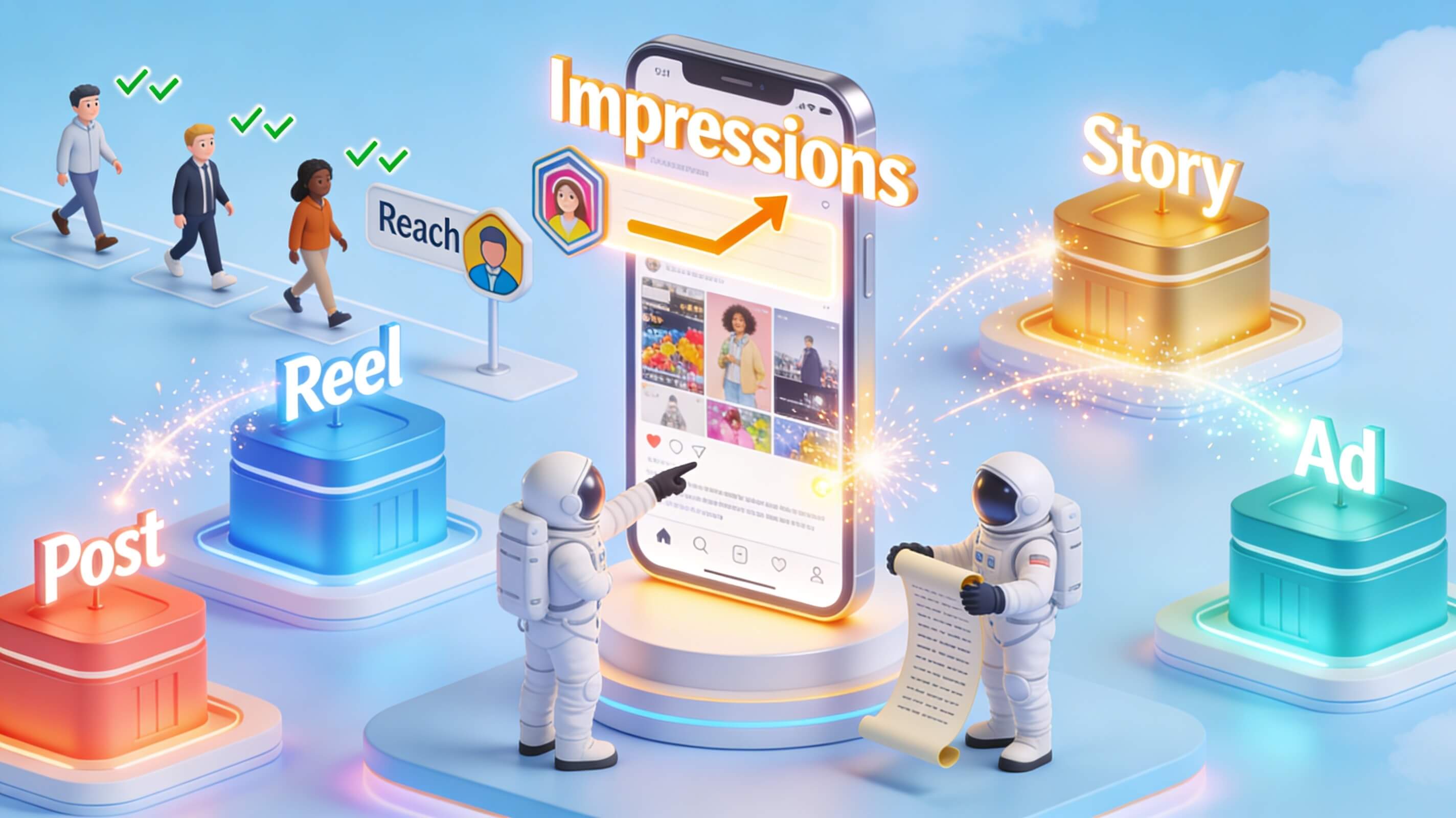
To fully grasp what does impression mean on Instagram today, you must first understand its historical context. For years, Instagram impressions counted every single time your content appeared on a user’s screen, regardless of whether they engaged with it or even noticed it. If one person scrolled past your post three times, that registered as three impressions. This metric was useful for gauging raw visibility but often inflated the perception of success because it didn’t differentiate between a quick scroll-by and a meaningful view.
In April 2025, Instagram officially deprecated Impressions and rolled out Views as the standardized metric. This change was applied retroactively to all data from January 1, 2025 onward. The key difference? Views are calculated more consistently across all content types. For example, a Reel that previously registered 1,000 Impressions might now show 1,500 Views because the new metric includes replays and autoplays in a more uniform way. According to Later’s coverage of the update, Reels saw a 50% increase in reported numbers, while carousel posts jumped 44%. This shift means that legacy data (before January 2025) still uses the term “Impressions,” while newer data uses “Views.” When you analyze your Instagram analytics over time, you’ll see a clear break point—data before 2025 appears as Impressions, and everything after appears as Views.
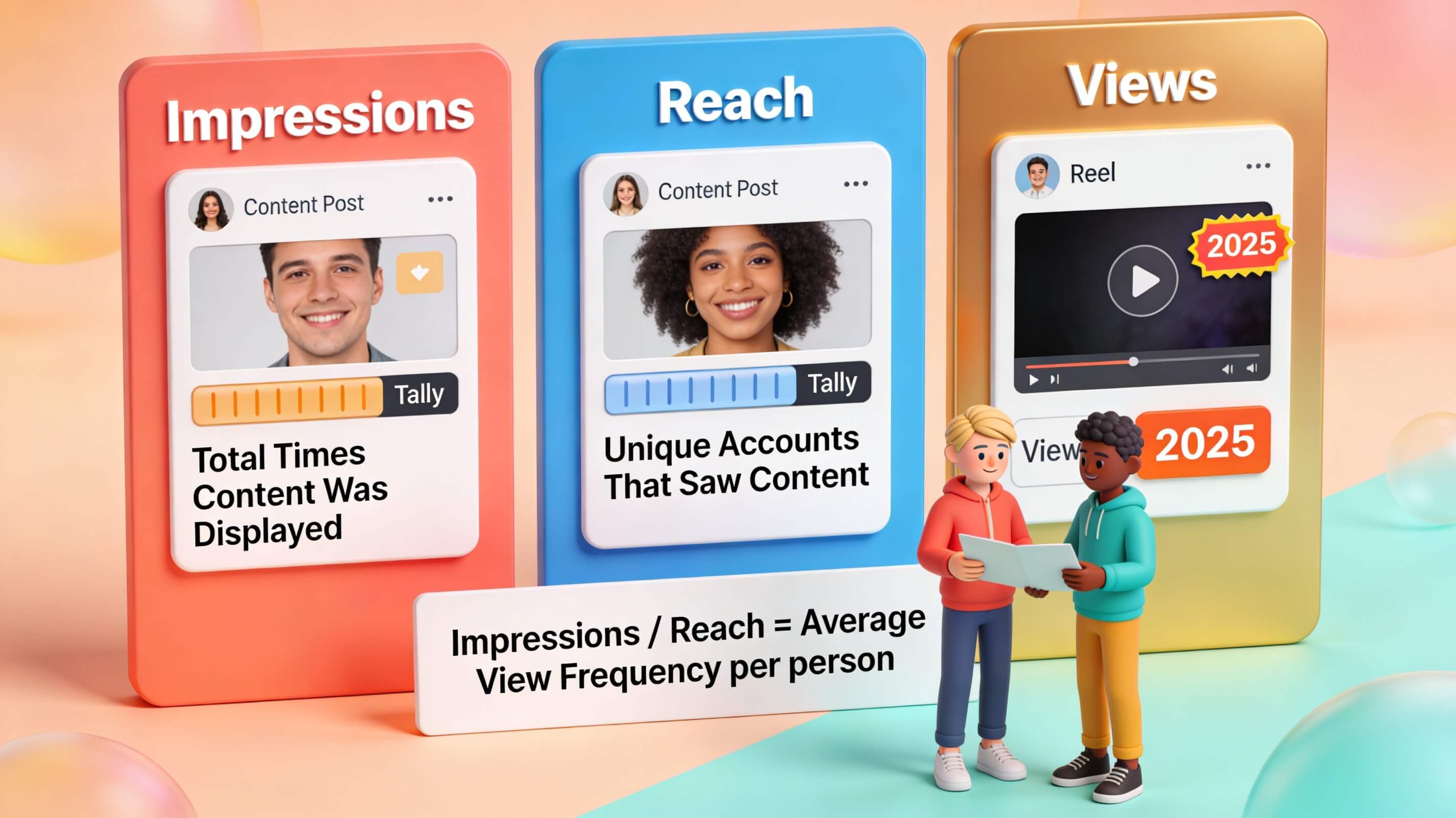
This evolution reflects Instagram’s broader goal: measuring content consumption, not just exposure. The old Impressions metric could be inflated by passive scrolling, but Views aim to capture instances where content is actually displayed and played, including repeat views. For anyone asking what does impression mean on Instagram in 2026, the accurate answer is that the term has been replaced, but the concept of tracking visibility lives on through Views. Understanding this history is crucial for interpreting your Instagram insights correctly, especially if you’re comparing performance across years.
Why Instagram Analytics Matters More Than Ever
Knowing what does impression mean on Instagram is just the starting point. The real power lies in using Instagram analytics to make strategic decisions that drive engagement, reach, and follower growth. In a crowded platform where millions of posts compete for attention, data is your compass. Instagram insights provide a dashboard of metrics that reveal not just how many people saw your content, but how they interacted with it, when they were most active, and which formats resonated most deeply.
Consider this: A post with 10,000 Views but only 2,000 Reach tells a very different story than one with 10,000 Views and 8,000 Reach. The first scenario suggests your existing audience is rewatching your content multiple times—a sign of strong loyalty and stickiness. The second scenario indicates your content is reaching many new people, signaling effective algorithmic distribution. Both are valuable, but they require different strategic responses. By analyzing these relationships within your Instagram insights, you can identify whether your content is deepening connections with existing followers or expanding your audience footprint.
Instagram analytics also break down performance by content type. Reels, for instance, are prioritized in the 2025+ algorithm for driving views and reach, often outperforming static posts by 3–5x. Stories, on the other hand, typically reach 60–80% of your followers but rarely extend to non-followers. By tracking which formats generate the highest views, engagement, and reach, you can allocate your creation effort where it yields the best return. A Sprout Social report found that brands using data-driven content strategies see 2.5x higher engagement rates than those posting on intuition alone. This is why mastering Instagram insights isn’t optional—it’s essential for growth.
Key Metrics You Must Monitor in Instagram Insights
Beyond understanding what does impression mean on Instagram, you need to track a suite of metrics that work together to tell your content’s full performance story. Instagram insights offers several critical data points, and interpreting them in relation to each other is where the magic happens. Here are the metrics you should monitor regularly:
- Views (Total Content Impressions): This is your primary visibility metric post-April 2025. It counts every time your content is displayed or played, including repeat views. A high View count indicates broad circulation.
- Reach (Accounts Reached): This measures unique accounts that saw your content at least once. High Reach with moderate Views suggests new audience discovery, while low Reach with high Views indicates strong follower loyalty.
- Engagement: The sum of likes, comments, saves, and shares. This shows how your audience interacts with your content, not just views it. Saves and shares are particularly valuable because they signal deep interest.
- Engagement Rate: Calculated as (Engagements / Views) × 100. This percentage tells you what portion of viewers actually interacted. Because Views are now higher than old Impressions, expect your engagement rate to be 20–30% lower than historical benchmarks.
- Follower Growth: Net followers gained over a period. This metric shows whether your content strategy is converting viewers into long-term followers. High Views with low follower growth may indicate content that entertains but doesn’t build community.
- Profile Visits: How many accounts clicked to visit your full profile. This indicates interest beyond a single post—a strong signal for potential conversions or follow-through.
- Saves: The most valuable engagement signal in 2026. When users save your content, they’re bookmarking it for future reference, which the algorithm interprets as high-quality and relevant.
By examining these metrics together through your Instagram analytics, you can identify which content resonates deepest with your audience and attracts new followers most effectively. For example, if a post has high Views but low Saves, it might be entertaining but not valuable enough to revisit. Conversely, high Saves with moderate Views suggests your existing audience deeply values your content, and you should double down on that topic or format.
Measuring Instagram Impressions: Reach and Visibility Explained
When you’re analyzing what does impression mean on Instagram in practical terms, you need to access your Instagram insights directly. For business and creator accounts, detailed metrics are available in the app. Navigate to your profile, tap the menu icon, select “Insights,” and choose “Total” to see aggregated performance, or select specific posts to view their individual metrics. The Views metric appears in several key reports: the Posts summary shows Views for each post, Stories analytics displays Views for each Story episode, and Reels provide comprehensive view data including watch time and replay metrics.
Instagram analytics also breaks down Views between organic (unpaid) and paid (promotional) sources. This breakdown helps you understand how much of your reach comes from algorithmic distribution versus paid promotion. If your organic Views are low but paid Views are high, your content may not be resonating naturally, and you need to revisit your content strategy rather than just increasing ad spend. A Buffer guide on Instagram insights emphasizes that organic reach is the truest measure of content quality because it depends on algorithmic favor without financial intervention.
Several factors influence your View count and overall visibility. Content quality is paramount—high-resolution visuals, engaging Reels, and well-composed images consistently generate higher Views. Posting time also matters; sharing when your audience is most active ensures immediate engagement, which signals quality to the algorithm. Hashtag strategy plays a role too—using 3–5 relevant tags helps your content appear in hashtag searches and Explore recommendations. Watch time is the dominant factor for Reels and videos; the longer users stay, the more the algorithm pushes your content to new audiences. Finally, your follower base size provides a baseline, but engagement rate matters more for algorithmic reach than raw follower count. A small account with a 10% engagement rate can outperform a large account with a 0.5% rate in terms of Views.
Interpreting Instagram Insights Metrics Correctly
Reading your Instagram insights requires understanding the relationships between metrics, not just looking at individual numbers. A post with 5,000 Views and 3,000 Reach means the average viewer saw your content 1.67 times, suggesting some rewatch value. This could indicate content that’s worth revisiting—like a tutorial or a visually stunning Reel. Conversely, 5,000 Views with 4,800 Reach means each person viewed it once, indicating successful audience expansion but potentially lower content “stickiness.” Both scenarios are valuable, but they require different strategic responses.
Here’s a practical framework for interpreting metric ratios:
- High Views : Low Reach: Your existing audience is rewatching your content multiple times. This indicates strong loyalty and high-quality content that resonates deeply. Double down on similar themes and formats.
- High Views : High Reach: New audiences are discovering your content and viewing it once. This signals effective algorithmic distribution. Create more content in this style to attract followers.
- Low Views : Low Reach: Poor algorithmic performance or low audience activity. Review your content quality, posting time, hashtag strategy, and engagement signals. Experiment with different formats.
- Views > Reach by 2x+: Your content is highly compelling to existing followers, encouraging repeated viewing. Build on this content pillar and repurpose it for other formats like Stories or carousels.
Understanding these relationship patterns within your Instagram analytics transforms raw numbers into actionable intelligence. A Social Media Examiner article on Instagram insights stresses that the most successful creators don’t just track metrics—they analyze them in context. For example, a drop in Reach might be alarming, but if Views remain stable, it could mean your content is deepening engagement with your core audience rather than expanding outward. This nuanced interpretation is what separates data-informed strategies from guesswork.
Understanding Instagram Reach: Unique Viewers vs. Total Impressions
Clarifying the distinction between Instagram Reach and what does impression mean on Instagram (now Views) is crucial for proper analytics interpretation. While Views count total content displays including repeats, Reach measures something fundamentally different: the number of unique accounts that saw your content at least once. This distinction dramatically impacts how you evaluate performance. For example, a post with 10,000 Views and 7,000 Reach means 7,000 unique accounts saw your content, but collectively they viewed it 10,000 times—an average of 1.43 views per person. This high rewatch ratio indicates compelling content that encourages repeated viewing. Conversely, 10,000 Views with 9,500 Reach means almost everyone viewed it once, suggesting wide distribution but less compelling stickiness.
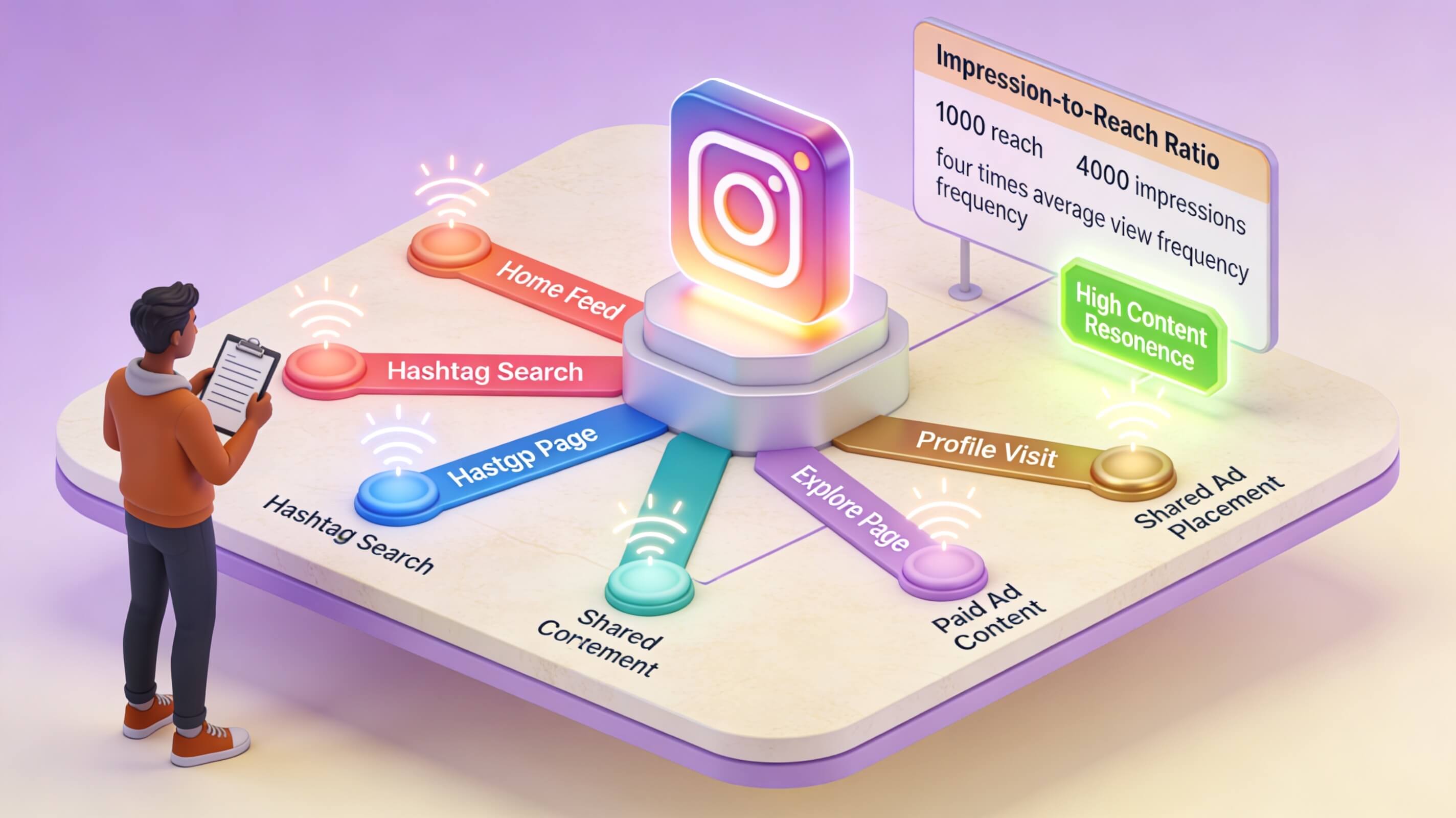
Instagram Reach is more valuable for understanding audience expansion, while Views measure content stickiness and algorithm favorability. Both metrics are essential for gauging content effectiveness. High Reach with low engagement indicates wide distribution but weak connection—your content is seen but not acted upon. High engagement with moderate Reach suggests strong content quality but limited algorithmic push—your audience loves it, but the platform isn’t showing it to new people. A WordStream comparison of Reach vs. Impressions highlights that for growth-focused accounts, Reach should be a primary KPI because it directly correlates with new audience acquisition.
Reach varies significantly by content format due to different algorithmic prioritization in 2026. Stories typically reach 60–80% of followers but rarely extend to non-followers. Regular Posts might reach 3–10% of followers unless they go viral. Reels consistently achieve 20–40% reach beyond followers due to algorithm prioritization. Carousel posts often outperform single images due to higher dwell time, which signals quality to the algorithm. Understanding these format-specific Reach patterns within your Instagram analytics helps you allocate content creation effort strategically, focusing on formats that align with your growth and engagement goals.
Enhancing Your Instagram Engagement Rate: Beyond Views and Reach
While understanding what does impression mean on Instagram provides visibility metrics, your Instagram engagement rate reveals content quality and audience connection. The engagement rate calculation shifted in April 2025: previously calculated as (Engagements / Impressions) × 100, it now uses Views: (Engagements / Views) × 100. This change typically results in lower engagement rates because Views are higher than old Impressions, but it provides consistency across content types. A strong engagement rate varies by account size and niche. General benchmarks based on the new Views metric include: accounts with 1,000–5,000 followers average 3.8–4.8% ER, 20,000–100,000 followers average 0.9–1.2% ER, and 100,000+ followers average 0.7–1.0% ER. These are lower than historical benchmarks, so don’t panic if your numbers dropped—they’re now more accurate.
Improving your engagement rate requires creating content that compels interaction, not just passive viewing. In 2026, Instagram’s algorithm prioritizes watch time, saves, and meaningful comments over simple likes. Implementing these strategies can significantly improve your engagement metrics:
- Create High-Value Content: Share content that educates, entertains, or solves problems. Users save valuable content for future reference, signaling quality to the algorithm. Tutorials, checklists, and insightful quotes perform well.
- Craft Compelling Captions: Write captions that ask questions, invite discussion, or provide context that enhances content value. Well-written captions increase comment volume and quality. For example, instead of “Great day at the beach,” try “What’s your go-to beach activity? I’m partial to reading a good book.”
- Use Call-to-Action Elements: Explicitly ask followers to like, comment, save, or share. Calls-to-action significantly increase engagement rates when used authentically. Phrases like “Save this for later” or “Share with a friend who needs this” work well.
- Respond to Every Comment: Quick responses to comments (within 1 hour) signal engagement, encourage follow-up discussion, and show followers that interaction matters. This also boosts your comment count, which the algorithm notices.
- Leverage Interactive Features: Use Reels with polls, Questions stickers in Stories, carousels that encourage swiping, and other interactive elements that boost engagement signals. These features increase dwell time and interaction rates.
- Post When Audience is Active: General optimal times are weekdays 11 AM–1 PM and 7 PM–9 PM, weekends 10 AM–12 PM and 6 PM–8 PM. However, your specific audience may differ—check your Instagram insights for your followers’ most active hours.
- Encourage Saves and Shares: Saves and especially DM shares are the strongest engagement signals in 2026’s algorithm. Create content worth saving and sharing with friends, such as actionable tips, relatable humor, or thought-provoking questions.
By systematically implementing these engagement-boosting strategies, you’ll see higher engagement rates even as your Views scale, indicating increasingly valuable audience interactions. A Later guide on engagement rate emphasizes that quality of engagement matters more than quantity—100 meaningful comments are worth more than 1,000 passive likes.
Maximizing Instagram Insights for Strategy Improvements
Transforming your Instagram insights from data into actionable strategy requires systematic analysis and experimentation. The goal isn’t simply to understand what does impression mean on Instagram, but to leverage that understanding alongside all other metrics to continuously improve performance. Here’s how to maximize the value you extract from your Instagram analytics:
Systematic Performance Analysis Process: Every two weeks, dedicate time to reviewing your Instagram insights across your recent posts. Export data from your analytics dashboard or take screenshots of key metrics. Organize posts by content format, topic, posting time, and hashtag strategy. Calculate average Views, Reach, and Engagement Rate for each category. Identify which variables correlate with highest performance. For example, if Reels posted at 8 PM consistently outperform those posted at noon, adjust your schedule accordingly. If carousel posts about industry trends get 3x more Saves than single images, prioritize that format.
Data-Driven Experimentation Framework: Use your Instagram analytics to test hypotheses systematically. For two weeks, try a specific change—perhaps different content formats, new hashtag combinations, altered posting times, or updated caption styles. Track the metric impact. Return to your previous approach for two weeks to establish whether the change caused improvement or if it was coincidence. Only adopt changes that show consistent, measurable improvement. For example, test whether longer captions (150+ words) or shorter captions (under 50 words) drive higher engagement rates for your audience. Run each version for two weeks and compare the results.
By treating your Instagram insights as a continuous experiment, you’ll steadily optimize each aspect of your strategy based on data rather than guesswork. A HubSpot marketing statistics report found that companies using data-driven content strategies see 6x higher conversion rates than those that don’t. This applies directly to Instagram—every post is an opportunity to learn and refine.
The Impact of the Instagram Algorithm on Your Metrics
Understanding the Instagram algorithm is essential for interpreting your Instagram insights and maximizing what does impression mean on Instagram in today’s environment. The algorithm doesn’t value all content equally; it prioritizes based on signals that indicate engagement quality, watch time, and shareability. In 2026, the algorithm has evolved significantly from previous years, placing emphasis on metrics beyond what your Instagram analytics explicitly displays.
According to Meta’s official guidance, the 2026 algorithm prioritizes watch time, saves, shares, and DM sends as key ranking signals. Likes, historically important, have become the weakest engagement signal. This represents a fundamental shift in what metrics matter for algorithmic reach. The algorithm operates differently across Instagram’s surfaces: the Feed algorithm prioritizes content from accounts you regularly interact with and content similar to what you’ve engaged with before. Stories prioritize accounts you watch most frequently. Explore prioritizes saved and shared content with high engagement metrics. Reels receive special algorithmic priority, with watch time being the dominant factor.
Key algorithm signals and their importance in 2026 include:
| Algorithm Signal | Importance Level (2026) | How It Impacts Views | How to Optimize |
|---|---|---|---|
| Watch Time (Reels/Videos) | Critical | Higher watch time = exponential reach boost | Hook in first 3 seconds, maintain engagement throughout |
| Saves | High | Strong signal for algorithmic distribution | Create bookmarkable, valuable content users reference later |
| DM Shares | Highest | Most powerful reach signal | Create highly shareable, conversation-starting content |
| Comments (Meaningful) | High | Deep conversation signals quality | Write captions that invite discussion, respond thoughtfully |
| Likes | Low | Minimal reach impact alone | Don’t optimize solely for likes; focus on deeper engagement |
| Shares | High | Content reposting extends reach significantly | Make content worth sharing publicly, not just DM sharing |
| Relationship Strength | High | Feed shows content from people you interact with most | Engage consistently with target audience accounts |
| Content Recency | Medium | Recent posts prioritized initially | Post regularly and consistently for algorithmic fairness |
Understanding these algorithm signals explains why your Instagram insights show the Views they do. Posts with high Saves and Shares but moderate Likes are favored by the algorithm and receive more Views than posts with many Likes but few Saves. This disconnect between visible metrics and algorithm success confuses many creators who still optimize for Likes. Adapting your strategy to these algorithm realities means optimizing content for: (1) watch time through compelling visuals and pacing, (2) saveability by providing value users want to reference, (3) shareability by creating conversation-starting or valuable content, and (4) engagement depth through meaningful captions and response to comments.
Conclusion
Answering what does impression mean on Instagram in 2026 requires understanding both historical context and current reality. While Instagram Impressions have been replaced by Views as of April 2025, the concept remains central to measuring content visibility. The key evolution is that Views provide more consistent, standardized measurement across all content types, and they’re calculated higher than legacy Impressions, requiring updated benchmarks. This shift reflects Instagram’s broader move toward measuring actual consumption rather than passive exposure.
Beyond simply understanding metrics, leveraging your Instagram analytics and Instagram insights strategically determines your success on the platform. By systematically analyzing Views alongside Reach, Engagement Rate, Saves, and Shares, you identify what resonates with your audience and what the algorithm favors. By understanding how the 2026 algorithm prioritizes watch time, saves, and meaningful engagement over simple likes, you can refine your content strategy to align with how Instagram actually distributes content.
The most successful accounts treat Instagram analytics not as a reporting tool but as a strategic guide that informs every content decision. Regular analysis, systematic experimentation, and algorithm-aware optimization transform raw data into audience growth and engagement. Start analyzing your metrics today, implement the strategies outlined in this guide, and watch your Instagram presence strengthen with data-driven improvements.