Cart 0

Share
Table of Contents
SEO and User Experience: Bridging the Gap for Digital Success
The most critical alliance for any website seeking sustainable growth is the one between search engine optimization and user experience. The modern digital landscape demands more than just visibility; it demands a website that is both found and favored. True digital success is achieved not by prioritizing one over the other, but by strategically integrating SEO and UX into a cohesive, high-performing whole. A site that ranks well but frustrates visitors will fail to convert, just as a beautiful, intuitive site that remains invisible will never attract an audience. This article will dissect this symbiotic relationship, providing a comprehensive framework to bridge the gap between technical optimization and human-centric design for measurable, long-term results. We will explore how aligning SEO and UX creates a powerful feedback loop where improved user signals directly boost search rankings, and higher rankings bring more users who experience a well-crafted journey. By the end, you will have a practical roadmap to transform your website into an asset that satisfies both algorithms and real people, driving traffic, engagement, and conversions simultaneously.

The Inseparable Link: Why SEO and UX Are a Unified Strategy
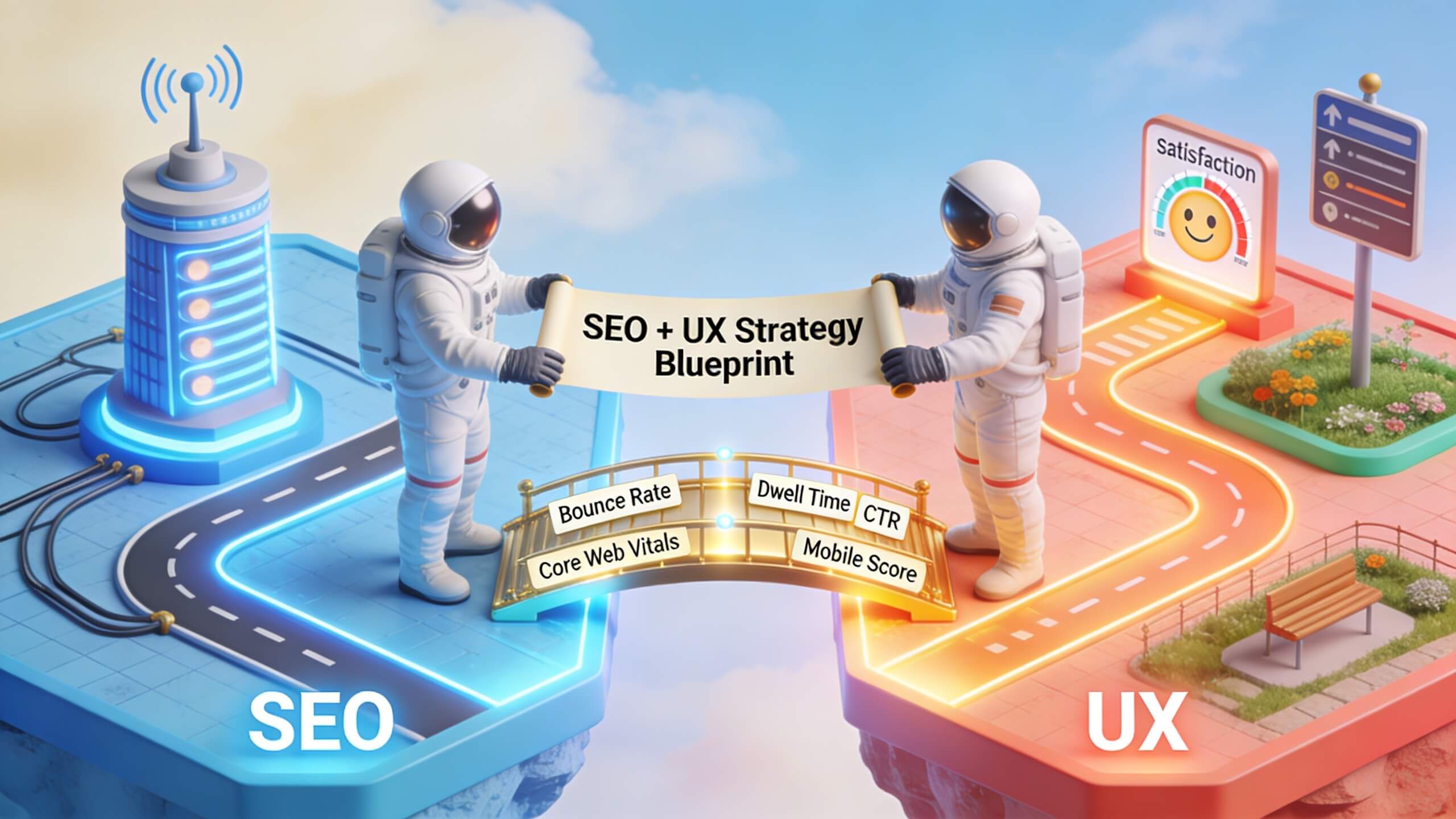
The traditional view of SEO as a purely technical, back-end function is obsolete. Today, Google’s core algorithms are fundamentally designed to reward positive user experiences. Metrics like Core Web Vitals—which quantify loading performance, interactivity, and visual stability—are direct SEO ranking factors. When you optimize for a faster, more responsive site, you are simultaneously executing a critical SEO task. Furthermore, user behavior signals, such as low bounce rates, high dwell time, and strong engagement, send powerful positive cues to search engines about your content’s relevance and quality. A study by Google consistently shows that pages meeting user intent rank better and retain traffic more effectively. Therefore, integrating SEO and UX is not a choice; it is a prerequisite for building a trustworthy, authoritative online presence that both algorithms and humans reward. This unified approach means every design decision, from button placement to font size, has SEO implications, and every SEO tactic, from keyword placement to internal linking, must consider the user’s experience. The gap between these disciplines is an illusion; they are two sides of the same coin, and treating them as separate silos is the fastest path to digital mediocrity.
Consider the concept of dwell time. If a user clicks on your search result but immediately bounces back to the SERP because the page loads slowly or the content is hard to read, that signals to Google that your page is not a good answer. Conversely, if a user stays on your page for three minutes, scrolling through a well-structured article with clear headings and engaging visuals, that tells the algorithm your content is valuable. This behavioral data is now a cornerstone of modern search evaluation. The synergy is clear: great SEO brings users to the door, but great UX invites them in and makes them stay. Without this integration, you are either building a beautiful storefront in a deserted alley or a cluttered shop on a busy street that no one wants to enter. The only winning strategy is to build the storefront on the busiest street and make it so inviting that everyone wants to explore.
Foundations of a User-Centric SEO Strategy
Building a website that satisfies both search engines and users requires a foundational strategy built on two pillars: intelligent keyword alignment and principled information architecture. The goal is to create a seamless journey from search query to satisfied user. This foundation is not about quick wins or hacks; it is about establishing a structural integrity that supports long-term growth. Every page, every link, and every category must serve a dual purpose: helping a human find what they need and helping a crawler understand what the page is about. When these two objectives are in harmony, the site becomes a well-oiled machine for discovery and satisfaction.
Keyword Research as a UX Tool
Effective keyword research transcends finding high-volume terms. It is the process of uncovering user intent—the “why” behind the search. Tools like Ahrefs or Moz are invaluable, but the insight comes from categorizing keywords by intent: informational (seeking knowledge), navigational (looking for a specific site), or transactional (ready to buy). Your content and site structure must then be crafted to fulfill that intent immediately. A page targeting “best running shoes for flat feet” must provide detailed, comparative advice, not just a sales pitch. This alignment is the first and most crucial step in the SEO and user experience integration process. When you understand intent, you can design the user journey from the search result snippet all the way to the conversion point. For example, if someone searches “how to fix a leaky faucet,” they want a step-by-step guide with clear instructions, not a list of plumbers. If your page delivers exactly that, the user stays, engages, and trusts your site. This trust transfers to other content on your domain, building a relationship that transcends a single visit. Intent-based keyword research is essentially user experience research disguised as SEO.
Architecting for Humans and Crawlers
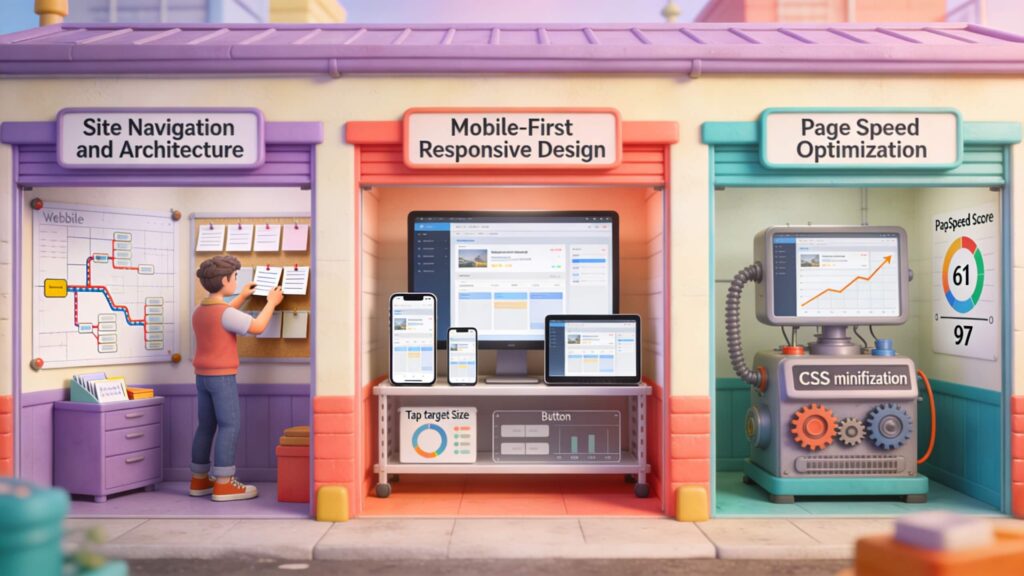
A logical, hierarchical site structure is the skeleton of good UX and SEO. Clear, broad categories that funnel down to specific topics (using a /category/subcategory/page structure) help users navigate intuitively and help search engines understand your site’s topical focus. This is complemented by a meticulous internal linking strategy. Silo architecture, where related content is interlinked within a topical cluster, distributes page authority (PageRank) throughout your site and keeps users engaged in a relevant content ecosystem. A flat, disorganized site forces both users and Googlebot to work harder, inevitably harming engagement and crawl efficiency. Think of your site architecture as a library. A good librarian organizes books by genre and author, with clear signage and a logical layout. A bad librarian just piles books randomly on shelves. Users and crawlers are like library visitors; they need a clear path to find what they are looking for. A well-structured site reduces cognitive load for users, making navigation feel effortless. For crawlers, it ensures that every important page is just a few clicks from the homepage, maximizing crawl budget and indexing efficiency. This dual benefit is why information architecture is the unsung hero of integrated SEO and UX.
On-Page Elements Where SEO and UX Converge
The page-level is where the integration of technical SEO and thoughtful design becomes most tangible. Every element must serve a dual purpose. From the title tag to the footer, each component should be optimized for both human readability and machine interpretation. This convergence is not about compromise; it is about finding the sweet spot where the needs of both audiences align perfectly. When done right, the page becomes a seamless experience that feels natural to the user while being perfectly understandable to search engines.
Content That Engages and Ranks
High-quality content is the cornerstone. It must be comprehensive, answering not just the primary query but related questions (addressing semantic search), while being presented for effortless consumption. This means using descriptive headers (H1, H2, H3) to create a clear content outline, integrating relevant keywords naturally, and employing multimedia like images and videos with optimized alt text. Readability is paramount; use short paragraphs, bullet points for scannability, and a confident, accessible tone. Content that is valuable, readable, and well-structured satisfies user intent and establishes topical authority for SEO. However, depth does not mean complexity. The best content makes complex topics simple. A user landing on a page about “quantum computing” should not need a PhD to understand it. Use analogies, examples, and clear explanations. This approach reduces bounce rates and increases dwell time, both of which are strong SEO signals. Moreover, comprehensive content naturally attracts backlinks, further boosting authority. The content creation process should always start with the question: “What does the user need to know?” and then answer it thoroughly, using keywords as a guide, not a constraint.
Technical Performance as a UX Imperative
Page speed is a direct ranking factor and the most immediate UX touchpoint. A delay of even a few seconds dramatically increases bounce rates. Optimization involves compressing images (using next-gen formats like WebP), minifying CSS and JavaScript, leveraging browser caching, and using a Content Delivery Network (CDN). Mobile optimization is non-negotiable; with mobile-first indexing, your site’s mobile version is the benchmark. A responsive design that offers flawless functionality and readability on any device is essential for both SEO and user experience success. Beyond speed, technical performance includes aspects like Cumulative Layout Shift (CLS). Imagine reading an article on your phone, and suddenly the text jumps down because an ad loads above it. That is a poor UX and a direct negative ranking signal. Ensuring visual stability, fast interactivity (First Input Delay), and quick loading (Largest Contentful Paint) creates a frictionless experience. Users do not consciously notice good performance, but they immediately feel bad performance. A technically sound site builds trust subconsciously, while a slow or janky site erodes it. This is why technical SEO is no longer a separate discipline; it is the engineering backbone of user experience.
| SEO Element | Primary SEO Goal | Direct UX Impact | Integration Action |
|---|---|---|---|
| Page Title & Meta Description | Click-through rate from SERPs | Sets accurate expectation, acts as a value proposition | Write compelling, benefit-driven snippets that match page content. |
| Header Tags (H1, H2, etc.) | Content structure for crawlers | Provides visual hierarchy and scannability for readers | Use descriptive, keyword-informed headers that guide the reading journey. |
| Image Alt Text | Context for image search & accessibility | Describes images for visually impaired users | Write concise, accurate descriptions that include context if relevant. |
| Internal Linking | Distributes authority, aids crawling | Guides users to related, valuable content | Link contextually to relevant cornerstone pages within your content. |
| URL Structure | Clear topic signaling | Creates clean, readable, and memorable paths | Use descriptive, keyword-inclusive slugs (e.g., /guide/on-page-seo). |
Optimizing for Engagement and Conversion
A website that is found and enjoyed must also guide users toward a goal. This is where UX design principles directly influence SEO outcomes by improving critical behavioral metrics. Engagement is not just about keeping users on the page; it is about moving them through a journey that ends in a desired action, whether that is a purchase, a sign-up, or a download. Conversion rate optimization (CRO) and SEO are deeply intertwined because a page that converts well signals value to both users and search engines. High conversion rates often correlate with low bounce rates and high session durations, creating a virtuous cycle of positive signals.
Intuitive Navigation and Journey Mapping
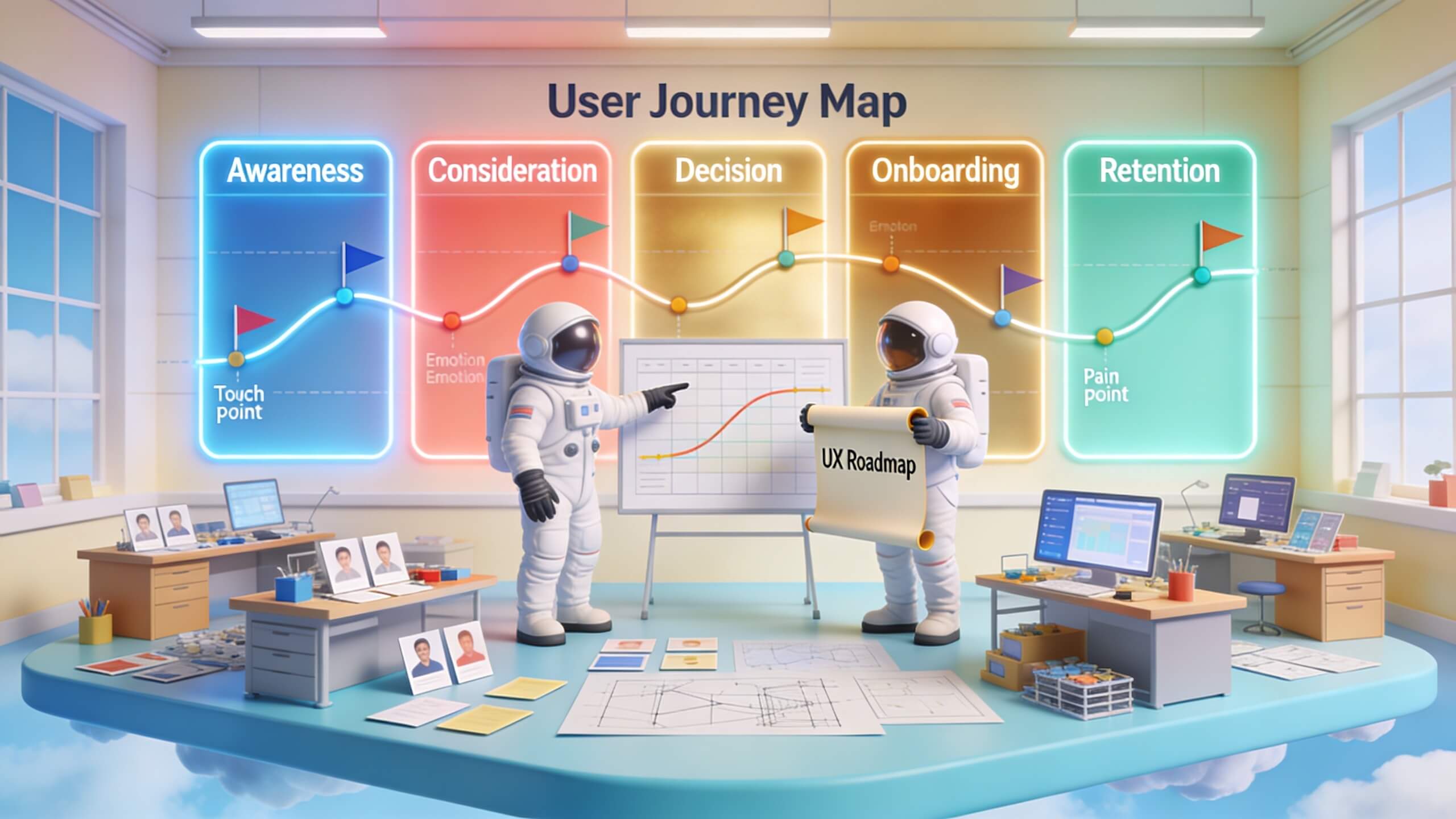
Users should never have to guess how to find information. A clean, consistent navigation menu with logical labels is vital. Implement breadcrumb trails to provide context and an easy backward path. More importantly, design key user journeys. Map the ideal path from a blog post to a product page, or from a service description to a contact form. Use clear, action-oriented calls-to-action (CTAs) at strategic points to facilitate these journeys. A seamless flow reduces friction, increases time on site, and improves the likelihood of conversion—all positive signals for SEO. Consider the “three-click rule”: users should be able to find any piece of information within three clicks. While not a hard rule, it underscores the importance of reducing navigation friction. Journey mapping is a UX technique that involves visualizing the steps a user takes to achieve a goal. When applied to SEO, it helps you identify which pages to optimize for which keywords and how to link them together. For example, a user searching “best CRM for small business” might start on a comparison blog post, then click to a features page, then to a pricing page, and finally to a sign-up form. Optimizing this flow with clear CTAs and relevant internal links ensures the user moves smoothly through the funnel, increasing the chances of conversion while keeping them engaged with your site.
Building Trust Through Design and Social Proof
User experience is deeply tied to trust. A professional, aesthetically pleasing design establishes credibility. Incorporating trust signals like client logos, customer testimonials, case studies, and security badges (SSL certificates) reduces user anxiety. For content-heavy or commercial sites, ensuring forms are simple and privacy policies are clear is crucial. Google’s E-E-A-T (Experience, Expertise, Authoritativeness, Trustworthiness) guidelines emphasize these very factors. By building a trustworthy environment, you enhance user satisfaction and align with the qualitative metrics search engines use to assess quality. Trust is not built overnight, but it can be destroyed in seconds. A single broken link, a confusing checkout process, or a lack of contact information can make a user leave forever. Design elements like consistent typography, harmonious color schemes, and intuitive layouts create a sense of professionalism that instills confidence. Social proof, such as displaying the number of subscribers, recent purchases, or positive reviews, leverages the bandwagon effect to reassure new visitors. When users trust your site, they stay longer, explore more pages, and are more likely to convert. This behavioral data translates directly into improved SEO metrics, creating a feedback loop where trust fuels visibility, and visibility fuels more trust.
Measuring the Integrated Performance
You cannot improve what you do not measure. The success of your integrated SEO and user experience strategy must be tracked through a blended dashboard of metrics. Key performance indicators should include traditional SEO metrics like organic traffic, keyword rankings, and crawl errors, alongside UX-centric metrics like bounce rate, average session duration, pages per session, and conversion rate. Tools like Google Analytics 4 and Search Console are indispensable. Pay particular attention to page-level data in GA4; a page with high traffic but a 90% bounce rate indicates a severe intent mismatch or poor user experience despite good SEO. Conversely, use heatmapping tools like Hotjar to visualize user behavior—where they click, scroll, and stall—providing qualitative insight to explain the quantitative data. The key is to correlate UX data with SEO data. For example, if you see a drop in rankings for a specific page, check its Core Web Vitals. If the LCP has degraded, that is likely the cause. Similarly, if a page has great rankings but low conversion rates, use heatmaps to see if users are getting stuck at a certain point. This integrated analysis reveals the true health of your digital presence, beyond vanity metrics like traffic alone. A page with high traffic and high engagement is a winner; a page with high traffic and low engagement is a leak in your funnel that needs immediate attention.

Overcoming Common Integration Pitfalls
Even with the best intentions, challenges arise. Recognizing and navigating these is key to a successful strategy. A major pitfall is keyword stuffing at the expense of readability. The solution is to write for the user first, then integrate keywords naturally as if explaining the topic to a colleague. Another challenge is the tension between rich, engaging media (which can slow pages) and speed requirements. The fix is technical optimization: lazy loading videos, using modern image formats, and serving scaled images. Finally, avoid creating content purely for SEO that offers no real user value. This “thin content” is increasingly penalized by algorithms and ignored by users. Every page should have a clear purpose for a human visitor. As highlighted by the Nielsen Norman Group, usability heuristics must be the foundation upon which SEO tactics are applied, not an afterthought. A common mistake is focusing on one discipline at the expense of the other. For instance, an SEO specialist might add dozens of internal links to a page without considering whether they are helpful to the user, creating a cluttered, confusing experience. Conversely, a UX designer might remove all links from a page to create a clean design, hurting crawlability and authority distribution. The solution is cross-functional collaboration. SEOs need to understand design principles, and designers need to understand search mechanics. Regular meetings, shared KPIs, and collaborative tools can bridge this gap. Another pitfall is ignoring mobile UX. With mobile-first indexing, a desktop-only optimized site is invisible to most users. Prioritize mobile design from the start, ensuring touch targets are large enough, text is readable without zooming, and navigation is thumb-friendly. These small details make a massive difference in both UX and SEO performance.
Sustaining Success: Adaptation and Continuous Improvement
The digital ecosystem is not static. Search algorithms evolve, user expectations rise, and competitors adapt. A successful integration of SEO and user experience demands a commitment to continuous learning and iteration. Stay informed on core algorithm updates from Google and industry trends through reputable sources like Search Engine Land. Regularly conduct site audits using tools like Screaming Frog to identify technical regressions. Most importantly, actively seek user feedback through surveys, usability testing, and analyzing support queries. This real-world data is invaluable for uncovering UX pain points that analytics alone might miss. Treat your website as a living product, not a finished project, and prioritize iterative enhancements based on performance data and user input. For example, if user feedback reveals that a checkout process is confusing, that is a UX problem that also impacts conversion rate and, indirectly, SEO (through reduced engagement signals). Fixing it improves both. Similarly, if an algorithm update penalizes thin content, a review of your content library might reveal dozens of pages that need to be expanded or consolidated. This continuous improvement cycle is not a one-time project; it is an ongoing operational process. Set aside time each month for a performance review, looking at both SEO and UX metrics. A/B test changes to navigation, CTAs, and page layouts. Monitor the impact on rankings and user behavior. This data-driven approach ensures that your site remains competitive and user-friendly, adapting to changes in the digital landscape rather than reacting to them after the fact. The most successful websites are those that treat optimization as a perpetual journey, not a destination.
Conclusion
The pursuit of digital success is no longer a choice between optimizing for machines or designing for people. The most effective, resilient, and competitive websites are those that master the synergy between SEO and user experience. This integration transforms your site from a static digital brochure into a dynamic, high-performance asset. It begins with understanding user intent, is built upon a foundation of technical excellence and intuitive architecture, and is sustained by creating genuinely valuable content and seamless user journeys. By consistently measuring performance with a blended lens and committing to ongoing refinement, you build a site that earns top rankings while fostering loyalty and driving conversions. The gap between SEO and UX is not a chasm to be leaped occasionally, but a space to be bridged permanently with every design decision, content update, and technical adjustment. Now is the time to take action. Start by auditing your site’s Core Web Vitals, reviewing your site architecture for logical flow, and analyzing user behavior data to identify friction points. If this process feels overwhelming, our team of seasoned digital strategists can help you build a comprehensive integration plan tailored to your business goals. Contact us today for a free consultation and discover how bridging the gap between SEO and UX can unlock your website’s full potential. Your users—and your search rankings—will thank you for it.