
Cart 0


Share
Table of Contents
Competitor Keywords: Unveiling Strategies for SEO Success
If your search rankings have plateaued or your organic traffic is declining despite consistent content production, the problem likely isn’t your effort—it’s your perspective. You’ve been looking inward when you should be looking outward. Mastering competitor keywords is the single most effective way to break through stagnation and claim market share from established players. This isn’t about copying what others do; it’s about understanding the battlefield so thoroughly that you can identify weaknesses, exploit gaps, and build a strategy that systematically outperforms every other site in your niche. In this comprehensive guide, we will move past generic advice and deliver a tactical, data-driven blueprint used by top SEO professionals. You will learn how to identify your true SERP competitors, extract their most valuable keyword assets, and deploy those insights to construct a dominant SEO strategy that converts intelligence into measurable business growth. By the end, you will have a repeatable process for turning competitor analysis into your greatest competitive advantage.
The Foundational Role of Competitor Analysis in SEO
Think of competitor analysis not as corporate espionage but as essential market reconnaissance. In the context of SEO, this analysis provides directional intelligence that raw keyword volume data alone cannot offer. You might identify a high-volume keyword with 10,000 monthly searches, but if three industry titans have monolithic content and vast link profiles targeting that exact term, your chance of ranking on page one is negligible. A deep competitive analysis reveals the realistic pathways to visibility. It answers pivotal questions: What content formats are resonating with your shared audience? Which informational keywords are they targeting to build top-of-funnel authority? What commercial terms drive their conversion pages? This process allows you to allocate resources wisely, avoiding futile battles while identifying “low-hanging fruit”—valuable keywords they may be overlooking or under-optimizing. Ultimately, this analysis shifts your strategy from guesswork to a calculated plan for gaining a competitive advantage, ensuring every piece of content and technical optimization serves a clear purpose in your market’s landscape. Without this foundation, you are essentially navigating the SERPs blindfolded.
Moving Beyond Direct Business Rivals
One of the most common mistakes in competitor keyword research is limiting analysis to direct business competitors. Your true SEO competitors are not necessarily the brands you compete with for customers. They are any entity competing for the same real estate on the search engine results pages (SERPs) for your target queries. This can include informational blogs, industry publications, review sites, forums, and even Wikipedia. For example, a local bakery’s SEO competitor might not be another bakery across town but a foodie blog with a perfectly optimized “best birthday cakes near me” guide or a national recipe site that dominates the “how to bake sourdough” query. Identifying these content competitors is the first, often overlooked, step in building an effective strategy. Use incognito searches for your core product and informational terms. The domains consistently appearing in positions 1 through 10, regardless of their business model, are the entities you must analyze. Their success reveals what Google’s algorithm currently rewards for those search intents. Ignoring these non-business rivals means you are fighting the wrong war.
Conducting In-Depth, Competitor-Informed Keyword Research
Effective keyword research is a two-pronged approach: understanding user demand and mapping the competitive supply. Start with your seed keywords, but let your competitors show you the landscape. Tools like Google Keyword Planner provide search volume and bid data, while Google Trends reveals seasonality and emerging queries. However, the critical layer is overlaying competitive data. Instead of just chasing high-volume terms, analyze the “Keyword Difficulty” or “Competition” scores provided by platforms like Ahrefs or SEMrush. These scores estimate the backlink strength needed to rank, directly correlating to the power of the pages currently ranking. This hybrid approach identifies opportunities where sufficient user interest meets a surmountable competitive barrier, a cornerstone for a sustainable keyword strategy. For instance, a keyword with 2,000 monthly searches and a difficulty score of 15 is far more valuable than a keyword with 10,000 searches and a difficulty of 85, because you can actually rank for the former. This is where competitor insights transform data into actionable strategy.
Featured Snippet: Defining a Competitor Keyword
A competitor keyword is any search term for which a rival website achieves significant visibility and ranking in organic search results. These terms become strategic assets when analysis reveals they are driving valuable traffic to a competitor’s site, indicating a shared target audience and a proven search intent. The goal of analysis is not to copy, but to understand the intent behind these terms and identify opportunities to create superior, more comprehensive content or target related, underserved queries.
Identifying and Prioritizing Your True Competitors
Cast a wide net initially, then narrow your focus strategically. Begin with a handful of known direct business rivals. For each, use a tool like SEMrush’s “Domain Overview” to see their top organic keywords. Export this list and look for commonalities; these shared high-value terms define the core competitive arena. Next, perform manual searches for five to ten of your most important “money” keywords. Catalog the top ten results for each, noting domains that appear multiple times across different searches. These are your true, SERP-level competitors. Finally, prioritize this list. Focus first on competitors who rank for many of your target terms but have a weaker overall domain authority than the absolute market leaders. These are the most viable targets for immediate displacement, providing quicker wins to fuel longer-term campaigns against industry giants. For example, if a mid-tier competitor ranks well for “best project management software” but has a domain authority of 45 compared to your 40, you have a realistic shot at overtaking them with superior content and targeted link building. This prioritization ensures you are not wasting resources on battles you cannot win yet.
Essential Competitor Analysis Tools and Techniques
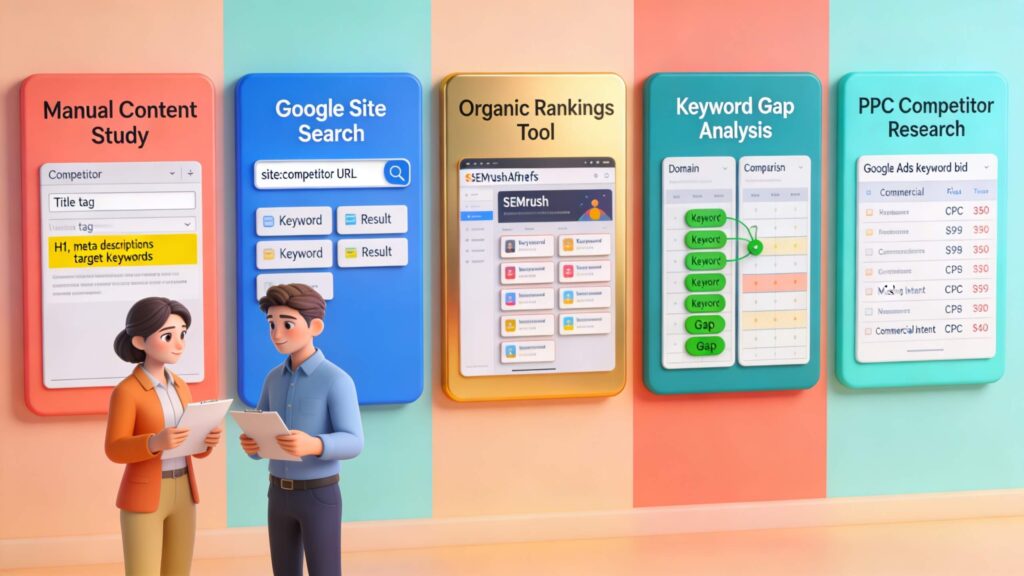
A professional toolkit is non-negotiable for efficient, scalable analysis. While manual review has value, these platforms automate data collection and reveal hidden insights that would take hours to uncover manually. SEMrush is unparalleled for a holistic view. Its “Organic Research” tool shows a competitor’s top-ranking pages and keywords, traffic value, and even estimated traffic distribution. The “Gap Analysis” function is pure gold, allowing you to input multiple competitors to find keywords they rank for that you don’t—your immediate opportunity list. Ahrefs excels in backlink analysis and content exploration. Its “Site Explorer” reveals the link profile powering a competitor’s rankings, while “Content Gap” performs a similar function to SEMrush’s tool. Ahrefs’ “Keywords Explorer” also provides superior data on keyword difficulty and click-through rates. SpyFu offers unique historical data, letting you see a competitor’s keyword ranking history over years, which can reveal long-term strategy shifts. For a more budget-friendly start, Google Search Console combined with manual analysis of SERPs and the MozBar browser extension can provide a solid foundation. The key is to use tools not as crutches but as force multipliers that accelerate your understanding of the competitive landscape.

Deconstructing Competitor Keyword Strategies
Analysis must move beyond a simple keyword list to understanding the underlying strategy. This involves a three-part audit of their on-page SEO, content architecture, and backlink profile. Each component reveals a different aspect of why a competitor ranks where they do, and each provides actionable insights for your own strategy.
On-Page and Technical Optimization Audit
Examine the pages ranking for your target keywords. How are they optimized? Look at title tag and meta description structure: Do they include the primary keyword early? Is the meta description compelling enough to earn a click? Analyze the URL structure, header tags (H1, H2s), and keyword placement in the first 100 words. Use a tool like Screaming Frog to crawl their site at scale, identifying patterns in how they structure title tags for different content types (e.g., blog vs. product pages). Note their internal linking strategy—how do they funnel link equity and user attention to key pages? For example, if a competitor consistently links from high-authority blog posts to their money pages, you should adopt a similar internal linking structure. Pay attention to page speed and mobile usability as well; a slow-loading page is a vulnerability you can exploit by creating a faster, better-optimized alternative.
Content Depth and Format Analysis
Here, you assess not just what they rank for, but how. For their top-performing pages, evaluate content depth, readability, and format. Is it a short, transactional page or a 3,000-word definitive guide? Do they heavily use multimedia, data visualizations, or interactive elements? Tools like Clearscope or MarketMuse can help estimate the comprehensiveness of their content compared to the SERP landscape. Identify the search intent they are satisfying and assess if there is room for a more authoritative, user-friendly, or updated version. For instance, if a competitor ranks for “how to install a faucet” with a text-only guide, you could create a superior piece with embedded step-by-step video, a downloadable tool checklist, and interactive diagrams. This is not about copying but about identifying the format that Google rewards and then executing it better. Content depth is often the deciding factor between page one and page two rankings.
Backlink Profile and Authority Dissection
A page’s ranking power is largely dictated by the quality and quantity of links pointing to it. Use Ahrefs’ “Backlink Profile” report for a competitor’s key page. Where are their links coming from? Are they from industry-relevant, high-authority sites, or low-quality directories? Analyze the anchor text: Is it brand-heavy, keyword-rich, or generic? This reveals their link-building strategy. A profile full of exact-match anchor text may be risky, while a natural, varied profile is a sign of sustainable strength. This analysis directly informs your own link building outreach targets. For example, if a competitor has a link from a respected industry publication like Forbes or Entrepreneur, you can target that same publication with a unique, data-driven piece of content that offers even more value. Understanding the backlink profile also helps you identify which pages are vulnerable; a page with few high-quality links is easier to displace than one with a robust, diverse link profile.
Leveraging Competitor Insights for Your SEO Strategy
Insights are worthless without action. This is where you tactically apply your findings to outmaneuver the competition. The goal is not to replicate but to innovate based on proven patterns. Use your “keyword gap” analysis to create a prioritized content calendar. Don’t just copy topics; create content that is demonstrably better—more comprehensive, better designed, more recently updated, or targeting a specific nuance of the query. For example, if a competitor ranks for “best CRM software for small businesses” with a listicle, you could create a detailed comparison table with pricing, features, and user reviews, plus a downloadable PDF guide. Model successful patterns from competitor pages. If all top-ranking pages for “best CRM software” include comparison tables, ensure yours does too—and make it more detailed or interactive. Optimize your meta data to be more compelling while naturally including primary and secondary competitor keywords. Your competitor’s backlink profile is a prospecting list. Identify the sites linking to them but not to you. Develop a tailored outreach campaign, offering an even more valuable resource or a unique angle on a related topic to earn a link from that same authoritative source. This targeted approach is far more effective than generic link building.
Tracking, Monitoring, and Iterating
SEO is a dynamic game. A one-time analysis provides a snapshot, but continuous monitoring is required to maintain and grow your advantage. Set up tracking for your competitors’ key rankings and your own. Use the “Position Tracking” tool in SEMrush or Ahrefs to monitor daily or weekly fluctuations. Set Google Alerts for competitor brand names and key industry terms. Regularly re-run gap analyses to see if they are targeting new keyword clusters. When a competitor’s page drops in ranking, investigate why—was there a core algorithm update, did they lose a key backlink, or did a new competitor enter the space? This real-time intelligence allows you to adapt quickly, capitalizing on their missteps and defending against their new initiatives. For example, if a competitor’s page drops from position three to position eight, you can immediately create or update your own content to fill the gap, potentially capturing the traffic they lost. Iteration is not optional; it is the engine of sustained SEO success.

Evaluating Success: Beyond Rankings to Business Impact
The ultimate measure of your competitor keyword strategy is not just ranking higher, but driving business outcomes. Track these core metrics to ensure your efforts translate into tangible value. Search engine rankings are your leading indicator; track average position for your target keyword set. Improvements here signal that your on-page and off-page efforts are working. Organic traffic is the next layer; use Google Analytics to monitor sessions and users from organic search. Segment this traffic to pages optimized using competitor insights to see which strategies are most effective. Conversion rates are the critical bottom-line metric. Are the visitors coming from these newly targeted keywords converting (making purchases, filling leads, subscribing) at a favorable rate? High traffic with low conversion may indicate a misalignment between keyword intent and page content. Share of voice is an advanced metric; tools can estimate your visibility share for a keyword set compared to competitors. A rising share of voice indicates you are winning the SERP landscape. The table below summarizes these key performance indicators and the tools to measure them.
| Performance Indicator | Primary Tool for Measurement | Strategic Insight Provided |
|---|---|---|
| Keyword Ranking Movement | SEMrush Position Tracking, Ahrefs Rank Tracker | Direct effectiveness of on-page and off-page SEO efforts. |
| Organic Traffic Growth | Google Analytics 4 | Whether improved rankings translate to actual site visits. |
| Target Keyword Conversion Rate | GA4 Goals & Conversions | Quality of traffic and alignment of content with user intent. |
| Competitive Backlink Gap | Ahrefs Backlink Gap, Moz Link Explorer | Opportunities for authority-building through link acquisition. |
Expanding Your Analytical Toolkit and Mindset
As you mature in your competitor analysis practice, integrate additional layers of intelligence. Google Trends helps identify rising queries before they appear in keyword tools, giving you a first-mover advantage. AnswerThePublic provides a visual map of question-based queries around a topic, perfect for uncovering long-tail opportunities competitors may miss. For local businesses, tools like BrightLocal offer competitor tracking in the local pack and maps, which is critical for dominating local SEO. Furthermore, adopt a “content pruning” mindset. Use your analytics to find pages targeting competitor keywords that are underperforming. Can they be consolidated, rewritten, or redirected to a stronger page? This improves site efficiency and concentrates ranking power. Remember, the goal is a virtuous cycle: analyze, implement, measure, and re-analyze. This iterative process ensures you are always ahead of the competition, adapting to algorithm changes and shifting user behavior. The mindset shift from reactive to proactive is what separates average SEO from market-leading SEO.
Conclusion
Mastering competitor keywords is what separates reactive SEO from a proactive, market-leading strategy. It transforms the SERPs from a black box into a clear, navigable map of opportunity and threat. This process—rooted in systematic identification, deep analysis, strategic application, and relentless iteration—ensures your efforts are precisely targeted and resource-efficient. You are no longer guessing what might work; you are replicating and improving upon proven models while exploiting gaps your rivals have overlooked. In an algorithm-driven landscape, this competitive intelligence is your most sustainable advantage. It allows you to build not just traffic, but authoritative market presence that is difficult to displace. The journey begins with a single analysis. Audit one key competitor today, identify just three tangible keyword opportunities, and begin crafting your path to overtaking them. If you need expert guidance to accelerate this process, contact our team for a personalized competitor audit and strategy session. Your future search dominance depends on the insights you unlock from your competition right now.