
Cart 0

Share
Table of Contents
Why Technical SEO Is Important for Search Rankings and User Experience
If you want your website to rank consistently in search results and deliver a seamless experience to visitors, technical SEO is not optional. It is the foundation that determines whether search engines can find, crawl, interpret, and index your content correctly. Many website owners focus exclusively on content quality and backlinks while neglecting the technical infrastructure that supports them. That is a costly mistake. Technical SEO encompasses everything from site speed and mobile responsiveness to structured data, security protocols, and crawl budget management. Without a solid technical setup, even the best content can remain invisible to search engines. This article explains why technical SEO matters, which elements have the greatest impact on rankings and user experience, and how you can implement these strategies effectively to gain a competitive edge in organic search.
What Is Technical SEO and Why Does It Matter Today
Technical SEO refers to the process of optimizing the infrastructure of your website so that search engine bots can crawl, render, and index your pages efficiently while users enjoy fast, secure, and intuitive interactions. In an era where Google processes over 8.5 billion searches daily and uses more than 200 ranking signals, ignoring technical optimization means leaving significant ranking potential untapped. The core objective of technical SEO is to remove barriers that prevent search engines from understanding your content and providing a positive experience to visitors. For any business serious about organic growth, technical SEO is the bedrock upon which all other SEO efforts are built.

Search engines have become increasingly sophisticated. Google’s algorithms now evaluate page experience signals such as Core Web Vitals, mobile-friendliness, HTTPS security, and intrusive interstitial guidelines. These factors are not secondary considerations; they are integral to how Google assesses and ranks websites. A site that loads in under two seconds, renders correctly on mobile devices, uses secure connections, and structures data with schema markup will consistently outperform a technically weak competitor, even if the latter has stronger content or more backlinks. This shift makes technical SEO a non-negotiable component of any modern SEO strategy.
Moreover, technical SEO directly influences how search engines allocate crawl budget. Large websites with thousands of pages must ensure that bots spend time indexing valuable content rather than getting stuck in duplicate pages, thin content, or redirect chains. Proper use of robots.txt, XML sitemaps, canonical tags, and logical internal linking helps guide crawlers to your most important pages. For smaller sites, technical SEO ensures that every page has a fair chance of being discovered and ranked. In short, technical SEO is the lens through which search engines view your website. If that lens is dirty or misaligned, your content will never receive the visibility it deserves.
Core Technical SEO Elements That Drive Search Performance
Understanding which technical components matter most allows you to prioritize your optimization efforts effectively. While every website is unique, certain elements are universally critical. Site speed leads the list because it affects both user experience and rankings directly. According to Google, the probability of bounce increases by 32 percent when page load time goes from one to three seconds. Beyond speed, crawlability and indexability determine whether search engines can access and store your pages in their databases. A page that cannot be crawled is essentially invisible. Mobile optimization is another pillar. With Google’s mobile-first indexing now the default, your site must perform flawlessly on smartphones and tablets. Schema markup adds context to your content, enabling rich results like star ratings, FAQ snippets, and product carousels. Website security, measured by SSL certificates and secure protocols, is both a trust signal and a ranking factor. Finally, site architecture – including URL structure, breadcrumb navigation, and internal linking – shapes how authority flows through your website and how easily users find what they need. Each of these elements interacts with the others, creating a cumulative effect on search performance.
To illustrate the importance of these elements, consider a mid-sized e-commerce site that implemented a comprehensive technical SEO overhaul. Before the changes, the site had an average page speed of 4.2 seconds, no structured data, and a non-responsive mobile design. After compressing images, enabling lazy loading, adding product schema, and adopting a responsive framework, the site saw a 40 percent increase in organic traffic within three months, a 25 percent reduction in bounce rate, and a 15 percent improvement in average session duration. This real-world example demonstrates that technical SEO is not abstract theory but a practical driver of measurable business outcomes.
Website Performance Optimization for Speed and Usability
Website performance optimization is the most visible and immediately impactful aspect of technical SEO. When visitors land on your site, they form an opinion within milliseconds. If the page loads slowly, they leave. If images take too long to render, they lose patience. If navigation feels clunky, they bounce. Google’s Core Web Vitals – Largest Contentful Paint (LCP), First Input Delay (FID), and Cumulative Layout Shift (CLS) – quantify these experiences and use them as ranking signals. Optimizing performance requires a multi-pronged approach that addresses server response times, resource delivery, and frontend rendering. Compressing images using modern formats like WebP or AVIF can reduce file sizes by up to 30 percent without visible quality loss. Minifying CSS, JavaScript, and HTML removes unnecessary characters and speeds up parsing. Leveraging browser caching stores static resources locally on returning visitors’ devices, reducing load times on subsequent visits. Using a content delivery network (CDN) distributes your assets across multiple geographic locations, bringing data closer to users and cutting latency significantly. Each of these techniques contributes to a faster, more responsive website that both users and search engines appreciate.
Beyond technical tweaks, performance optimization also involves strategic decisions about page design. Lazy loading ensures that images and videos below the fold are only loaded when users scroll to them, preserving bandwidth and speed. Reducing the number of HTTP requests by combining files and using CSS sprites can accelerate page rendering. Server-level improvements, such as upgrading to HTTP/2 or HTTP/3, enable multiplexing and faster data transmission. For sites built on content management systems like WordPress, choosing a lightweight theme, optimizing database queries, and using reliable hosting are foundational steps. The cumulative effect of these optimizations is a website that feels instant, which translates into higher engagement, lower bounce rates, and improved conversion rates. Google’s own research shows that improving site speed by just one second can increase mobile conversions by up to 20 percent. When you consider that e-commerce sites can lose nearly half of their visitors if a page takes more than three seconds to load, the business case for performance optimization becomes undeniable.
Performance optimization is also closely tied to crawl efficiency. Faster pages allow search engine bots to crawl more pages within their allocated budget. If your site responds slowly, bots may crawl fewer pages, leaving valuable content unindexed. This is particularly important for large websites with thousands of product pages or articles. By improving server response times and reducing page weight, you effectively increase the number of pages that Google can evaluate in each crawl session. This can lead to faster indexing of new content and more frequent updates in search results. In competitive niches where freshness matters, such as news or e-commerce, this can be a decisive advantage.
Site Structure, Crawlability, and Indexing Best Practices
A well-organized site structure is the backbone of effective technical SEO. When your website’s pages are arranged in a logical hierarchy, both users and search engines can navigate them intuitively. A flat architecture, where any page is reachable within three or fewer clicks from the homepage, distributes authority evenly and helps crawlers discover content efficiently. Using descriptive, keyword-rich URLs that reflect the content’s topic further clarifies the page’s relevance. For example, a URL like example.com/technical-seo-guide is far more useful to search engines than example.com/page123. Breadcrumb navigation provides contextual links that reinforce site structure and can appear as rich snippets in search results, improving click-through rates.
Crawlability refers to the ability of search engine bots to access and traverse your website. Several technical elements influence crawlability. The robots.txt file tells crawlers which parts of your site to ignore. While this is useful for preventing bots from accessing admin areas or duplicate content, it must be configured carefully to avoid accidentally blocking important pages. The XML sitemap provides a roadmap of all your important pages, including metadata like last update date and priority. Submitting this sitemap to Google Search Console ensures that crawlers know about your content from the start. Canonical tags prevent duplicate content issues by specifying which version of a page is the primary one. This is crucial for e-commerce sites that may have multiple URLs for the same product due to tracking parameters or filter options. Without proper canonicalization, search engines may split ranking signals across duplicate pages, diluting your authority.
Indexing is the final step in the discovery process. Even if a page is crawlable, it may not be indexed. Common reasons include low-quality or thin content, noindex tags left in place inadvertently, or content that is blocked by JavaScript rendering issues. Google now renders JavaScript-based content, but this process consumes resources and can delay indexing. Ensuring that critical content is available in the initial HTML response, using server-side rendering or dynamic rendering for JavaScript-heavy frameworks, can improve indexing reliability. Regularly auditing your indexed pages in Google Search Console helps identify pages that are excluded or have errors. By maintaining a clean, logically structured site with clear signals for crawlers, you maximize the chances that every valuable page gets indexed and ranked appropriately.
To summarize the relationship between these elements, the following table outlines key technical SEO components and their primary functions:
| Component | Primary Function | Impact on SEO |
|---|---|---|
| XML Sitemap | Provides a list of all important pages for crawlers | Improves discovery and indexing speed |
| Robots.txt | Directs crawlers on which areas to avoid | Prevents wasted crawl budget |
| Canonical Tags | Indicates the preferred version of duplicate pages | Consolidates ranking signals |
| URL Structure | Creates readable, descriptive paths for pages | Enhances relevance signals and user trust |
| Internal Linking | Connects related pages within the site | Distributes authority and improves navigation |
| Breadcrumbs | Shows users and search engines the page hierarchy | Supports rich snippets and UX |
Mobile Optimization in a Mobile-First World
Google’s shift to mobile-first indexing means that the mobile version of your website is now the primary version used for ranking and indexing. If your site is not fully optimized for mobile devices, you are effectively competing with one hand tied behind your back. Mobile optimization goes beyond responsive design, though that is a critical starting point. It encompasses touch-friendly navigation, font sizes that are legible without zooming, adequate spacing between clickable elements, and fast loading times on cellular networks. Google’s Mobile-Friendly Test tool provides specific recommendations for improvement, but the real measure is how real users experience your site on their phones. High bounce rates from mobile visitors often indicate that the mobile experience is subpar, which can drag down your overall search rankings.

Responsive design is the most recommended approach because it uses a single URL for both desktop and mobile versions, serving different CSS based on screen size. This eliminates the complexity of maintaining separate mobile sites and avoids issues with duplicate content. However, responsive design alone is not sufficient. You must also consider mobile page speed. Images that look great on a desktop monitor may be excessively large for mobile devices. Using responsive images with the srcset attribute ensures that smaller screens download appropriately sized files. AMP (Accelerated Mobile Pages) is another option, though its importance has diminished as Google now considers page experience holistically. The key is to prioritize user experience on mobile by simplifying layouts, reducing pop-ups that cover content, and ensuring that forms and buttons are easy to tap.
Mobile optimization also involves technical considerations like configuring viewport meta tags correctly, avoiding software like Flash that is not supported on mobile, and using legible font sizes without requiring pinch-to-zoom. With over 60 percent of all web traffic coming from mobile devices according to Statista, neglecting mobile users means alienating the majority of your audience. For local businesses, mobile optimization is even more critical because users often search for nearby services while on the go. A mobile-friendly site with clear contact information, click-to-call buttons, and location data can directly drive foot traffic and phone inquiries. In this context, technical SEO becomes a bridge between online visibility and real-world conversions.
Schema Markup and Structured Data for Rich Results
Schema markup is a form of microdata that you can add to your website’s HTML to help search engines understand the context and relationships of your content. It is one of the most powerful technical SEO tools because it enables rich snippets, which make your listings stand out in search results. Rich snippets can include star ratings, review counts, product prices, availability, recipe times, event dates, and FAQ sections. According to research by Search Engine Land, pages with rich snippets can experience click-through rates that are 20 to 30 percent higher than standard listings. This is because rich snippets provide users with immediate, useful information that helps them decide whether to click. For e-commerce sites, product schema can display pricing and stock status directly in search results, reducing friction and attracting more qualified traffic.
Implementing schema markup requires careful selection of the appropriate schema types for your content. Google recognizes dozens of types, including Article, LocalBusiness, Product, Recipe, Event, FAQPage, HowTo, and Review. Each type has specific properties that you need to populate. For example, a Product schema requires properties like name, image, description, brand, and offers. A LocalBusiness schema includes address, phone number, opening hours, and geo-coordinates. Using Google’s Structured Data Markup Helper or plugins like Yoast SEO for WordPress can simplify the initial setup, but manual validation is essential. The Rich Results Test tool allows you to check whether your markup is valid and which rich features are eligible. Keep in mind that schema markup does not guarantee rich snippets, but it significantly increases the likelihood when applicable.
Beyond rich snippets, structured data also supports knowledge panels and voice search optimization. When search engines understand the entities and relationships on your site, they can present your information in knowledge graph entries and answer boxes. This is especially valuable for authoritative sources and local businesses. As voice search continues to grow – with over 50 percent of all searches expected to be voice-based by 2026 according to Comscore – having well-structured data ensures that your content can be parsed and delivered as spoken answers. Technical SEO professionals should view schema markup not as a one-time task but as an ongoing practice that evolves with new schema types and search engine capabilities. Regular audits of your structured data can identify errors or missing properties that may be preventing rich results from appearing.
Website Security as a Ranking Signal
Website security is a fundamental component of technical SEO that directly influences both trust and rankings. Google has explicitly stated that HTTPS is a ranking signal, and since 2018, Chrome has marked all HTTP pages as “Not Secure.” This warning drives visitors away and damages your brand’s credibility. Implementing an SSL certificate encrypts data transmitted between your server and users, protecting sensitive information like login credentials, payment details, and personal data. For e-commerce sites, SSL is not just an SEO recommendation; it is a legal and ethical requirement. Beyond SSL, security measures like regular software updates, strong password policies, two-factor authentication, and web application firewalls help prevent breaches that can take your site offline or inject malicious content. A hacked site can be removed from Google’s index entirely, resulting in catastrophic traffic loss.
Security also impacts user behavior and engagement metrics. Visitors are less likely to complete a purchase or submit a contact form on a site that appears insecure. Browsers may block downloads or scripts from HTTP pages, disrupting functionality. For sites that handle financial transactions, compliance with PCI DSS standards is mandatory. These factors collectively influence how Google perceives your site’s overall quality. A secure, well-maintained site signals reliability and professionalism, which aligns with Google’s mission to provide users with the best possible experience. While security alone will not skyrocket your rankings, its absence can be a significant liability. In competitive markets where multiple sites offer similar content, the presence of HTTPS and other security features can be the deciding factor in which site ranks higher.
To maintain robust security, adopt a proactive approach. Use security plugins that monitor for suspicious activity, enable automatic updates for your CMS and plugins, and perform regular backups so you can recover quickly from incidents. Consider using a CDN with built-in DDoS protection, and always use strong, unique passwords for all accounts. Security should be reviewed as part of your regular technical SEO audits. If you inherit a site that still runs on HTTP, migrating to HTTPS requires careful planning to avoid broken links and mixed content warnings. Properly implementing 301 redirects and updating internal links ensures that the migration does not harm your existing rankings. The effort is well worth it because a secure foundation protects your investment in all other SEO activities.
User Experience and Engagement Through Technical Excellence
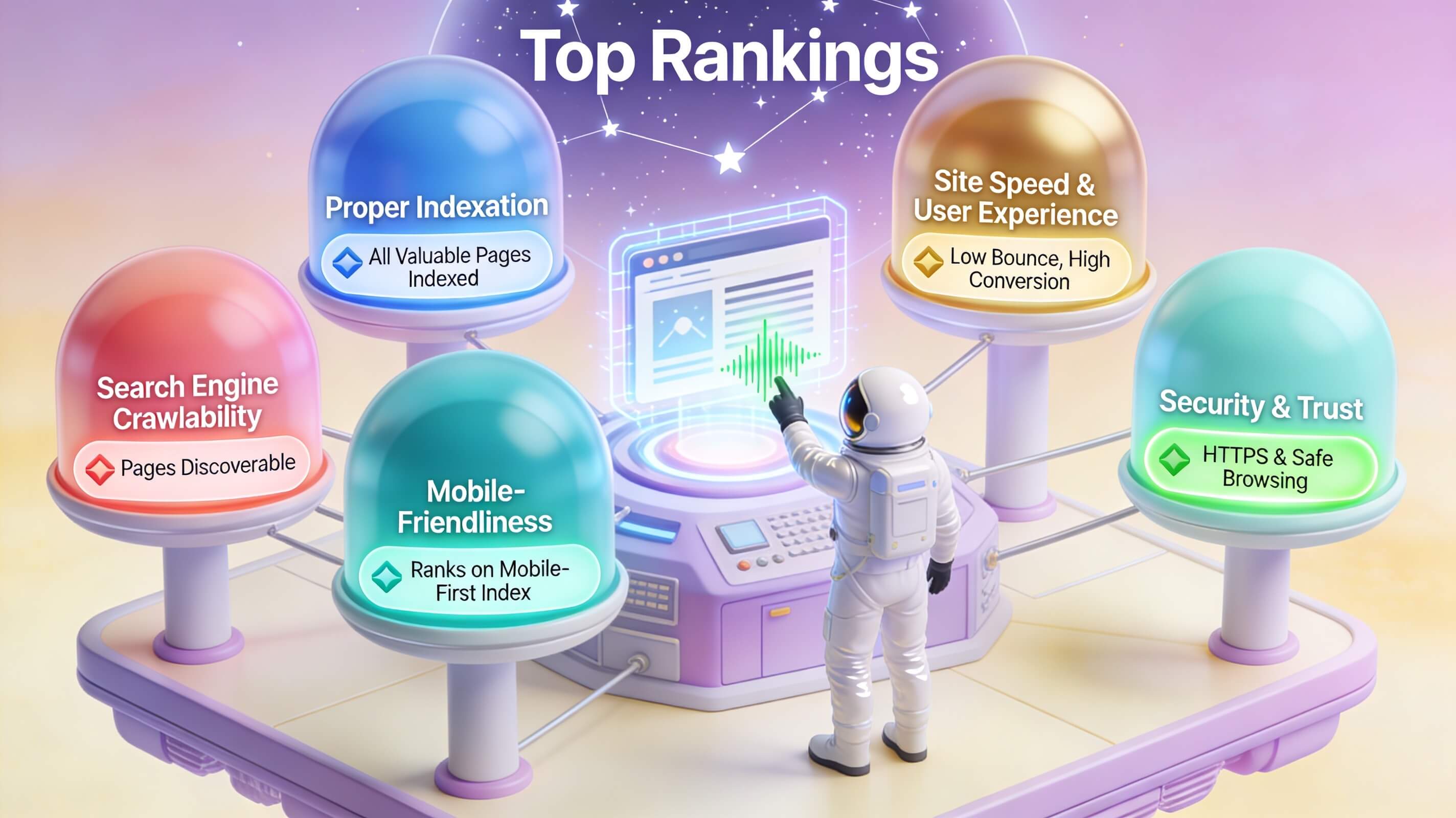
Technical SEO and user experience are deeply intertwined. Every technical decision you make – from how fast a page loads to how easily a mobile user can tap a button – affects how users interact with your site. Google’s Page Experience update formalized this connection by incorporating Core Web Vitals, mobile-friendliness, safe browsing, HTTPS, and intrusive interstitial guidelines into the ranking system. The underlying message is clear: websites that prioritize user experience will be rewarded with better visibility. Technical SEO provides the tools to deliver that experience consistently. When users can navigate your site without frustration, find content quickly, and trust that their data is secure, they are more likely to stay longer, explore more pages, and convert. These positive engagement signals, in turn, reinforce your site’s authority and relevance in the eyes of search engines.
One of the most effective ways to improve user experience through technical SEO is by streamlining navigation and information architecture. Logical site structures with clear categories, subcategories, and breadcrumb trails reduce cognitive load and help users find what they need quickly. Internal linking that connects related content encourages deeper exploration and signals topical authority to search engines. For content-heavy sites, implementing faceted navigation with proper indexing controls allows users to filter products or articles without creating duplicate content issues. Each of these elements requires technical precision to implement correctly, but the payoff is a site that feels intuitive and responsive.
Accessibility is another dimension of user experience that falls under technical SEO. Ensuring that your site is usable by people with disabilities – including those who rely on screen readers, keyboard navigation, or voice commands – is both an ethical responsibility and an SEO opportunity. Alt text for images, proper heading hierarchy, descriptive link text, and sufficient color contrast improve accessibility and help search engines understand your content better. Google’s algorithms may not explicitly reward accessibility, but the improved usability and engagement that result from accessible design indirectly support better rankings. In an environment where user satisfaction directly influences rankings, technical SEO that prioritizes accessibility creates a virtuous cycle of better experiences and stronger performance.
Conclusion
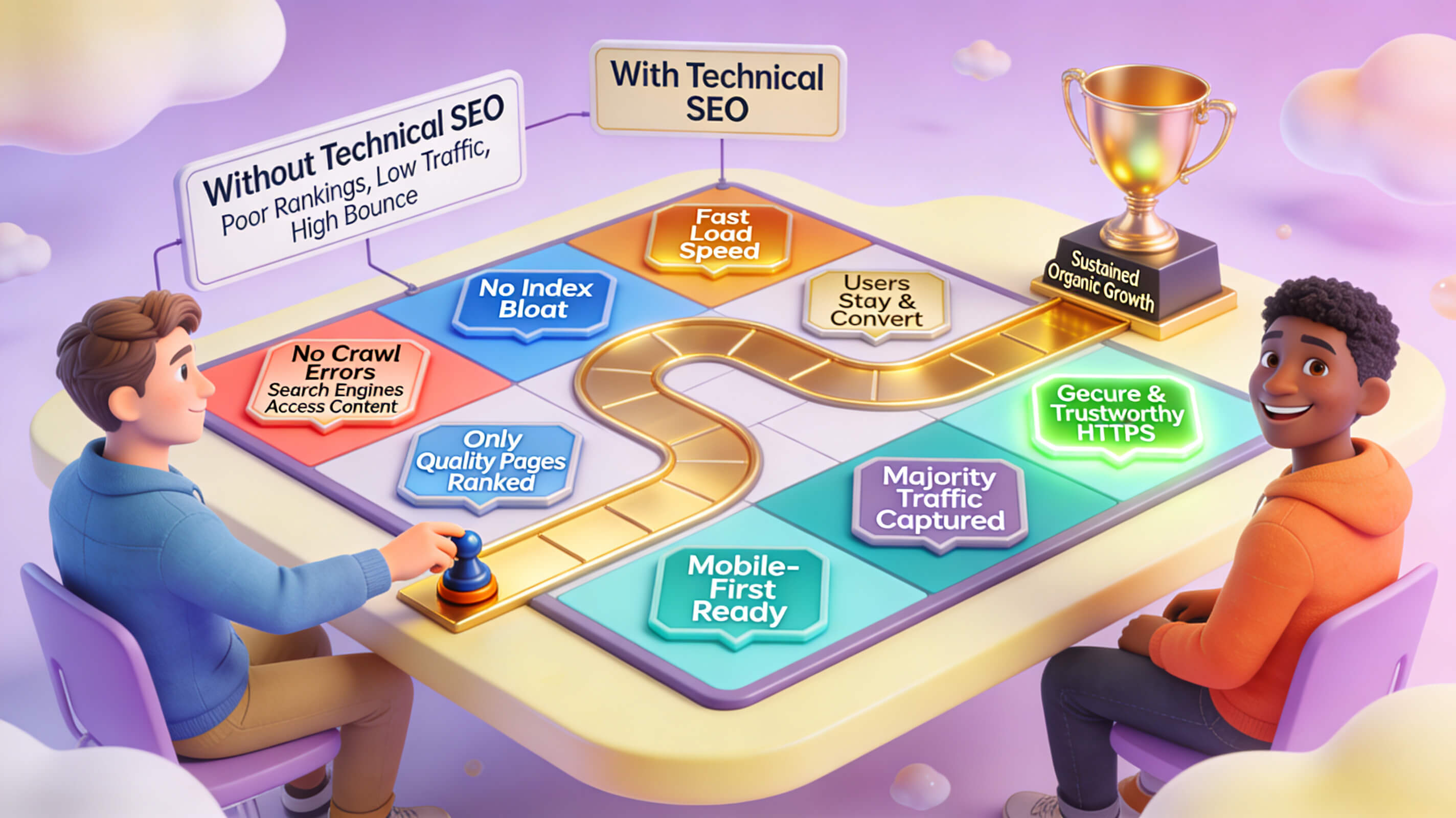
Technical SEO is not a set of optional enhancements to consider after you have written content and built links. It is the essential infrastructure that determines whether your website can compete in modern search environments. From site speed and mobile optimization to crawlability, structured data, and security, every technical element contributes to your site’s ability to attract, engage, and retain visitors. Neglecting these factors leaves your site vulnerable to poor rankings, high bounce rates, and lost revenue. The sites that consistently outperform their competitors are those that treat technical SEO as an ongoing priority, continuously auditing and refining their technical foundation to adapt to algorithm updates and evolving user expectations.
The most successful digital marketing strategies integrate technical SEO from the start. Whether you are building a new site or overhauling an existing one, dedicating resources to technical optimization will yield compounding returns over time. As search engines become more sophisticated, the gap between technically optimized sites and neglected ones will only widen. For businesses that rely on organic traffic for growth, this gap represents a significant competitive threat. Investing in technical SEO today positions your site for sustainable visibility and performance tomorrow.
If your website is not yet optimized for technical SEO, the time to act is now. Start with a comprehensive technical audit that evaluates site speed, mobile responsiveness, crawlability, indexation, schema markup, and security. Prioritize the issues that have the greatest impact on user experience and rankings. For many sites, simple improvements like compressing images, enabling caching, and adding schema markup can produce noticeable results quickly. For more complex challenges – such as restructuring a large site or migrating to HTTPS – consider working with an experienced technical SEO professional who can navigate the nuances without introducing errors. Your website’s visibility in search results depends on the strength of its technical foundation. Build that foundation correctly, and everything else you do in SEO will have a better chance of succeeding. Take the first step today by auditing your site’s technical health and committing to ongoing optimization. Your search rankings – and your users – will thank you.