
Cart 0

What is Evergreen Content? Understanding Its Definition and Characteristics for Online Success

Share
Table of Contents
What Is Evergreen Content? Understanding Its Definition and Characteristics for Online Success
Some content you publish this week will be irrelevant by next month. Other content you publish today will still be driving organic traffic, earning backlinks, and converting new visitors two, three, or even five years from now. The difference between those two outcomes is the strategic choice to create evergreen content—content built around timeless topics that remain relevant and valuable to your audience regardless of when they encounter it. The performance gap between these approaches is striking: according to research cited in Arfadia’s ultimate evergreen content marketing guide, evergreen content accounts for just 10% of the average website’s total content but drives 38% of all organic traffic, with 60% of high-performing evergreen posts continuing to attract visitors for three or more years after publication. When updated and re-optimized, this content can generate up to 106% more organic traffic than its original baseline—making it one of the highest-ROI investments available in any content marketing budget. Understanding exactly what is evergreen content, how to create it, and how to maintain it over time is therefore not just a useful skill for content marketers—it is a fundamental strategic competency for any brand that wants to build lasting digital presence.
What Is Evergreen Content? A Clear Definition
Evergreen content is any content—article, video, guide, infographic, podcast episode, or tool—that addresses topics with stable, enduring relevance to a specific audience rather than topics tied to current events, seasonal trends, or fast-moving news cycles. The “evergreen” metaphor is apt: just as evergreen trees retain their foliage year-round rather than shedding it seasonally, evergreen content retains its value and usefulness to readers regardless of when they discover it. A person reading a well-crafted guide on “how to write a compelling cover letter” in 2026 benefits from it just as much as a reader who found it in 2022—because the underlying skill it addresses has not materially changed.
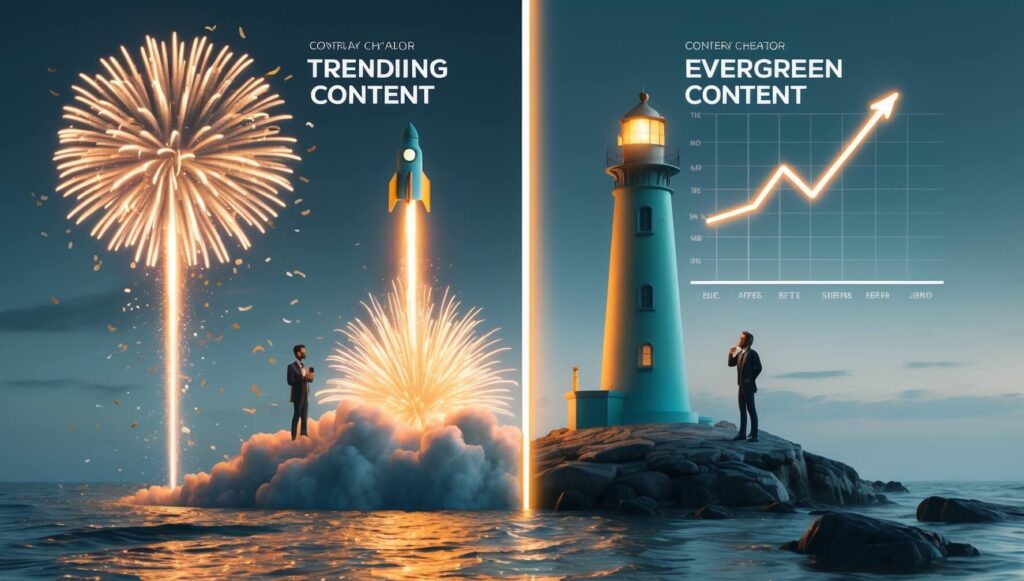
This stands in sharp contrast to time-sensitive content like news articles covering a specific product launch, trend pieces about a viral social media moment, or seasonal guides tied to a specific holiday. That content may generate significant traffic immediately after publication but experiences rapid decay in interest and relevance as the event passes. As the evergreen content framework detailed in Increv’s evergreen content definition and strategy guide confirms, while trending content may spike initially, evergreen pieces provide a steady stream of visitors over time, consistently deliver SEO value, position brands as authoritative experts in their field, and offer a far superior long-term return on the investment of creation. The defining characteristics of evergreen content are topic permanence, audience-specific utility, depth of coverage, and the ability to answer questions that people will still be asking years from now.

The Defining Characteristics of Evergreen Content
Not all content that ages gracefully qualifies as strategically evergreen. Understanding the specific qualities that make content durable—and commercially valuable over time—helps you make deliberate creative choices that maximize longevity from the moment of conception rather than hoping retrospectively that a piece holds up.
| Characteristic | What It Means in Practice | Why It Matters |
|---|---|---|
| Topic permanence | Addresses a need or question that will not be resolved by a single news event or trend cycle | Ensures the content retains search demand and readership value over years, not days |
| Audience specificity | Written for a clearly defined reader with a specific problem, goal, or knowledge gap | Increases relevance and time-on-page for the right audience; reduces bounce rate |
| Comprehensive depth | Covers a topic thoroughly enough to be the definitive resource, not a surface-level overview | Earns backlinks, featured snippet positions, and repeat visits as a trusted reference |
| Search intent alignment | Targets keywords with stable, consistent search volume rather than spiking trend-driven queries | Generates predictable organic traffic month after month without seasonal variation |
| Timeless language | Avoids date-specific references, “this year” constructions, and event-tied framing | Prevents content from feeling dated without requiring complete rewrites over time |
| Updateability | Structured so that new examples, statistics, or developments can be incorporated without restructuring | Allows periodic freshening that maintains search rankings and reader credibility |
The combination of these characteristics creates content that functions as a long-term digital asset rather than a short-lived content piece. As the evergreen content strategy analysis from SE Ranking’s guide to using evergreen content to boost SEO emphasizes, the most durable evergreen content identifies keywords with proven, stable search demand, covers related subtopics comprehensively within a single piece, and uses long-term language that avoids anchoring the content to a specific moment in time—all choices that must be made at the content planning stage, before a single word is written.
Why Evergreen Content Is Vital to Your Content Strategy
The strategic case for investing seriously in evergreen content rests on performance data that is difficult to ignore. Beyond the 38% traffic share from 10% of content cited above, the business case extends across multiple dimensions of digital marketing performance that compound over time rather than decaying.
Continuous, Compounding Organic Traffic
Evergreen content generates what marketing professionals call compounding returns: unlike a social media post or news article whose traffic peaks sharply at publication and then drops to near-zero, a well-optimized evergreen page accumulates search rankings progressively. As it earns more backlinks from other sites citing it as a reference, its authority grows. As more readers engage with it and share it, its social signals strengthen. As Google processes more user interaction data confirming its relevance to the target query, its ranking stabilizes and often improves. The result is a traffic curve that rises gradually over months and then plateaus at a consistently high level—delivering organic visitors month after month without requiring additional paid promotion or content investment. A content strategy built around a library of high-performing evergreen assets creates a traffic floor that insulates your site from the volatility of trending topics, algorithm changes, or reduced publishing frequency. As the organic traffic case study from Augurian’s evergreen marketing strategy guide demonstrates, one well-executed evergreen content program drove approximately 7,500 clicks in its first quarter and 15,600 clicks in its second quarter—purely from SEO-driven organic growth as the content accumulated ranking authority.
Superior Return on Content Investment
Content production is expensive—in time, in creative labor, and often in direct production costs for video or design. Evergreen content distributes these creation costs across a dramatically longer useful life than time-sensitive content, delivering a fundamentally better return on each production dollar spent. The ROI comparison data from Arfadia’s evergreen content performance research shows that evergreen content delivers 4x higher ROI than seasonal or trending content and costs 62% less per lead than traditional advertising—with businesses that maintain active evergreen content strategies earning 434% more indexed pages and 97% more inbound links than those without formal content programs. These are not marginal improvements; they reflect the fundamental economic difference between creating content that functions as a long-term asset and creating content that functions as a short-lived promotional message.
Natural Backlink Acquisition and Domain Authority
High-quality, comprehensive evergreen content earns backlinks organically—other writers, bloggers, journalists, and researchers cite it as a source when addressing related topics because it is the most thorough, reliable, or accessible resource available on its subject. These editorial backlinks from contextually relevant domains are exactly the link quality that search engines weight most heavily in authority calculations, and they accumulate passively over time without requiring active link-building outreach for each individual link. A single definitive evergreen guide on a topic within your niche can generate dozens or hundreds of natural backlinks over its lifetime, each one strengthening your domain’s overall authority and improving your ranking potential across all your content—not just the piece that earned the links. This compounding authority effect is one of the clearest reasons why brands with strong evergreen content foundations consistently outrank newer competitors even when the newer sites produce more total content volume.
Evergreen Content vs. Trending Content: Understanding the Right Mix
A sophisticated content strategy does not choose exclusively between evergreen and trending content—it deploys each type strategically to serve complementary objectives, with the balance weighted toward evergreen for sustainable long-term performance.
| Dimension | Evergreen Content | Trending Content |
|---|---|---|
| Traffic pattern | Slow build, then sustained plateau for months or years | Sharp spike at publication, rapid decline within weeks |
| Typical lifespan | 2–5+ years with periodic updates | Days to a few months before decay |
| Primary goal | SEO authority, lead generation, long-term brand positioning | Immediate visibility, social sharing, real-time brand relevance |
| Production economics | Higher upfront cost, dramatically better long-term ROI | Lower upfront cost, poor long-term return as content decays |
| Backlink acquisition | Strong; referenced as a durable resource over years | Weak; cited during news cycle then forgotten |
| Ideal content mix share | 70–80% of total content output | 20–30% for brand freshness and social engagement |
The performance comparison analyzed in Automateed’s comprehensive evergreen vs. trending content comparison confirms that evergreen pieces tend to stay in Google’s top 10 results for over two years, providing continuous inbound traffic, while trending content peaks within days or weeks and often becomes less relevant after one to three months. This does not mean trending content has no role—it is valuable for establishing brand relevance in ongoing industry conversations, capturing social media engagement around current events, and signaling to your audience that you are active and current. But relying on it as your primary content type creates a publication treadmill where you must constantly produce new content simply to maintain current traffic levels, because each previous piece is continuously decaying in relevance and ranking.
Best Examples of Evergreen Content Formats
Knowing what makes a topic evergreen is important, but recognizing the specific formats and content types that consistently deliver durable performance accelerates your ability to build a strong evergreen content library efficiently. As the format taxonomy from SE Ranking’s evergreen content strategy guide and the format performance analysis from Shape My Content’s evergreen content examples and SEO guide confirm, the formats with the strongest track records of sustained performance include:
- Comprehensive how-to guides — Step-by-step instructional content on skills and processes that people consistently need to learn; examples include “How to Write a Business Plan,” “How to Brew Coffee at Home,” and “How to Start a Podcast.” These consistently earn top rankings for instructional queries and remain useful indefinitely.
- Definitive beginner’s guides — In-depth introductions to foundational concepts in a field—”The Beginner’s Guide to SEO,” “A Beginner’s Guide to Investing”—that serve as the first authoritative resource for anyone new to a topic. These accumulate enormous backlinks because they are perpetually cited by content that assumes reader familiarity with the basics.
- FAQ pages and question-answer content — Comprehensive answers to the most commonly asked questions in your niche, structured around the exact language your audience uses. These capture high-intent voice and text search queries and work exceptionally well for featured snippet optimization.
- Glossaries and definition pages — Authoritative definitions of industry terminology and concepts that serve as reference resources both for human readers and for other content creators who link to them as citation sources.
- Research-backed resource roundups — Curated lists of tools, statistics, studies, or resources on a specific topic, maintained and updated over time. These earn consistent backlinks from writers who cite them as secondary sources.
- Interactive calculators and assessment tools — Tools like ROI calculators, budget planners, and skill assessments deliver immediate personalized value while remaining relevant indefinitely because the underlying calculation or assessment framework does not become outdated. This is one of the fastest-growing evergreen content formats for 2025, as noted in the emerging format analysis from Arfadia’s 2025 evergreen content strategy report.
- Ultimate guides and pillar content — Exhaustive, authoritative treatment of a broad topic that functions as a hub for subtopic content and earns topical authority signals from search engines by demonstrating comprehensive coverage of an entire subject area.
How to Create Evergreen Content: A Strategic Process
Creating content that genuinely earns long-term performance requires a disciplined process at every stage, from topic selection through publication and ongoing maintenance. The following framework draws on best practices validated by high-performing content programs across multiple industries.
Step 1 — Identify Topics with Stable Search Demand
The foundation of all effective evergreen content is a topic that generates consistent search volume over time—not a spike-and-crash pattern associated with trending topics. Use keyword research tools to evaluate search volume trends over a 24-month window. Avoid topics where search volume shows a sharp peak followed by decline; pursue topics where volume is flat or growing gradually over the full period. Look for queries framed as timeless questions: “how to,” “what is,” “best way to,” “guide to,” “checklist for.” The keyword research guidance from Siege Media’s evergreen content guide with 30 SEO-friendly examples recommends targeting keywords where click volume is at least half of search volume—indicating high user engagement—with a keyword difficulty level that is realistically attainable given your domain’s current authority.
Step 2 — Define Your Audience and Search Intent Precisely
A topic that is evergreen for one audience may be irrelevant to another. Before writing a single word, define the specific reader your content serves: their knowledge level, their specific problem or goal, the stage of their journey with this topic, and the outcome they are trying to achieve. Then map your content structure to their search intent—informational, navigational, transactional, or commercial investigation. Search engine land’s SEO guidance from Search Engine Land’s evergreen content and SEO importance analysis advises studying the top-ranking results for your target query and mirroring their structure—covering all the information those top articles include—while adding a unique angle that only your brand’s specific expertise and perspective can provide.
Step 3 — Write with Depth, Clarity, and Timeless Language
The difference between an evergreen piece that dominates its category for years and one that barely registers often comes down to depth of coverage and quality of explanation. Cover your topic comprehensively enough that a reader who finishes your content has everything they need—they do not have to search for supplementary information elsewhere. Use clear, accessible language that serves readers at multiple knowledge levels. Critically, use timeless language throughout: avoid phrases like “this year,” “recently,” “new,” or “just released” that anchor the content to a specific moment. Instead, use constructions like “historically,” “in practice,” “the standard approach,” and “over time” that remain accurate regardless of when a reader encounters the content.
Step 4 — Optimize for SEO with Evergreen Best Practices
Evergreen content requires the same rigorous on-page SEO optimization as any other content—but with particular attention to the elements that drive long-term ranking stability. Include your focus keyword naturally in the title tag, the H1, the first paragraph, at least two H2 headings, the meta description, and image alt text. Build comprehensive semantic coverage of related terms and subtopics that your target audience searches for in conjunction with the primary topic—this topical depth signals authority to search algorithms and expands the long-tail keyword footprint of a single piece. Structure your content with clear H2 and H3 headings that answer specific questions, making it easy for search engines to identify and extract individual answers for featured snippet positioning—a format that is particularly valuable for voice search queries. As the SEO optimization detail from EspioLabs’s guide to creating evergreen content that works in 2025 confirms, modern search algorithms evaluate not just keyword presence but comprehensive topic coverage and semantic relationships between related concepts.
Step 5 — Incorporate Multiple Formats and Visual Elements
Evergreen content is not limited to long-form written articles. In fact, diversifying the formats in which you present evergreen content both broadens its audience reach and increases its shareability across different platforms and contexts. Embed explanatory videos within written guides to serve visual learners and improve time-on-page. Create custom infographics that visualize key statistics, processes, or comparisons—these are among the most-shared content formats and frequently earn standalone backlinks from sites that embed or reference them. Build downloadable checklists, templates, or worksheets that give readers a tangible takeaway they will return to repeatedly. Each format variation extends the reach and utility of the underlying evergreen topic while contributing distinct SEO signals to your domain.

Maximizing Evergreen Content Longevity: Updates and Repurposing
Even genuinely evergreen content requires periodic maintenance to sustain its performance over multi-year horizons. The world changes gradually even around timeless topics—tools get updated, statistics become dated, best practices evolve—and content that ignores these changes gradually accumulates inaccuracies that erode reader trust and search rankings. A structured update and repurposing strategy converts this maintenance requirement from a cost center into a traffic amplification opportunity.
Refreshing Evergreen Content for Continued Performance
The 106% traffic increase from updating evergreen posts cited by Automateed’s content performance data reflects a well-documented SEO phenomenon: Google’s algorithms treat meaningfully refreshed content as newly valuable, often rewarding updated pages with temporary ranking boosts that can establish a new, higher long-term baseline. Effective updates include replacing outdated statistics with current data, adding new examples or case studies that reflect current industry context, expanding sections that have become thinner relative to competitive content that has since been published, correcting any technical information that has changed, adding new subsections addressing questions that have become frequently searched since the original publication, and updating the publication date and author note to reflect the refresh. Schedule a full content audit of your evergreen library every six to twelve months to identify pieces that need refreshing based on ranking trajectory, traffic trends, and accuracy review.
Repurposing Evergreen Content Across Channels
A comprehensive written evergreen guide contains enough intellectual content to fuel multiple derivative content pieces across different formats and platforms—a strategy that multiplies your return on the original creation investment while reaching audience segments who prefer different media types. A single definitive guide on a topic can be repurposed into a YouTube explainer video targeting the same keyword in video search, an infographic summarizing the key framework that earns social shares and embeds, a podcast episode where the author discusses the topic conversationally, an email newsletter series breaking the guide into digestible weekly installments, a social media carousel walking through the key steps or concepts, and a LinkedIn article adaptation for a professional audience context. Each repurposed format targets the same underlying evergreen topic but through a different channel and medium, compounding the traffic and authority returns from the single original piece of research and expertise.
Evergreen Content and SEO: A Reinforcing Relationship
The relationship between evergreen content and search engine optimization is mutually reinforcing in ways that grow stronger over time rather than weakening. Each element of SEO performance that evergreen content improves in turn creates conditions that further strengthen the content’s evergreen value—a virtuous cycle that is difficult for competitors to disrupt once it is established.
Dwell time and reduced bounce rate are the most immediate effects: a comprehensive, well-structured evergreen piece keeps visitors engaged longer than a thin or time-sensitive piece because it genuinely answers their question completely. Search engines interpret sustained dwell time and low bounce rate as quality signals, contributing to ranking improvements that increase organic traffic, which in turn generates more engagement signals. The backlink accumulation that high-quality evergreen content earns organically over time further strengthens domain authority, improving ranking potential across all pages on the site. The featured snippet positions that well-structured FAQ and how-to content earns place your brand at Position Zero for voice search queries—delivering voice search traffic that is not tracked as traditional organic visits but represents real brand exposure and click potential. As the evergreen SEO performance analysis from Young Urban Project’s complete evergreen content marketing guide confirms, businesses that build their content strategies around deep, well-maintained evergreen assets consistently outperform competitors who rely on high-volume, low-depth content publishing in search visibility, domain authority, and cost-per-lead metrics over multi-year horizons.
Leveraging Evergreen Content Across Multiple Channels
Publishing your evergreen content to your website is the necessary first step—but it is far from the only way to extract value from the asset you have created. A deliberate multi-channel distribution strategy ensures your evergreen content continues reaching new audience segments throughout its lifetime, not just in the immediate post-publication window.
- Email marketing sequences — Incorporate your highest-value evergreen guides into automated welcome sequences for new subscribers. A new subscriber is the ideal recipient for your most foundational evergreen content, as they are actively seeking to understand your brand’s area of expertise. Evergreen content embedded in nurture sequences continues delivering value to new subscribers indefinitely without requiring you to update the email workflow.
- Social media evergreen scheduling — Use a social media scheduling tool to re-share your top evergreen content pieces on a recurring cycle—every three to six months for platforms like LinkedIn, Facebook, and X. Because your social audience turns over and new followers are always discovering your brand, previously published evergreen content is genuinely new content to a significant portion of your current audience at any given re-share.
- Guest posting and content syndication — Contribute evergreen articles as guest posts to reputable publications in your industry, linking back to the full original resource on your site. This builds domain authority through backlinks while exposing the evergreen content to audiences who may not have discovered your brand through organic search.
- Internal linking from new content — Every new piece of content you publish provides an opportunity to link to relevant evergreen resources within your existing library, passing link equity to those pages, improving crawlability, and extending the session duration of visitors who follow internal links to explore related topics. Building a disciplined internal linking practice around your evergreen content pillars is one of the most consistently underutilized evergreen distribution strategies. As the multi-channel approach outlined in Increv’s evergreen content strategy guide details, combining SEO optimization with email, social media, and cross-channel repurposing maximizes the reach and impact of each evergreen asset far beyond what organic search alone can deliver.
Measuring Evergreen Content Performance
Investment in evergreen content is only justifiable over the long term if you can demonstrate that the investment is performing—and that requires tracking the right metrics with a timeframe appropriate to evergreen content’s characteristically slow-build performance curve. Monthly snapshots of an evergreen piece’s traffic miss the compounding growth that defines its value; you need quarterly and annual trend data to see the asset appreciate.
The primary metrics for evaluating evergreen content performance include organic search traffic per page over rolling 12-month periods (not just monthly snapshots), keyword ranking positions and their trajectory over time for the primary and secondary target keywords, featured snippet ownership for target queries, number of referring domains linking to each evergreen page and how that count grows over time, average time on page and scroll depth as proxies for content engagement quality, conversion rate for readers of the content who complete a desired action (email subscription, demo request, product purchase), and the content’s contribution to overall domain authority metrics over multi-year periods. By establishing baseline measurements for each new evergreen piece at publication and then tracking them quarterly, you build the performance data needed to identify which content types and topics generate the strongest compounding returns for your specific audience and industry—and to concentrate future evergreen content investment in the formats and topics that have already proven their long-term value in your specific competitive context.