
Cart 0


Share
In the realm of digital analytics, understanding fundamental concepts proves essential for effective data analysis and strategic decision-making. This comprehensive guide delves into the concept of what is a dimension in Google Analytics, exploring how dimensions function as core building blocks for meaningful data analysis. You will learn what dimensions are, how they are defined in Google Analytics, and why they are critical for gaining valuable insights into your website’s performance and user behavior. Understanding dimensions in Google Analytics represents crucial knowledge for anyone seeking to harness data effectively and optimize their online presence through informed, evidence-based strategies. Dimensions in Google Analytics represent the qualitative characteristics and attributes of your data. They allow you to organize and segment your information into meaningful categories, such as the source of traffic, the device used, or the geographic location of your users. By analyzing these dimensions, you can uncover patterns and trends that help you make informed decisions to improve your website’s performance and achieve your business goals. The significance of dimensions in Google Analytics cannot be overstated—they provide essential context to your data, enabling you to better understand your audience, track the effectiveness of your marketing campaigns, and assess the performance of your website content. Now, let’s explore what is a dimension in Google Analytics through comprehensive analysis and practical application.
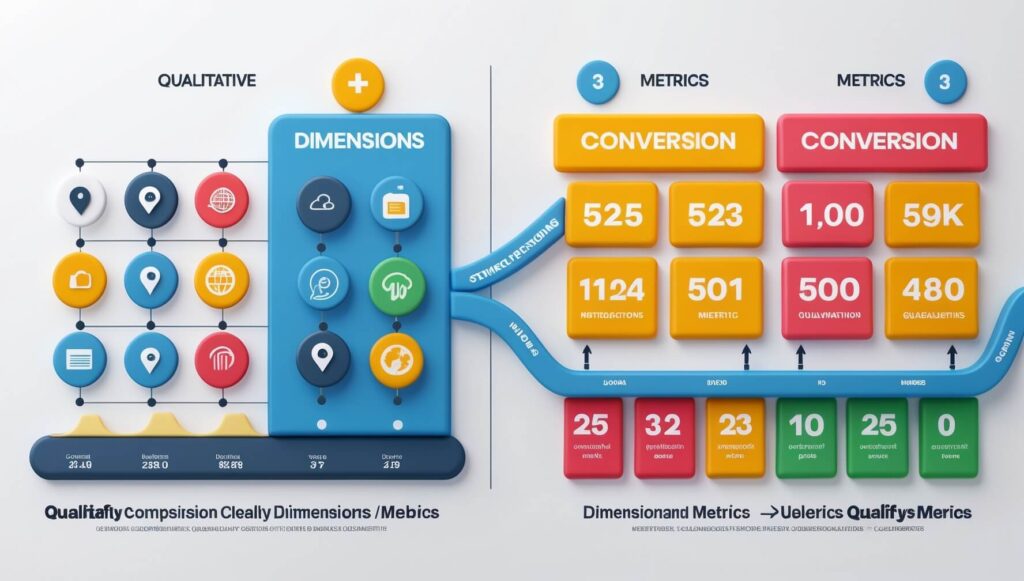
Table of Contents
Dimensions vs Metrics in Google Analytics
In Google Analytics, dimensions and metrics are two fundamental components that help you analyze and understand your website’s performance. While they work together, they serve distinct purposes and provide different types of insights. Understanding the difference between these concepts proves essential for effective data analysis.
Dimensions in Google Analytics refer to the attributes of your data that you can analyze and segment. They provide context and additional information about your website visitors, such as their location, device type, or traffic source. Think of dimensions as the descriptive elements that give meaning to your data by categorizing and classifying information. Dimensions are non-quantitative attributes that describe characteristics rather than measure them.
On the other hand, metrics are the actual quantifiable measurements of your website’s performance. They represent the numerical values that you track and analyze, such as the number of visitors, bounce rate, or conversion rate. Metrics provide quantitative data that allows you to assess the success or failure of specific actions. Where dimensions describe the “what,” metrics answer the “how many” or “how much” of your data.
Here’s a comparison to help clarify the distinction:
| Dimensions | Metrics |
|---|---|
| Qualitative (descriptive) | Quantitative (measurable) |
| Used for segmentation | Used for performance measurement |
| Examples: Traffic Source, Device Category, Landing Page | Examples: Sessions, Pageviews, Conversion Rate |
| Appear as rows in reports | Appear as columns in reports |
Understanding these distinctions between dimensions and metrics is crucial for effective data analysis in Google Analytics. By utilizing dimension attributes strategically, you can segment and examine your data from different perspectives, gaining deeper insights into user behavior and patterns. Metrics, conversely, allow you to quantify and measure the impact of your website’s performance, providing numerical evidence supporting strategic decisions.
What is a Dimension in Google Analytics
In Google Analytics, dimension attributes play a crucial role in enhancing your data analysis capabilities. They provide valuable insights into various aspects of your website visitors and their interactions. Let’s explore the different types of dimension attributes and how they contribute to your comprehensive data analysis strategy.
User-related Dimension Attributes
These dimension attributes focus on the characteristics of your website visitors. They help you gain a deeper understanding of your audience’s demographics, behaviors, and interests. Examples of user-related dimension attributes include age, gender, location, and interests. By analyzing user-related dimensions, you can create audience segments that inform personalized marketing strategies tailored to specific visitor characteristics.
Traffic-related Dimension Attributes
These dimension attributes provide insights into the various sources of traffic that bring visitors to your website. They help you understand which channels are driving the most traffic and which are most effective for your marketing efforts. Examples of traffic-related dimension attributes include source (e.g., Google, Facebook, Direct), medium (e.g., organic, referral, PPC), campaign name (e.g., Summer Sale, Holiday Promotion), and ad content. These dimensions are critical for understanding traffic effectiveness across marketing channels.
Content-related Dimension Attributes
These dimension attributes focus on the performance and effectiveness of your website content. They help you gauge how well your pages, articles, or products are resonating with your audience, and identify areas for improvement. Examples include page title, page category, product category, and author. Content-related dimensions enable you to understand which content types drive the most engagement, conversions, and user satisfaction.
Device-related Dimension Attributes
These dimension attributes provide insights into the devices and technology your visitors are using to access your website. They help you optimize your website for different devices and ensure a seamless user experience. Examples of device-related dimension attributes include device type (e.g., desktop, mobile, tablet), operating system, browser, and screen resolution. Understanding device behavior proves essential for optimizing mobile experiences in an increasingly multi-device world.
Custom Dimension Attributes
In addition to the predefined dimension attributes in Google Analytics, you can also create custom dimensions to track specific data points that are unique to your business. This allows you to tailor your data analysis and extract insights most relevant to your goals and objectives. Custom dimensions extend Google Analytics’ default capabilities, enabling you to capture business-specific information that drives competitive advantage through proprietary insights.
Exploring Custom Dimensions in Google Analytics
Custom dimensions play a crucial role in tailoring your data analysis in Google Analytics to fit your specific business needs. These dimensions allow you to capture additional data points beyond the default dimensions provided by Google Analytics. By creating and utilizing custom dimensions effectively, you can gain deeper insights into your website performance and audience behavior that inform strategic optimization efforts.
Creating Custom Dimensions
Creating custom dimensions in Google Analytics follows a straightforward process. Follow these steps to set up custom dimensions:
- Go to your Google Analytics account and navigate to the Admin section.
- Select “Custom Definitions” under the “Property” column.
- Click on “Custom Dimensions” and then “Create Custom Dimension.”
- Provide a name for your custom dimension and choose a scope that determines where the dimension will be applied.
- Save your custom dimension and ensure that you have implemented the necessary tracking code on websites.
Custom dimension scope determines whether the dimension applies at event level, user level, or item level, with each scope affecting how data is collected and reported. Event-scoped custom dimensions track specific user interactions, user-scoped dimensions capture visitor characteristics, and item-scoped dimensions apply to e-commerce products or items.
Utilizing Custom Dimensions
Once you have created custom dimensions, you can begin leveraging them to enhance your data analysis meaningfully. Custom dimensions allow you to segment your data in more meaningful ways, enabling you to uncover valuable insights about your audience, content, and marketing campaigns. Custom dimensions can track user interactions with specific website features, segment audience based on demographic information, analyze performance of different content categories, and measure marketing campaign effectiveness through custom parameters.
By combining custom dimensions with other default dimensions and metrics in Google Analytics, you can gain comprehensive understanding of your website’s performance and make data-driven decisions driving business growth. GA4 permits up to 25 user-scoped custom dimensions per property, enabling substantial extensibility for business-specific tracking needs.
The Role of Dimensions in Data Analysis
In the realm of data analysis, dimensions play a crucial role in providing valuable insights into your website’s performance. By understanding the importance of dimensions in Google Analytics, you can unlock the power to segment and analyze your data in a more granular and meaningful way. Dimensions fundamentally transform raw data into actionable business intelligence through strategic segmentation and contextual analysis.
Dimensions in Google Analytics are the attributes that help classify and organize your data. They provide context and allow you to slice and dice your data based on various factors such as user characteristics, behavior, geography, and more. By using dimensions, you can gain deeper insights into the specific aspects of your website or app that contribute to its success or need improvement. This dimensional analysis approach enables hypothesis testing about specific audience segments, traffic sources, content categories, or device types.
Segmentation Made Easy
One of the key benefits dimensions bring to data analysis is the ability to segment your audience effectively. With dimensions, you can isolate and examine user groups based on specific criteria. This segmentation allows you to identify trends, patterns, and behaviors that may go unnoticed when analyzing your data as a whole.
For example, with dimensions such as “geographic location” or “device type,” you can analyze how users from different regions or using different devices interact with your website or app. This information helps you tailor your marketing strategies, improve user experience, and optimize your content accordingly. Secondary dimensions enhance this capability by enabling two-dimensional segmentation—combining primary and secondary dimensions reveals nuanced behavioral patterns.
Uncovering User Behavior Insights
Dimensions also enable you to delve deeper into user behavior patterns. By analyzing dimensions such as “landing page,” “exit page,” or “traffic source,” you can understand how users navigate through your site, where they drop off, and which channels are driving the most traffic. Additionally, dimensions like “user type” or “engagement level” allow you to differentiate between new and returning users or measure the level of user engagement. These insights guide you in creating personalized experiences, targeting specific user segments, and improving customer retention strategies.
Visualizing Data with Custom Reports
Google Analytics offers the flexibility to create custom reports that combine dimensions and metrics to provide comprehensive views of your data. By leveraging dimensions in custom reports, you can visualize data in formats aligning with your specific reporting needs. You can create custom reports displaying dimensions like “age group” or “gender” alongside metrics such as “average session duration” or “conversion rate” for deeper audience segment analysis.
| Dimension | Associated Metrics | Business Insight |
|---|---|---|
| Geographic location | Pageviews, Sessions | Geographic performance distribution |
| Traffic source | Bounce rate, Conversion rate | Channel effectiveness assessment |
| User type | Conversion rate, Engagement | New vs. returning user value |
By harnessing the power of dimensions in Google Analytics, you can navigate through the sea of data and extract meaningful insights that drive informed decision-making and fuel the growth of your online presence. Dimensions transform volume of raw data into strategic understanding, enabling precise targeting and optimization.

Using Dimensions for Audience Analysis
Dimensions play a crucial role in audience analysis with Google Analytics. By leveraging dimensions effectively, you can gain valuable insights into your website visitors’ behaviors, demographics, and preferences. Understanding your audience is essential for optimizing your marketing strategies and delivering personalized experiences.
Audience Behavior Analysis
One of the key advantages of using dimensions for audience analysis is the ability to analyze user behaviors comprehensively. By applying dimensions such as source/medium, landing page, or behavior flow, you can track how different segments of your audience interact with your website. This information allows you to identify high-performing pages, popular referral sources, and potential areas for improvement. Understanding behavioral patterns enables deeper user journey analysis revealing conversion bottlenecks and optimization opportunities.
Demographics Segmentation
Another powerful aspect of dimensions is the ability to segment your audience by demographics. With dimensions such as age, gender, and location, you can identify the characteristics of your website visitors and tailor your content or marketing campaigns accordingly. This level of segmentation empowers you to create personalized experiences and target specific demographics with relevant messaging resonating with their unique needs.
Conversion Analysis
Dimensions also enable you to analyze audience conversions and identify trends or patterns. By applying dimensions like traffic source or campaign, you can track the effectiveness of your marketing efforts and determine which channels are driving the most conversions. This information allows you to allocate your resources more strategically and optimize your conversion rates. Channel-level conversion analysis reveals which marketing investments deliver strongest ROI.
Device Analysis
With the increasing use of mobile devices, analyzing audience behavior across different devices has become critical. By using dimensions like device category or screen resolution, you can gain insights into how your website performs on various devices and optimize the user experience accordingly. This analysis helps you prioritize mobile optimization efforts and deliver seamless experiences across all devices, recognizing that mobile traffic represents majority of web interactions.
| Dimension | Description | Use Case |
|---|---|---|
| Source/Medium | Identifies traffic source and medium (organic search, referral, social media) | Channel attribution analysis |
| Landing Page | Tracks specific page where users enter website | Landing page performance testing |
| Age | Segments audience into age groups | Age-based targeting strategy |
| Gender | Classifies audience as male or female | Gender-specific content personalization |
| Location | Provides geographic distribution insights | Geographic expansion strategy |
| Device Category | Categorizes device types (desktop, mobile, tablet) | Mobile-first optimization priority |
| Campaign | Tracks marketing campaign performance impact | Campaign ROI measurement |
Dimensions for Content Performance Analysis
In this section, we will explore how dimensions can be valuable tools for analyzing and improving the performance of your content in Google Analytics. By utilizing dimensions effectively, you can gain valuable insights into how your content is resonating with your audience and make data-driven decisions to optimize your content strategy.
Assessing the Effectiveness of Your Content
Dimensions in Google Analytics allow you to analyze various aspects of your content to determine its effectiveness. You can use dimensions to segment your data and understand how different content types, categories, or topics perform. By examining metrics such as page views, time on page, and bounce rate for each dimension, you can identify patterns and trends guiding your content strategy. For example, if you have an e-commerce website, you can use dimensions to analyze the performance of different product categories and allocate resources accordingly.
Making Data-Driven Decisions for Improvement
Once you have gathered insights from your content analysis, dimensions help you make informed decisions improving your content strategy. By identifying the dimensions correlating with higher engagement and conversions, you can focus on creating more content in those areas or optimizing existing content aligning with audience preferences. GA4 enables creation of new dimensions for paid and organic traffic analysis, providing enhanced reporting capabilities.
Content Performance Analysis Table
| Dimension | Pageviews | Time on Page | Bounce Rate |
|---|---|---|---|
| Blog Category A | 5,000 | 2 minutes | 30% |
| Blog Category B | 3,500 | 3 minutes | 25% |
| Blog Category C | 2,000 | 1.5 minutes | 45% |
Based on these insights, Blog Category B demonstrates highest engagement and lowest bounce rate, indicating strong audience resonance. This information guides future content creation and optimization efforts, helping you achieve better results. By leveraging dimensions in Google Analytics for content performance analysis, you gain deeper understanding of content effectiveness enabling data-driven optimization.
Dimensions for Campaign Analysis
When it comes to analyzing the success of your marketing campaigns in Google Analytics, dimensions play a crucial role. By leveraging dimensions effectively, you can gain valuable insights into various aspects of your campaigns and make data-driven decisions for optimization. Dimensions provide the framework for categorizing campaign data enabling strategic performance evaluation.
Dimensions in Google Analytics provide a way to categorize and classify data, allowing you to segment and analyze your campaign performance based on specific attributes. These attributes can include parameters such as campaign source, medium, keywords, and more. By utilizing dimensions for campaign analysis, you can track the effectiveness of your marketing efforts and identify key areas for improvement.
Campaign Source Dimension
The campaign source dimension allows you to understand which sources are driving the most traffic to your campaigns. With this information, you can assess the performance of different marketing channels and allocate your resources accordingly. By analyzing source-level performance, you identify highest-performing channels deserving increased investment.
| Campaign Source | Users | Conversions | Conversion Rate |
|---|---|---|---|
| Google Ads | 10,000 | 250 | 2.5% |
| Facebook Ads | 8,000 | 180 | 2.25% |
| Email Marketing | 5,000 | 150 | 3% |
Campaign Medium Dimension
The campaign medium dimension provides insights into the different mediums through which your campaigns are reaching your audience. This dimension helps you evaluate the performance of various marketing tactics and channels. Understanding medium-level performance enables tactical optimization decisions about which channels deserve greater resource allocation.
| Campaign Medium | Users | Conversions | Conversion Rate |
|---|---|---|---|
| Paid Search | 7,000 | 200 | 2.86% |
| Social Media | 5,000 | 150 | 3% |
| 3,000 | 100 | 3.33% |
Campaign Keywords Dimension
The campaign keywords dimension helps you analyze the keywords that drive traffic and conversions for your campaigns. By understanding the keywords resonating with your audience, you can refine your targeting and improve your campaign performance. Keyword-level analysis reveals which search terms generate most valuable traffic, informing keyword bidding and content strategies.
| Campaign Keywords | Users | Conversions | Conversion Rate |
|---|---|---|---|
| Product A | 2,500 | 75 | 3% |
| Product B | 1,800 | 60 | 3.33% |
| Product C | 1,200 | 40 | 3.33% |
By examining data in these tables, you can determine which keywords are driving most value for your campaigns. This knowledge allows you to optimize your keyword targeting and improve overall campaign performance through evidence-based strategic decisions.

Advanced Techniques with Dimensions in Google Analytics
In this section, we will introduce you to some advanced techniques for utilizing dimensions in Google Analytics. By leveraging these techniques, you can gain deeper insights and make more informed decisions based on your data analysis. Advanced dimension usage transforms Google Analytics from reporting tool into strategic business intelligence platform.
Combining Dimensions
Combining dimensions allows you to uncover unique insights by analyzing multiple dimensions together. This technique enables you to segment your data in more granular ways, providing comprehensive views of your website visitors and their behaviors. For example, you can combine dimensions like “source” and “device category” to analyze the performance of your marketing campaigns across different devices and traffic sources. This approach reveals sophisticated audience segments deserving specialized strategies.
Creating Custom Reports
Custom reports offer tailored views of your data, allowing you to focus on specific dimensions and metrics most relevant to your business goals. By creating custom reports, you can design personalized dashboards providing holistic views of your data, making it easier to spot trends and patterns. You can include dimensions like “landing page” and metrics like “conversion rate” in your custom reports to enhance GA4 reports significantly, enabling stakeholder-specific reporting tailored to audience needs.
Gaining Deeper Insights
Dimensions in Google Analytics go beyond simple data segmentation. They can be combined with metrics to gain deeper insights into your website performance. By combining the “pageviews” metric with the “country” dimension, you can identify which countries generate most engagement on specific pages of your website. These insights help you optimize your content and marketing strategies to better target your audience geographically and culturally.
Conclusion
Throughout this article, we have explored the concept of dimensions in Google Analytics and their importance in data analysis. Dimensions, as defined in Google Analytics, provide valuable insights into various attributes of your website visitors, content performance, and marketing campaigns. Understanding what is a dimension in Google Analytics represents foundational knowledge enabling sophisticated data analysis.
By utilizing dimensions effectively, you can enhance your data analysis capabilities and make informed decisions for your business. Dimensions allow you to segment and analyze data in more granular and meaningful ways, enabling you to understand your audience, evaluate content performance, and measure campaign success. We discussed the different types of dimension attributes in Google Analytics, including custom dimensions that can be created to suit your specific business needs. We also introduced advanced techniques such as combining dimensions and creating custom reports to gain deeper insights from your data.
In conclusion, dimensions play a crucial role in Google Analytics, empowering you to unlock valuable information and drive data-informed strategies. By harnessing the power of dimensions, you can optimize your website, content, and marketing efforts, ultimately leading to improved performance and sustainable growth for your business through evidence-based decision-making grounded in dimensional analysis.


Comments are closed.