
Cart 0


Share
Reaching your target audience across the digital landscape represents one of the most critical challenges modern marketers face when competing for consumer attention. The Google Display Network transforms advertising strategy by providing comprehensive access to over 90% of global internet users through more than 2 million websites and applications worldwide. Unlike search advertising that reaches users actively seeking solutions, display advertising positions brands directly in front of audiences during their browsing experiences across diverse platforms. Understanding what are the key benefits of using the Google Display Network proves essential for marketers seeking to maximize brand visibility, drive qualified traffic, and achieve measurable return on investment at scale. This comprehensive guide explores the strategic advantages that position GDN as a cornerstone of modern digital advertising, from unprecedented reach and advanced targeting capabilities through cost-effective performance metrics enabling data-driven optimization.
Table of Contents
Massive Reach and Brand Visibility: Expanded Online Exposure
Grasping the foundational advantage requires examining GDN’s unparalleled scale and coverage that fundamentally transforms campaign reach potential. The network encompasses over 2 million websites and mobile applications, reaching approximately 90% of global internet users—a scale advantage that creates exponential visibility opportunities compared to single-channel or limited-network strategies. Every 24 hours, GDN reaches 65% of this audience, meaning approximately 1.17 million users rotate through the network daily, providing continuous exposure opportunities for campaign messages.
This massive reach addresses fundamental marketing challenges by solving visibility barriers that constrain growth in competitive markets. Brands can expose products and services to vastly larger audiences than traditional media, local advertising, or even multiple smaller networks combined could achieve. When examining what are the key benefits of using the Google Display Network, reach represents the cornerstone advantage—the sheer scale enables brands to build awareness among audiences who might never encounter products through search advertising or owned channels alone. According to recent analysis, GDN’s extensive reach significantly builds brand awareness by positioning brands consistently across websites and applications users visit regularly.
Beyond raw numbers, reach translates into practical advantages for audience discovery and market penetration. New products enter markets where brand recognition is minimal—display advertising across vast networks accelerates awareness building by positioning brands in high-traffic environments where target audiences congregate. Established brands maintain visibility among new customer segments that search advertising alone might miss. Regional businesses expand beyond geographic limitations by advertising across web platforms reaching users nationally or internationally. This reach foundation underpins all downstream benefits, enabling sophisticated targeting, personalization, and conversion optimization impossible without large-scale audience access.
| Reach Metric | Scale | Business Implication |
|---|---|---|
| Network Coverage | 2+ million websites & apps | Unmatched platform diversity for audience access |
| Global Internet Penetration | 90% of global users | Enables worldwide market expansion and brand building |
| Daily Active Reach | 65% daily (1.17M+ users) | Consistent daily exposure opportunities for messaging |
| Platform Diversity | Websites, apps, YouTube, Gmail | Multi-touchpoint brand presence across user journeys |

Advanced Targeting Precision: Reaching the Right Audience
Massive reach alone generates wasted impressions without precise targeting connecting brands with audiences most likely to engage. GDN’s sophisticated targeting architecture transforms raw reach into precision marketing by enabling advertisers to segment audiences across multiple dimensions simultaneously. Demographic targeting segments audiences by age, gender, location, income level, and parental status—basic categorizations enabling core audience definition. However, advanced options extend far beyond demographics through interest targeting based on browsing history and demonstrated preferences, behavioral targeting analyzing purchase patterns and engagement history, and contextual targeting matching ads to webpage content ensuring relevance.
This targeting sophistication directly addresses fundamental performance challenges by eliminating inefficient reach—resources concentrate on audiences with highest conversion potential rather than scattering budget across indiscriminate impressions. When analyzing what are the key benefits of using the Google Display Network, targeting precision emerges as the mechanism enabling reach to convert into results. Contextual targeting particularly demonstrates unique capability—Google analyzes webpage content and serves ads specifically relevant to that context, meaning a vacation-planning article receives travel ads while technology news receives software ads. This ensures ads appear in environments where audiences actively engage with related topics, dramatically improving relevance and engagement likelihood.
Audience-based targeting creates additional precision through first-party data analysis revealing actual visitor behaviors and interests. Affinity audiences reach users repeatedly demonstrating interest in specific topics. In-market audiences identify users actively researching and considering purchases. Custom intent audiences target users searching for specific keywords indicating purchase readiness. This layering enables hyper-targeted campaigns that would be impossible through demographic targeting alone—reaching exactly the right person with exactly the right message at optimal moments in their consideration journey maximizes efficiency and conversion probability.
Cost-Effective Advertising Model: Maximizing Budget Efficiency
Investment efficiency distinguishes successful marketing programs from budget waste. GDN’s pay-per-click (PPC) pricing model eliminates payment for wasted impressions by charging only when users actually click advertisements—a fundamental efficiency advantage over cost-per-impression models where brands pay regardless of user engagement. This performance-based pricing aligns advertiser and platform interests by rewarding engaging creative and relevant targeting while penalizing irrelevant placements.
Cost structure directly impacts budget sustainability and ROI potential, making efficiency a critical evaluation dimension when assessing what are the key benefits of using the Google Display Network. Typical display advertising cost-per-click averages substantially lower than Google Search Network, providing access to audience exposure at reduced price points. This affordability makes GDN particularly attractive for businesses with limited advertising budgets seeking to build awareness without massive financial commitments. Brands can test campaign hypotheses, experiment with creative variations, and gradually scale successful approaches without committing enormous upfront budgets—a critical advantage for small-to-medium businesses establishing digital advertising programs.
Budget control mechanisms enable sophisticated spending optimization. Advertisers set daily budgets preventing unexpected overspending, customize maximum bids per click enabling cost management within target parameters, and adjust bids by audience, demographic, or placement for granular spending allocation. Real-time analytics reveal cost-per-click by audience segment, placement, and creative variation enabling rapid reallocation toward high-efficiency combinations. This combination of pay-for-performance pricing, accessible price points, and sophisticated budget controls makes GDN economically viable for organizations ranging from bootstrapped startups to multinational corporations, democratizing access to large-scale advertising previously accessible only to well-funded competitors.
Rich Media and Interactive Ad Formats: Engaging User Experiences
Static text-based advertising increasingly fails to capture attention amid content abundance and ad blindness pervasiveness. GDN supports diverse ad formats enabling experiential marketing that engages audiences beyond passive viewing. Responsive display ads automatically adjust to available placements, dynamically sizing and formatting to match webpage layouts—a single ad creation effort serves thousands of placement variations without manual optimization. Image ads showcase visual products through high-quality graphics and photography particularly effective for visual categories like travel, real estate, fashion, and e-commerce. Video ads leverage storytelling and emotional connection through dynamic content that demonstrates products, reveals customer testimonials, or explains complex concepts impossible through static formats.
Interactive ad formats represent sophisticated engagement tools enabling audiences to interact with ads directly within ad units. Quizzes and surveys provide entertainment while capturing audience preference data. Carousel ads enable users to browse products through interactive gallery experiences. App promotion ads feature game-like interactions encouraging direct installation engagement. These interactive experiences dramatically outperform static ads through entertainment value and direct participation, transforming ads from passive messages into engagement experiences. Understanding what are the key benefits of using the Google Display Network includes recognizing that format diversity enables creative teams to match ad types to campaign objectives—awareness campaigns leverage video storytelling, consideration campaigns use comparison formats, decision-stage campaigns drive interactive product configurations.
Rich media support extends beyond basic formats to sophisticated advertising innovations. Google introduced auto-generated video capabilities enabling AI-powered video creation from product feeds, expanding video reach to advertisers lacking video production resources or budgets. Gmail sponsored promotions place ads within Gmail Promotions tabs, expanding when clicked into full email-like experiences. 3D ad formats emerging in 2025 enable immersive product visualization increasing engagement and conversion likelihood. This format evolution ensures GDN remains current with creative innovation trends, providing access to emerging formats as they prove effective—early adopters gain competitive advantages before formats become saturated.
Remarketing and Audience Re-engagement: Converting Lost Opportunities
Visitor acquisition represents one of marketing’s most expensive activities—acquiring website or app visitors costs significantly through advertising, content marketing, and search optimization. Abandoning visitors without conversion optimization wastes acquisition investments catastrophically. GDN’s remarketing capabilities address this inefficiency by re-engaging visitors who failed to convert on initial exposure, providing second and third opportunities for conversion without additional acquisition costs.
Remarketing strategy acknowledges that purchase decisions rarely occur after single exposures—complex consideration processes typically require multiple touchpoints across extended timeframes. When exploring what are the key benefits of using the Google Display Network, remarketing emerges as high-efficiency, high-ROI capability because audiences already demonstrated interest by visiting websites or using apps. Rather than cold audience development, remarketing targets warm leads with proven interest substantially more likely to convert than untargeted audiences. This explains why remarketing typically generates 5-10x higher conversion rates than cold audience targeting despite lower volume—conversion probability far exceeds acquisition targeting despite smaller audience size.
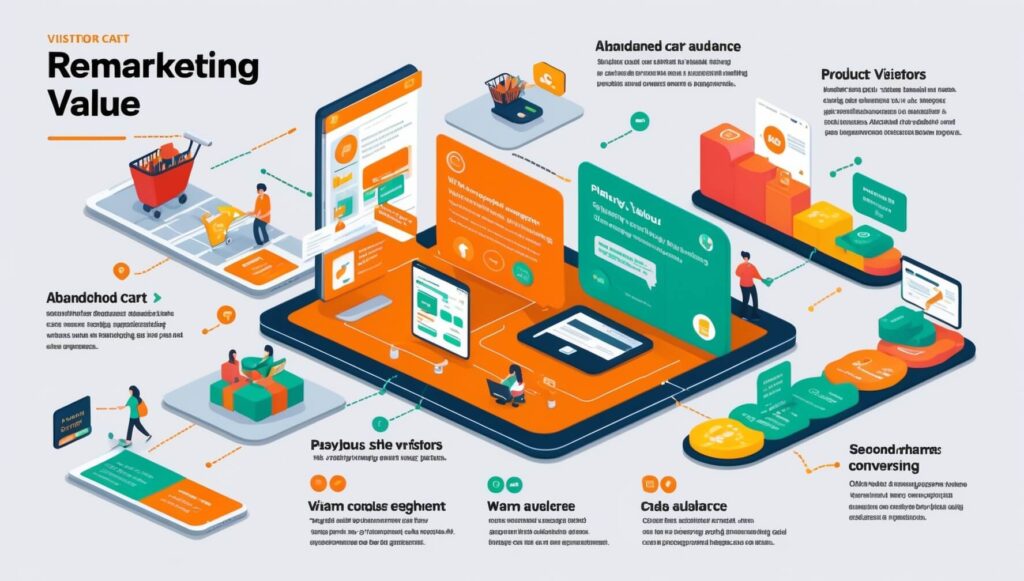
Advanced remarketing segmentation enables sophisticated re-engagement strategies addressing distinct abandonment reasons. Abandoned cart audiences receive targeted incentives—discount codes, free shipping offers, urgency messaging—specifically designed to overcome purchase hesitation. Product page visitors who viewed specific items receive dynamic ads showcasing those exact products, reducing friction by pre-qualifying audiences for specific products. Site visitors without engagement receive educational content introducing brand value propositions. Existing customers receive cross-sell and upsell messaging promoting complementary products. This segmentation ensures re-engagement messaging addresses specific abandonment contexts rather than generic “come back” messaging.
| Remarketing Segment | Trigger | Messaging Strategy | Expected Impact |
|---|---|---|---|
| Abandoned Cart | Added items without purchasing | Discount incentives, urgency messaging | 25-35% recovery rate |
| Product Viewers | Viewed specific products | Dynamic product ads showing exact items | 8-15% conversion rate |
| Site Visitors | Visited but didn’t explore | Educational content, value proposition | 3-7% conversion rate |
| Existing Customers | Completed purchases previously | Cross-sell, upsell, loyalty rewards | 15-25% repeat purchase rate |
Cross-Device Targeting: Seamless Multi-Platform Presence
Modern audiences fragment across multiple devices throughout daily routines—researching on smartphones during commutes, browsing on tablets during leisure time, working on desktop computers during office hours, and connecting through smart home devices. This device fragmentation creates marketing complexity because users frequently start journeys on one device and complete them on another. Traditional single-device advertising creates silos where brands manage separate campaigns per device without cohesive experience continuity.
GDN’s cross-device targeting capability unifies user experiences across device transitions, maintaining consistent brand messaging and messaging continuity regardless of device switching. When evaluating what are the key benefits of using the Google Display Network, cross-device capability addresses fundamental modern marketing complexity by enabling brands to follow users seamlessly across devices. A user researching on mobile sees consistent branding on desktop, creates aligned messaging across their consideration journey, and maintains momentum toward conversion despite device transitions. This continuity proves particularly important for remarketing—audiences who abandoned carts on mobile should receive coordinated re-engagement messages when using tablets or desktops rather than duplicative or conflicting messaging.
Device optimization extends beyond consistency to platform-specific adaptation—ads automatically optimize for mobile with thumb-friendly button sizing, simplified designs reducing data consumption, and vertical-oriented layouts matching smartphone screens. Desktop ads leverage larger creative canvases for detailed information and sophisticated interactive elements. Tablet experiences balance mobile and desktop approaches. This device-aware optimization ensures users receive optimal experiences suited to device characteristics rather than identical experiences scaled inappropriately across platforms. The result improves engagement across all devices while maintaining integrated brand experiences across the multi-device user journey.
Detailed Performance Analytics and Measurement: Data-Driven Optimization
Effective marketing requires rigorous measurement enabling evidence-based decision-making replacing assumption-driven campaign management. GDN provides comprehensive analytics integration with Google Analytics enabling granular performance visibility across impressions, clicks, conversions, demographics, placements, and audience segments. This measurement foundation transforms campaign management from guesswork into systematic optimization identifying what works, what doesn’t, and where to allocate resources for maximum impact.
Understanding what are the key benefits of using the Google Display Network requires acknowledging measurement as foundational competitive advantage. Detailed visibility into impressions reveal reach and frequency across campaigns and placements. Click data indicates creative appeal and audience relevance—higher CTR suggests resonant messaging while low CTR signals creative or targeting misalignment. Conversion data connects downstream results to advertising touchpoints, enabling attribution analysis revealing which placements, audiences, and creatives drive revenue. Cost metrics including cost-per-click, cost-per-acquisition, and return on ad spend enable economic evaluation determining campaign profitability.
Advanced analytics capabilities increasingly incorporate AI-powered insights and predictive analysis. Google Analytics 4 integration provides enhanced cross-device tracking improving attribution accuracy across device transitions. Predefined reports surface performance patterns without requiring custom analysis. Custom dashboards consolidate key metrics enabling single-view performance monitoring. Conversion modeling compensates for cookieless tracking challenges by predicting user behaviors using machine learning. This evolution toward AI-augmented analytics enables marketers to extract actionable insights from vast datasets, identifying opportunities and threats faster than manual analysis could achieve.
Placement reporting deserves particular attention for GDN optimization—visibility into specific websites, apps, and YouTube channels where ads appear enables optimization decisions targeting high-performing placements with increased bids while excluding underperforming placements wasting budget. This granular visibility combined with management controls enables continuous optimization improving campaign efficiency. Real-time performance dashboards enable rapid response to performance changes, detecting problems before they accumulate waste, and scaling successes before competition catches up.

User-Friendly Campaign Management: Accessible Advertising Technology
Sophisticated advertising platforms intimidate marketers lacking technical expertise, creating barriers to entry that exclude smaller organizations from advanced capabilities. GDN deliberately democratizes access through intuitive interfaces, templates, and automation reducing required technical knowledge while maintaining capability for expert optimization. Campaign creation wizards guide users through setup processes with logical sequences and helpful prompts. Pre-built templates provide starting points for common campaign types rather than blank canvas intimidation. Responsive ads automatically adjust to placements eliminating manual size and format management.
When considering what are the key benefits of using the Google Display Network, accessibility emerges as competitive advantage for democratizing sophisticated advertising. Small businesses without dedicated marketing technology expertise can launch competitive campaigns without hiring specialized staff or expensive consultants. In-house marketing teams without display advertising background can quickly become operational rather than requiring extensive learning curves. This democratization accelerates time-to-market for advertising initiatives and reduces barrier-to-entry costs enabling resource-constrained organizations to participate in growth channels previously accessible only to well-resourced competitors.
Automation features progressively reduce manual workload as experience increases. Smart bidding automates optimization toward conversion goals, adjusting bids across thousands of placements automatically. Performance Max campaigns enable broad reach strategies using AI to determine optimal placements and format combinations. Responsive search ads automatically test copy variations, learning which combinations perform best. Campaign validation tools identify common mistakes preventing suboptimal campaign launch. While experienced marketers retain manual control for specialized optimization, automation defaults enable rapid competence for newcomers with aspirations toward expert-level performance.
AI-Powered Targeting and Personalization Innovation: 2025 Advances
Artificial intelligence increasingly transforms advertising by automating targeting decisions, personalizing creative at individual user levels, and predicting conversion probability before campaign exposure. GDN’s 2025 innovations integrate AI throughout targeting and optimization eliminating manual tasks while improving performance through machine-scale optimization impossible manually. AI-driven audience predictions identify users most likely to convert, adjusting bid strategies dynamically to concentrate budget on highest-probability audiences. Dynamic creative optimization automatically tests creative combinations identifying winners at individual user levels rather than broad segments.
Examining what are the key benefits of using the Google Display Network increasingly requires acknowledging AI integration as foundational differentiator. Approximately 52% of companies now utilize AI for marketing efficiency according to recent analysis, and GDN adoption of AI capabilities positions it competitively within this evolution. Auto-generated video capabilities enable advertisers without video production expertise to create video ads automatically from product feeds. Natural language processing improves ad copy by analyzing performance data and suggesting optimization opportunities. Audience lookalike modeling identifies users similar to best customers, expanding reach toward audiences most likely to exhibit similar conversion behaviors.
Privacy-compliant personalization addresses tracking restrictions through first-party data analysis and predictive modeling. As third-party cookies deprecate, GDN increasingly relies on authenticated user data, customer list uploads, and machine learning predicting user behaviors without individual-level tracking. This evolution maintains personalization sophistication despite privacy regulation while positioning GDN advantageously compared to platforms struggling with privacy compliance.
Complementary Positioning: Balancing Display and Search Advertising
Sophisticated advertising strategies rarely rely on single channels—comprehensive approaches integrate multiple channels addressing different audience stages and mindsets. GDN and Google Search complement each other through distinct advantages—search ads reach users actively seeking solutions through keyword specificity, while display ads build awareness among browsing audiences without active search intent. This complementarity creates strategic value when properly balanced.
Search advertising exhibits higher conversion rates because searchers demonstrate active intent, but reaches limited audience volume through search volume constraints. Display advertising reaches vastly larger audiences at lower cost but exhibits lower conversion rates due to passive exposure contexts. Combined strategies capture both active-intent high-converting users through search while building awareness among larger populations through display—expansion amplifying total reachable market. Understanding what are the key benefits of using the Google Display Network includes recognizing this complementary positioning enables comprehensive audience coverage that single-channel reliance cannot achieve.
Strategic integration requires appropriate budget allocation across channels based on campaign objectives and audience maturity. Awareness campaigns might allocate 70% display, 30% search focusing on reach and brand building. Consideration campaigns might balance closer to 50-50 targeting research-phase audiences both actively searching and browsing content. Conversion campaigns might allocate 20% display (remarketing warm audiences), 80% search targeting high-intent keywords. This intelligent allocation maximizes budget efficiency by matching channels to appropriate campaign stages rather than distributing budgets equally regardless of channel fit.
Conclusion: Strategic GDN Implementation for Advertising Success
The Google Display Network delivers transformative advertising capabilities addressing fundamental marketing challenges through massive reach, precision targeting, cost efficiency, and measurement sophistication. When assessing what are the key benefits of using the Google Display Network, comprehensive understanding encompasses all dimensions—reach and visibility building brand awareness among vast audiences, advanced targeting precision connecting brands with ideal customers, cost-effective pay-per-click models enabling sustainable budget efficiency, rich media formats enabling engaging creative experiences, remarketing capabilities recovering abandoned opportunities, cross-device consistency maintaining brand presence across user device transitions, and detailed analytics enabling systematic performance optimization.
These benefits combine synergistically into comprehensive advertising systems where reach enables targeting, targeting enables personalization, and measurement enables continuous optimization. Organizations embracing GDN strategically position themselves for competitive advantage through audience access, cost efficiency, and performance transparency that fragmented alternative approaches struggle to match. Whether launching new digital advertising initiatives, expanding existing programs, or evaluating platform consolidation opportunities, the Google Display Network offers compelling advantages justifying prominent positioning within modern advertising strategies.
Implementation success requires moving beyond feature awareness toward strategic integration—defining clear objectives, establishing measurement frameworks, developing creative assets suited to multiple formats, establishing audience segmentation strategies, and committing to continuous optimization based on performance data. Organizations approaching GDN as tactical campaign tool versus strategic competitive capability will achieve results matching their ambition levels. Those investing in systematic strategy, rigorous measurement, creative excellence, and optimization discipline will unlock GDN’s full potential, capturing competitive advantages through superior efficiency, reach, and results that justify GDN’s prominence within modern digital advertising ecosystems. The strategic question evolves from whether to use Google Display Network toward how to maximize its potential through thoughtful strategy and disciplined execution.


Comments are closed.