Cart 0

Share
Table of Contents
WGU Data Analytics: Charting Your Course in Data Analytics
The numbers defining the data analytics job market in 2024 are striking by any professional benchmark. Average data analyst salaries have risen to $111,000—an increase of more than $20,000 from the previous year—while the U.S. Bureau of Labor Statistics projects a 23% increase in demand for data analytics professionals by 2032, a growth rate far outpacing most other technical fields. Against that backdrop, the decision to formalize your data analytics education is less a question of whether it is strategically worthwhile and more a question of which program gives you the most direct, efficient path to career-ready competency. The WGU Data Analytics program has earned significant recognition as one of the most structurally distinctive options in that landscape—combining a competency-based learning model, embedded industry certifications, and a genuinely flexible online format in a single accredited degree that was designed specifically around the practical requirements of working professionals. This guide examines the program in depth: its curriculum architecture, the certifications it includes, the technical skills it develops, the career outcomes it enables, and why its model differs fundamentally from traditional semester-based online programs in ways that matter for students balancing education with professional and personal commitments.
What Makes WGU Data Analytics Distinctively Different
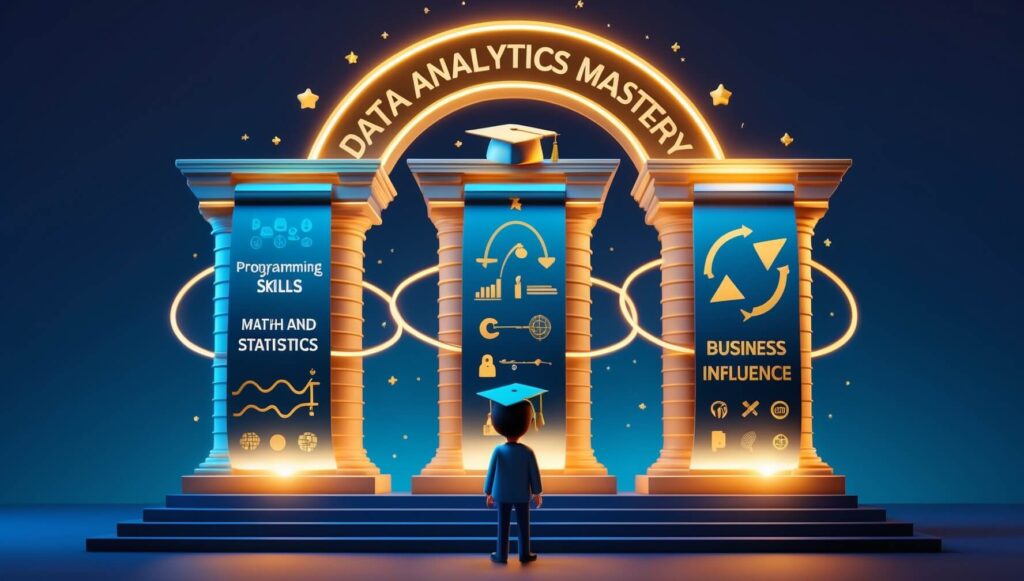
Western Governors University operates on a competency-based education (CBE) model that is philosophically and structurally different from every traditional university offering an online degree. In a conventional program, your academic progress is measured by time: you complete a course over a fixed semester, take exams at scheduled intervals, and advance on a calendar regardless of how quickly or slowly you have actually mastered the material. At WGU, progress is measured exclusively by demonstrated competency: you advance when you can prove you have mastered the material, not when a certain number of weeks have elapsed. If you already have strong working knowledge of SQL, statistical methods, or Python from professional experience, you can move through those competency assessments quickly and invest your study time where you genuinely need to build new skills. If a concept requires more time and practice to master solidly, you can take that time without falling behind on an arbitrary calendar. As the official curriculum overview from WGU’s Bachelor of Science in Data Analytics program page confirms, the B.S. in Data Analytics consists of 42 courses structured around three balanced skill dimensions—programming skills, mathematical skills, and business influence skills—with each competency assessed independently and advancement tied entirely to demonstrated mastery rather than seat time.
The practical implication of this model for working professionals is significant: students who dedicate focused effort can progress substantially faster than a fixed-semester program permits, with some students completing the bachelor’s degree in as little as six months to a year through intensive study. The flat per-term tuition structure—where you pay by the six-month term regardless of how many courses you complete—means that faster progression directly translates into lower total program cost. Equally importantly, the self-paced model eliminates the scheduling conflicts that prevent many working professionals from pursuing traditional degree programs: there are no fixed class meeting times, no mandatory live sessions to schedule around work obligations, and no penalties for taking a lighter load during professionally demanding periods and accelerating during periods with more available study time.
The Curriculum: Three Skill Pillars Built for Industry Relevance
The WGU Data Analytics bachelor’s program curriculum is deliberately structured around three interconnected skill dimensions that reflect what employers across industries consistently identify as the full competency profile of a valuable data analytics professional. This tripartite framework is one of the program’s most thoughtful design elements, because it addresses a common gap in narrowly technical data programs: producing graduates who can analyze data rigorously but struggle to communicate findings, influence decisions, or operate effectively within organizational contexts.
Programming and Technical Skills
The technical programming dimension of the curriculum builds proficiency in the languages and tools that form the practical foundation of professional data work. Students develop working knowledge of Python for data manipulation, automation, and machine learning implementation—the language referenced most frequently in data analyst job postings across all industries and experience levels. The curriculum also covers R programming for statistical computing and visualization, SQL for database querying and data management, data wrangling techniques for cleaning and preparing real-world messy datasets, and scripting approaches for building reproducible data pipelines. Beyond individual languages, the program addresses systems thinking—understanding how data flows through organizational architectures and how individual analysis work connects to broader data infrastructure. Machine learning fundamentals are also integrated, reflecting the growing expectation from employers that data analysts can apply basic ML concepts to predictive and classification problems, not just descriptive analysis. As the skills certificate curriculum detail from WGU’s Data Analytics Skills Certificate program page confirms, students also develop proficiency with industry-standard business intelligence tools including Microsoft Power BI and Tableau—the two visualization platforms most widely used in enterprise analytics environments.
Mathematics and Statistical Analysis
The mathematical dimension ensures that WGU Data Analytics graduates understand the quantitative foundations of the analytical methods they apply, rather than using tools as black boxes without comprehending the assumptions and limitations of the underlying techniques. Core coverage includes probability theory, statistical inference, hypothesis testing, regression analysis, and the mathematical foundations of data science methods. Discrete mathematics provides the logical and combinatorial reasoning foundations that underlie database operations, algorithm design, and computational problem-solving. Statistical analysis courses teach students to apply both descriptive and inferential statistical methods to real datasets—calculating measures of central tendency and dispersion, identifying distributions, building and interpreting linear and logistic regression models, and assessing the statistical significance of findings in ways that produce defensible, reproducible conclusions rather than data-dredged artifacts. This mathematical rigor is what separates analysts who understand why their models work—and when they will fail—from those who can run analyses mechanically without being able to diagnose when results are unreliable or interpret the limits of their inferences.
Business Influence and Communication Skills
The third pillar—business influence skills—is what most purely technical data programs underinvest in, and it is increasingly where the career differentiation between good data analysts and great ones is decided. Technical proficiency in Python and statistical modeling creates the analytical foundation, but the ability to communicate findings compellingly to non-technical stakeholders, build organizational support for data-driven recommendations, translate business questions into analytical frameworks, and navigate change management dynamics determines how much real-world impact those analytical capabilities actually generate. The WGU Data Analytics curriculum addresses this through coursework in data storytelling—the craft of building narratives around data that make complex findings accessible and persuasive to diverse audiences—as well as leadership, critical thinking, design thinking, and change management. These are not soft additions to a technical curriculum; they are the professional capabilities that employers across every industry consistently rank as differentiating factors between data analysts who advance rapidly and those who plateau in entry-level technical roles. The career outlook analysis from 365 Data Science’s comprehensive data analyst job outlook for 2025 confirms that communication, stakeholder management, and the ability to translate data insights into business recommendations appear in a significantly higher percentage of senior data analyst job postings than technical skills alone—reinforcing why WGU’s inclusion of this dimension reflects genuine market intelligence rather than curriculum padding.
Data Mining and Advanced Analytics Techniques
One of the core technical competency areas in the WGU Data Analytics program is data mining—the process of discovering patterns, relationships, and anomalies in large datasets using computational methods that go beyond standard descriptive statistics. Mastering data mining equips graduates to tackle the kinds of complex, open-ended analytical problems that generate the highest business value: predicting customer churn, detecting fraudulent transactions, identifying product cross-sell opportunities, segmenting customer populations for targeted marketing, and surfacing non-obvious operational inefficiencies in large process datasets.
| Data Mining Category | Techniques Covered | Business Applications |
|---|---|---|
| Data extraction and exploration | Exploratory data analysis (EDA), data sampling, dimensionality reduction, data integration | Initial dataset profiling, feature identification, multi-source data consolidation |
| Data preparation and cleaning | Pre-processing pipelines, normalization techniques, outlier detection, missing data handling | Ensuring data quality for reliable downstream analysis; enterprise data governance |
| Pattern discovery | Association rule mining, clustering algorithms, anomaly detection | Market basket analysis, customer segmentation, fraud detection |
| Predictive modeling | Decision trees, neural networks, regression models, ensemble methods | Churn prediction, demand forecasting, risk scoring, recommendation engines |
The decision tree algorithms covered in the program are foundational to both interpretable machine learning and business rule modeling—they produce results that non-technical stakeholders can follow and validate, which makes them particularly valuable for high-stakes decision support applications in healthcare, finance, and operations. Neural network fundamentals provide the conceptual foundation for understanding the deep learning systems that increasingly underlie automated analytics in large enterprises. Association rule mining—the technique behind “customers who bought X also bought Y” recommendations—is one of the most practically deployed data mining methods in retail, e-commerce, and supply chain contexts. As the career skills requirements confirmed in the U.S. Bureau of Labor Statistics Occupational Outlook Handbook for data scientists demonstrate, proficiency across this full spectrum of data mining and predictive modeling techniques is what qualifies graduates for the more advanced and higher-compensated roles in the data analytics career pathway.

Data Visualization: Communicating Insights That Drive Action
Analytical findings that cannot be effectively communicated generate no organizational value. Data visualization—the discipline of representing quantitative information graphically in ways that illuminate patterns, highlight anomalies, and make complex insights immediately comprehensible to diverse audiences—is one of the most practically impactful skills in the modern data analyst’s toolkit, and the WGU Data Analytics program develops it with both depth and tool-level proficiency.
Tableau for Interactive Dashboards
Tableau remains one of the two most widely adopted business intelligence visualization platforms in enterprise environments, prized for its ability to create highly interactive, visually polished dashboards from large datasets without requiring extensive programming knowledge. In the WGU curriculum, students learn to build Tableau dashboards that allow non-technical stakeholders to explore data interactively—filtering, drilling down, and cross-referencing dimensions to answer their own analytical questions without requiring analyst support for every query. This self-service analytics capability is one of the highest-value contributions a data analyst can make to an organization’s analytical culture, because it scales data-informed decision-making across the organization rather than creating a bottleneck around the analytics team. Students learn to connect Tableau to multiple data sources, design layouts optimized for different audience contexts and device formats, and build calculated fields and parameters that expose analytical logic to dashboard users in accessible forms.
R and Python for Programmatic Visualization
While Tableau and Power BI excel at business intelligence dashboards, R’s ggplot2 library and Python’s matplotlib, seaborn, and plotly libraries provide the flexibility and customization needed for research-quality visualizations, reproducible analytical reports, and complex custom chart types that commercial BI tools cannot produce. R’s visualization ecosystem is particularly strong for statistical graphics—probability distributions, residual plots, correlation matrices, confidence interval visualizations, and other technically precise representations of analytical outputs that need to accurately convey statistical uncertainty and model performance. Python’s visualization stack integrates directly with the pandas and scikit-learn data science workflow, making it the natural choice for embedding visualizations within automated analytical pipelines and reports. Proficiency in programmatic visualization also develops the conceptual vocabulary—choosing the right chart type for each data relationship and audience context, encoding multiple dimensions of information efficiently without visual clutter, using color and layout to direct attention to key insights—that makes all visualization work more effective regardless of the specific tool being used.
D3.js for Web-Based Custom Visualizations
D3.js (Data-Driven Documents) is the JavaScript library that powers the most sophisticated, fully custom interactive data visualizations on the web—the kind of rich, animated, explorable graphics that appear in major publications and advanced analytics products where standard chart library outputs are insufficient. Mastering D3.js places WGU graduates in a relatively small category of data analysts who can build bespoke visualizations for web deployment that meet design and interactivity requirements that no off-the-shelf BI tool can satisfy. This skill opens doors to data visualization specialist roles, front-end analytics engineering positions, and advanced analytics product development work that command premium compensation. While Tableau and Power BI remain the production workhorses for most enterprise analytics contexts, D3.js proficiency signals advanced technical capability that distinguishes candidates at the more senior and specialized end of the data analytics job market.
Harnessing Big Data Analytics
The data volumes that organizations must analyze have grown far beyond what traditional relational databases and single-server processing can handle efficiently—and the WGU Data Analytics curriculum addresses this reality directly. Big data analytics involves not just analyzing larger datasets but working with different architectural paradigms—distributed computing frameworks, cloud-based data warehouses, streaming data processing—that enable analysis at scales that would be computationally impossible in conventional environments. The program covers cloud computing fundamentals through AWS Cloud Practitioner certification content, giving students exposure to the cloud infrastructure that underpins modern enterprise data platforms. Understanding how data moves through cloud-based pipelines, how distributed processing frameworks like Spark partition computation across multiple machines, and how cloud data warehouses like Redshift and BigQuery enable SQL-based analysis of massive datasets without managing server infrastructure positions graduates to work effectively in the modern enterprise data stack rather than only in the smaller-scale environments that traditional data education tools support.
The business value of big data analytics capabilities extends across every major industry sector. According to the comprehensive career and industry analysis from Skilify Solutions’s data analyst job outlook for 2026, demand for data analytics professionals is growing across finance, healthcare, retail, technology, and government at rates that reflect the universal recognition that data-driven decision-making produces measurable competitive and operational advantages. Healthcare organizations use big data analytics to identify high-risk patient populations for preventive intervention, reducing costly emergency admissions. Retailers use it to optimize inventory placement and pricing dynamically based on real-time sales patterns and external demand signals. Financial institutions use it to detect fraud patterns in transaction streams that would be invisible to rule-based systems analyzing individual transactions in isolation. Governments use it to optimize resource allocation, identify program effectiveness, and predict infrastructure maintenance needs before failures occur.
Industry-Recognized Certifications Embedded in the Degree
One of the most tangible structural advantages of the WGU Data Analytics program is its inclusion of industry-recognized third-party certifications as integrated components of the degree program—at no additional cost beyond standard tuition. Most universities require students to independently pursue, register for, and pay for professional certifications after graduating. WGU’s model embeds certification preparation into the coursework itself, so students emerge from the program with both a degree and a portfolio of credentials that are immediately recognizable and valued by hiring managers.
| Certification | Issuing Organization | What It Demonstrates |
|---|---|---|
| Data+ | CompTIA | Core data analysis, visualization, policy, and communication skills |
| Project+ | CompTIA | Project management fundamentals applicable to data analytics initiatives |
| AWS Cloud Practitioner | Amazon Web Services | Foundational cloud infrastructure knowledge essential for modern data environments |
| Data Analyst Nanodegree | Udacity (WGU partnership) | Applied data wrangling, statistical analysis, and visualization project portfolio |
| Data Analyst Practitioner | WGU Certificate | Competency in data analysis methods; earnable mid-program to strengthen résumé before graduation |
| Data Engineering Practitioner | WGU Certificate | Competency in data pipeline construction and management; earnable mid-program |
| Design Thinking Professional (optional) | Certiprof | Human-centered design methodology applied to analytical problem framing |
| MSI Change Management (optional) | MSI | Organizational change management skills for data-driven transformation initiatives |
The Udacity Nanodegree partnership is particularly noteworthy: Udacity Nanodegree holders receive ongoing career support from Udacity that includes employment placement assistance, résumé review, networking guidance, and LinkedIn optimization—effectively giving WGU Data Analytics graduates access to two career support networks simultaneously. The WGU Practitioner certificates are designed to be earnable mid-program, before degree completion, so students can add verified credentials to their résumés and LinkedIn profiles while still actively studying—a career acceleration advantage that is genuinely uncommon in traditional degree programs. As the full certification and curriculum detail from WGU’s Master of Science in Data Analytics program page confirms, the master’s level program extends this model further with a Data Analytics Professional Certificate and specialization-specific certificates in Data Science, Decision Process Engineering, or Data Engineering—enabling graduate students to differentiate their credentials based on their specific career trajectory.

Career Opportunities and Salary Landscape for WGU Graduates
The WGU Data Analytics degree opens career pathways across a spectrum of roles that vary in technical depth, industry context, and compensation level—giving graduates the flexibility to pursue positions that align with their specific professional background, industry preferences, and long-term career objectives. The common thread across all of these roles is the ability to transform raw data into structured, actionable insights that improve organizational decision-making.
- Data Analyst ($90,000–$111,000+ average in 2025) — The foundational role in the data analytics career pathway, responsible for collecting, cleaning, analyzing, and visualizing data to answer specific business questions and support operational and strategic decisions. Entry-level data analysts earn approximately $90,000 on average, with experienced practitioners exceeding $119,000.
- Business Intelligence Analyst ($94,944 average) — Focuses specifically on designing and maintaining the dashboards, reports, and data warehouse structures that enable organizations to monitor performance metrics and conduct self-service analytics. Strong Tableau, Power BI, and SQL skills are the core technical requirements.
- Data Scientist ($129,294 average) — Extends beyond descriptive and diagnostic analytics into predictive and prescriptive modeling, applying machine learning and statistical modeling techniques to solve complex forecasting, classification, and optimization problems. The U.S. Bureau of Labor Statistics projects 16% job growth for data scientists through the early 2030s.
- Operations Research Analyst ($69,331–$86,200) — Applies advanced analytical and mathematical methods to help organizations solve complex operational problems, optimize processes, and improve efficiency—a role projected to grow 21% through the next decade.
- Market Research Analyst ($73,087 average) — Uses survey data, consumer behavior data, and market trend analysis to help organizations understand customer needs, competitive dynamics, and market opportunities—a field projected to add 941,700 jobs globally in the near term.
- Data Engineer — Designs and builds the data pipelines, warehouses, and infrastructure that make data available for analysis, increasingly in cloud environments. The Data Engineering Practitioner certificate embedded in the WGU program directly targets this growing specialization.
The salary trajectory data from 365 Data Science’s data analyst job outlook and salary analysis shows that data analytics compensation has increased dramatically—with entry-level roles now starting at $90,000, a $20,000 increase from the prior year—reflecting genuine talent shortage dynamics in a market where the supply of qualified analytics professionals continues to lag the explosive growth in organizational demand for data capabilities. Machine learning skills mentions in job postings have doubled to 14%, with New York, San Francisco, Chicago, and Seattle representing the highest concentration of open positions and the strongest salary premiums for experienced practitioners.
The Master’s Program: Advancing to Senior Analytics Leadership
For professionals who have completed a bachelor’s degree and are ready to advance toward senior data analytics roles, data science specialization, or data engineering leadership, WGU’s Master of Science in Data Analytics provides the deeper technical and strategic competencies that senior positions require. The program focuses on both theory and application through a project-based “learn by doing” model, with students completing data analytics projects in stages that build progressively toward a comprehensive capstone demonstrating mastery of graduate-level competencies.
The master’s program offers three distinct concentration areas that allow students to specialize based on their career objectives: Data Science (focused on advanced machine learning, deep learning, and AI applications), Data Engineering (focused on scalable data infrastructure, cloud architecture, and pipeline engineering), and Decision Process Engineering (focused on advanced analytical modeling for strategic decision support). Each concentration includes its own specialization certificate that students earn on the path to the full degree, as confirmed in the graduate program details from WGU’s online Master of Science in Data Analytics program overview. The graduate program’s competency-based, self-paced model mirrors the undergraduate program’s structure, providing the same flexibility advantages for working professionals while demanding the greater depth of analysis and independent research that distinguish master’s-level academic work. The combination of an accredited master’s degree, multiple embedded certificates in a chosen specialization, and a portfolio of graduate-level analytics projects gives program completers a credential package that positions them competitively for senior individual contributor and leadership roles across the data analytics profession.
Is WGU Data Analytics the Right Fit for You?
The WGU Data Analytics program’s structural model—self-paced, competency-based, certification-integrated, and priced at a flat per-term tuition regardless of completion speed—creates a specific profile of students for whom it represents an exceptional value proposition, and a different profile for whom a more structured conventional program might be a better fit. Understanding this distinction honestly helps prospective students make a more informed enrollment decision.
The program is particularly well-suited for working professionals who have existing data-related experience or adjacent technical background from which they can accelerate through competency assessments; self-directed learners who thrive with autonomy and can maintain consistent study momentum without the external accountability of fixed class schedules; cost-conscious students who want to minimize total program cost by completing coursework as efficiently as possible; and professionals who need the credential quickly to support a near-term career transition or promotion and can invest intensive focused time over a shorter period. It is also an excellent fit for students who want industry certifications embedded in their degree rather than as separate post-graduation expenses and commitments. As the online degree landscape analysis from NMSU Global Campus’s online data analytics degree skills and career impact overview observes, the most consistently successful online analytics students are those who can independently sustain study momentum and who leverage the program’s flexibility as a feature—actively managing their pace to optimize for their specific circumstances—rather than those who need the structure of fixed external deadlines and mandatory class engagement to maintain consistent progress.