Cart 0

Share
Table of Contents
What Is Organic Traffic? How It Works, Why It Matters, and How to Get More of It
Organic traffic is the lifeblood of sustainable online growth, representing visitors who land on your website by clicking unpaid results in search engines like Google, Bing, or DuckDuckGo. According to BrightEdge, organic search drives between 47.8% and 53.3% of all website traffic across industries, making it the dominant channel by a wide margin. Unlike paid advertising, where every click costs money, organic traffic is earned through strategic content creation, technical optimization, and authority building. This guide explains exactly what organic traffic is, how search engines decide who ranks, and the proven methods to increase it for your business. Whether you are launching a new site or scaling an established one, understanding organic traffic gives you a competitive edge that compounds over time.
What Is Organic Traffic? A Clear Definition
Organic traffic consists of visits from users who find your website through unpaid search engine results. When someone types a query like “best wireless headphones for running” and clicks on a non-ad result that leads to your site, that visit is organic. You did not pay for that click. The search engine displayed your page because its algorithm determined your content is relevant, helpful, and authoritative enough to answer the searcher’s question. This contrasts with paid traffic, where you bid on keywords and pay per click through platforms like Google Ads.
In Google Analytics 4 (GA4), organic traffic appears under the “Organic Search” channel group. It includes visits from Google, Bing, Yahoo, and other search engines where the user clicked a natural, non-paid result. GA4 also separates “Organic Social” and “Organic Video,” but when most people refer to organic traffic, they specifically mean organic search traffic. The distinction matters because organic visitors come with intent—they actively searched for something, and your page appeared as a solution. This intent-driven behavior makes organic traffic one of the highest-converting channels available.
How Organic Traffic Differs From Other Traffic Sources
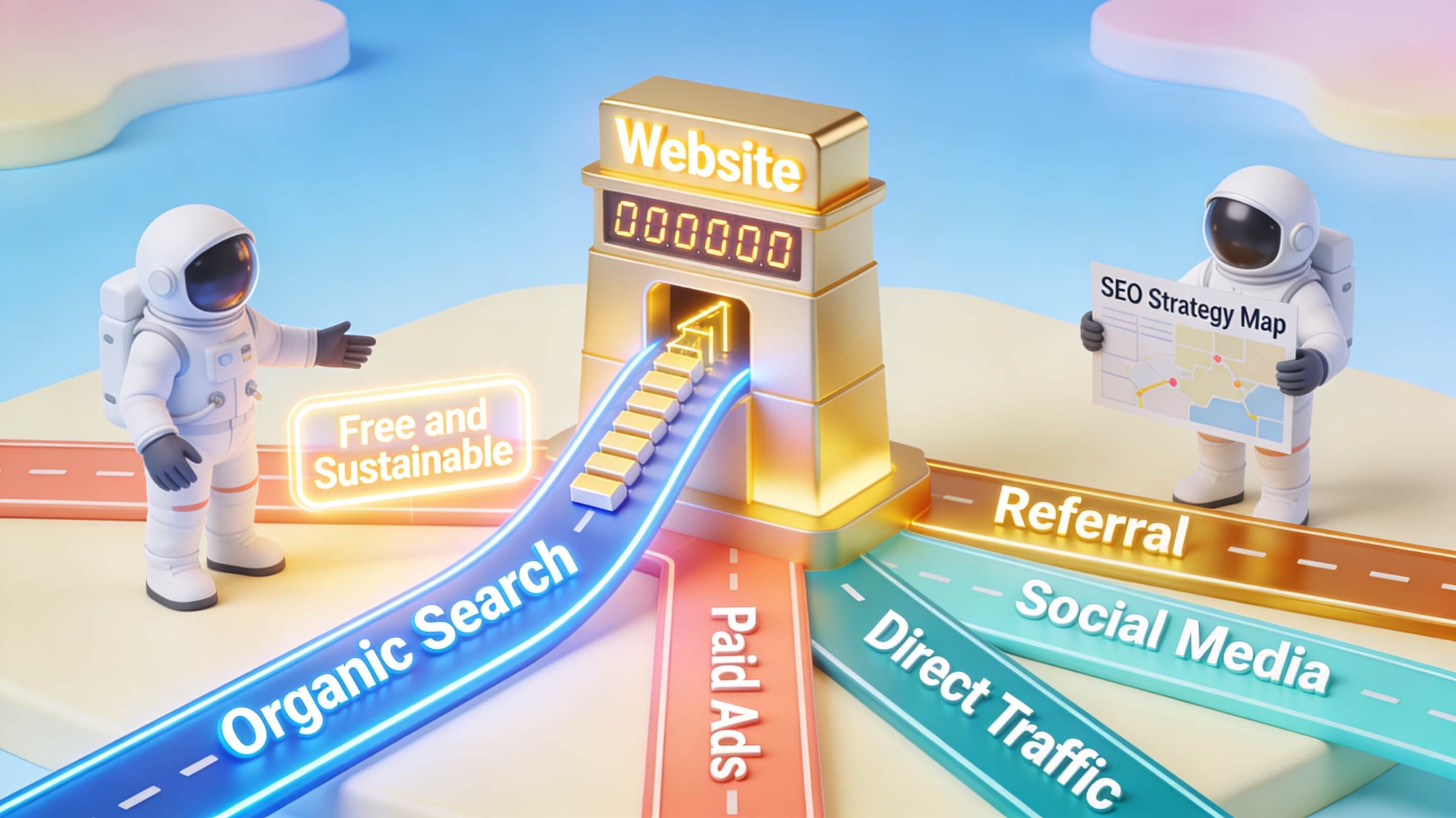
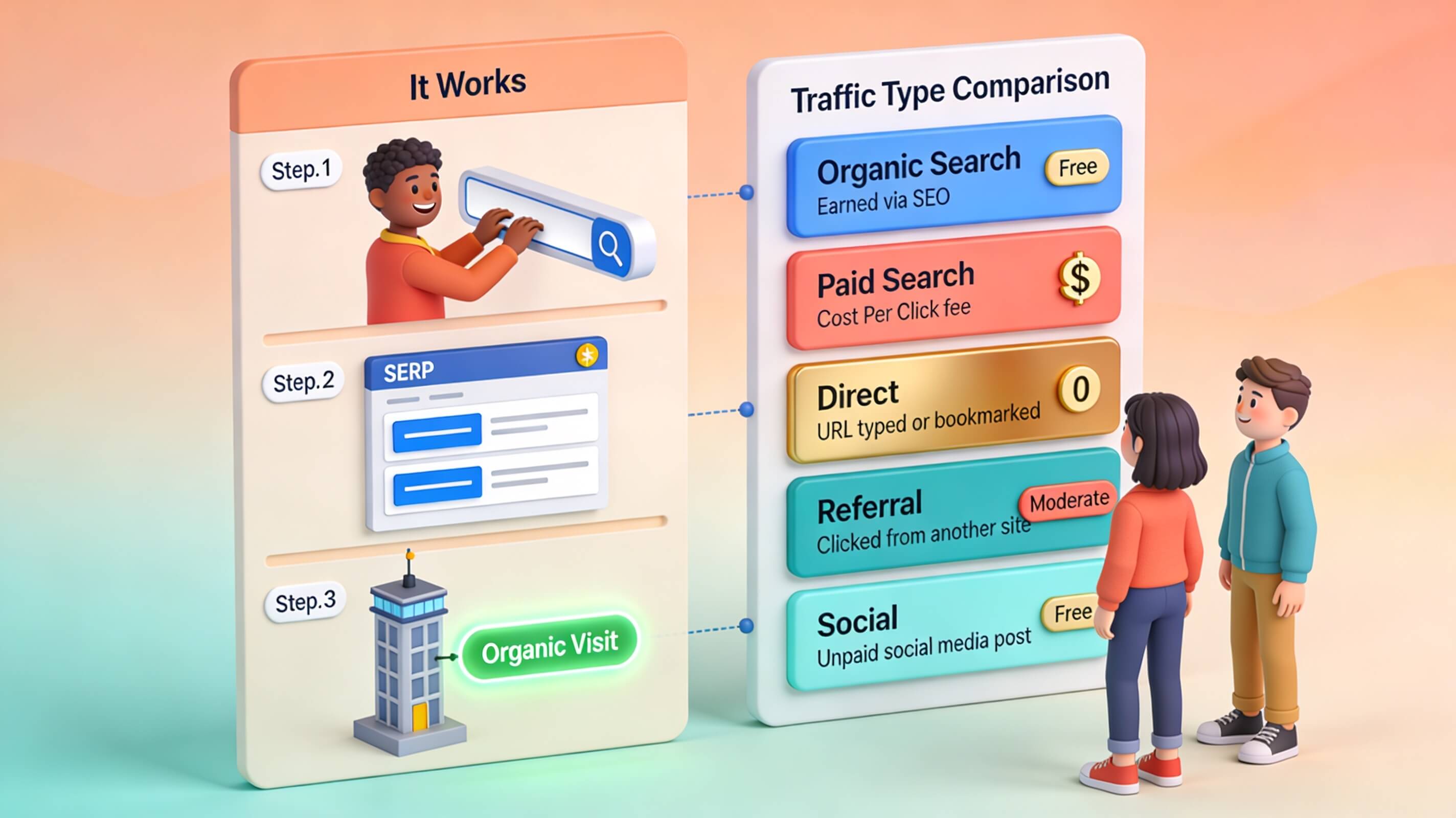
Understanding where organic traffic sits relative to other channels clarifies why it deserves priority in your digital strategy. Each traffic source has unique characteristics in cost, sustainability, and conversion potential. Below is a comparison of major traffic sources:
| Traffic Source | How It Works | Cost Model | Typical Share of Total Traffic |
|---|---|---|---|
| Organic Search | Users click unpaid search results | Free per click (investment in SEO/content) | 47%–53% |
| Paid Search | Users click on ads in search results | Pay per click (PPC) | 10%–27% |
| Direct | Users type your URL or use a bookmark | Free (brand awareness) | 12%–22% |
| Social Media | Users click links from social platforms | Free (organic) or paid (ads) | 5%–9% |
| Referral | Users click links on other websites | Free (earned media) | 3%–7% |
| Users click links in email campaigns | Low cost (list building) | 2%–5% |
Research from Conductor reveals that up to 60% of traffic labeled as “Direct” in analytics is actually misattributed organic search traffic. This happens because browsers sometimes fail to pass referral data, encrypted searches lose tracking information, and older iOS versions default to reporting visits as direct. When corrected, organic search may account for as much as 64% of total website traffic, reinforcing its dominance as a traffic channel.
Why Organic Traffic Matters: The Business Case
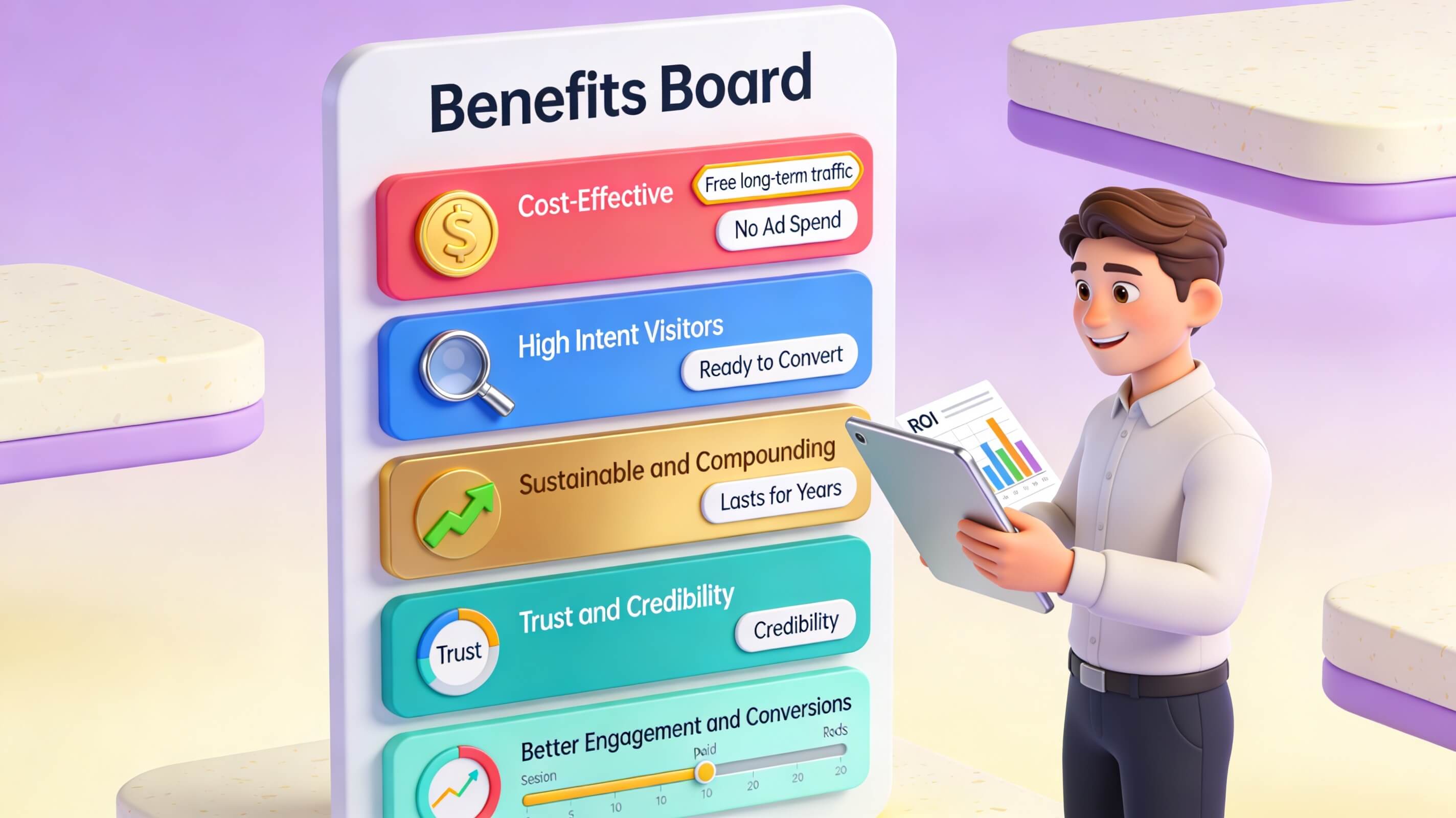
Organic traffic is not just the largest traffic source—it is also the most cost-effective, sustainable, and high-converting channel available. Here is why it deserves a central role in your digital strategy.
Higher Conversion Rates
Organic visitors arrive with intent. They searched for something specific, and your page appeared as a relevant answer. This intent-driven behavior translates directly into higher conversion rates. Data from Semrush shows that organic traffic converts at an average rate of 2.4% to 3.75% across industries. For B2B specifically, SEO-generated leads close at a 14.6% rate compared to just 1.7% for outbound leads, making organic leads roughly 8.5 times more likely to convert into customers. This means every organic visitor has a much higher probability of taking a desired action—whether that is making a purchase, signing up for a newsletter, or requesting a demo.
Cost-Effectiveness and ROI
Content marketing, the primary engine behind organic traffic, costs 62% less than traditional marketing while generating approximately three times more leads per dollar spent. According to First Page Sage, companies investing in organic traffic campaigns over one to three years see an average ROI of 748%, compared to significantly lower returns from paid campaigns that stop producing the moment you stop spending. The cost per acquisition through organic search runs 62% lower than paid search across most industries. This efficiency makes organic traffic particularly valuable for businesses with limited marketing budgets.
Sustainable Long-Term Growth
Unlike paid advertising, where traffic disappears the instant your budget runs out, organic traffic compounds over time. A well-optimized article published today can continue ranking and driving traffic for months or years. HubSpot reports that 75% of their blog views and 90% of blog leads come from posts published in previous months. This compounding effect means your organic traffic library becomes an appreciating asset rather than a depreciating expense. Each piece of content you create adds to a growing foundation of traffic that requires only maintenance, not continuous spending.
Brand Authority and Trust
Users trust organic results far more than paid ads. Research shows that 70% to 80% of internet users skip paid advertisements entirely and go straight to organic results. Consistently appearing at the top of search results for relevant queries positions your brand as an authority in your space. This visibility builds familiarity and credibility that influence purchasing decisions even beyond the immediate click. When users see your brand repeatedly in organic search results, they begin to associate it with expertise and reliability.
The Click-Through Rate Advantage
The first organic position on Google earns an average click-through rate (CTR) of 39.8% according to 2024 data from First Page Sage. The second position gets 18.7%, the third gets 10.2%, and positions four through ten gradually decline to 1.6%. Featured snippets push CTR even higher, up to 42.9%. Compare this to paid ads, where the top ad position earns only a 2.1% CTR. Organic rankings deliver dramatically more clicks per impression than paid placements, making them far more efficient at converting search visibility into actual visits.
How Search Engines Determine Organic Rankings
To increase organic traffic, you need to understand how search engines decide which pages to show for a given query. Google processes over 8.5 billion searches per day and uses hundreds of ranking signals to evaluate pages. While the exact algorithm is proprietary, the core principles are well documented and consistent across industry research.
Relevance
Google evaluates whether your page matches the searcher’s intent. This goes beyond simple keyword matching. Google’s natural language processing systems, including BERT and MUM, analyze the meaning behind queries and the context of your content to determine if your page genuinely answers what the user is looking for. For example, a search for “apple” could mean the fruit, the technology company, or the record label. Google uses the surrounding context of the query—such as other searches the user has made or the time of year—to determine intent. Your content must align with this intent to rank effectively.
Content Quality and E-E-A-T
Google’s Search Quality Rater Guidelines emphasize E-E-A-T: Experience, Expertise, Authoritativeness, and Trustworthiness. While E-E-A-T is not a direct ranking factor, it is the framework Google uses to design and evaluate its ranking systems. Pages that demonstrate real-world experience, factual accuracy, credible authorship, and strong trust signals—such as HTTPS, proper citations, and transparent sourcing—tend to earn the kinds of engagement, links, and mentions that ranking algorithms reward. For example, a medical article written by a practicing doctor with citations from peer-reviewed journals will outperform a generic article written by an anonymous author with no credentials.
Backlinks
Backlinks, which are links from other websites pointing to your page, function as votes of confidence. The quality, relevance, and diversity of your backlink profile remain among the strongest ranking signals. A single link from a high-authority site like a major news outlet or government resource carries far more weight than dozens of links from low-quality directories. Google’s PageRank algorithm, which remains a core component of its ranking system, evaluates the quantity and quality of these votes to determine a page’s authority. Building a natural, diverse backlink profile takes time but pays significant dividends in organic rankings.
Technical Performance
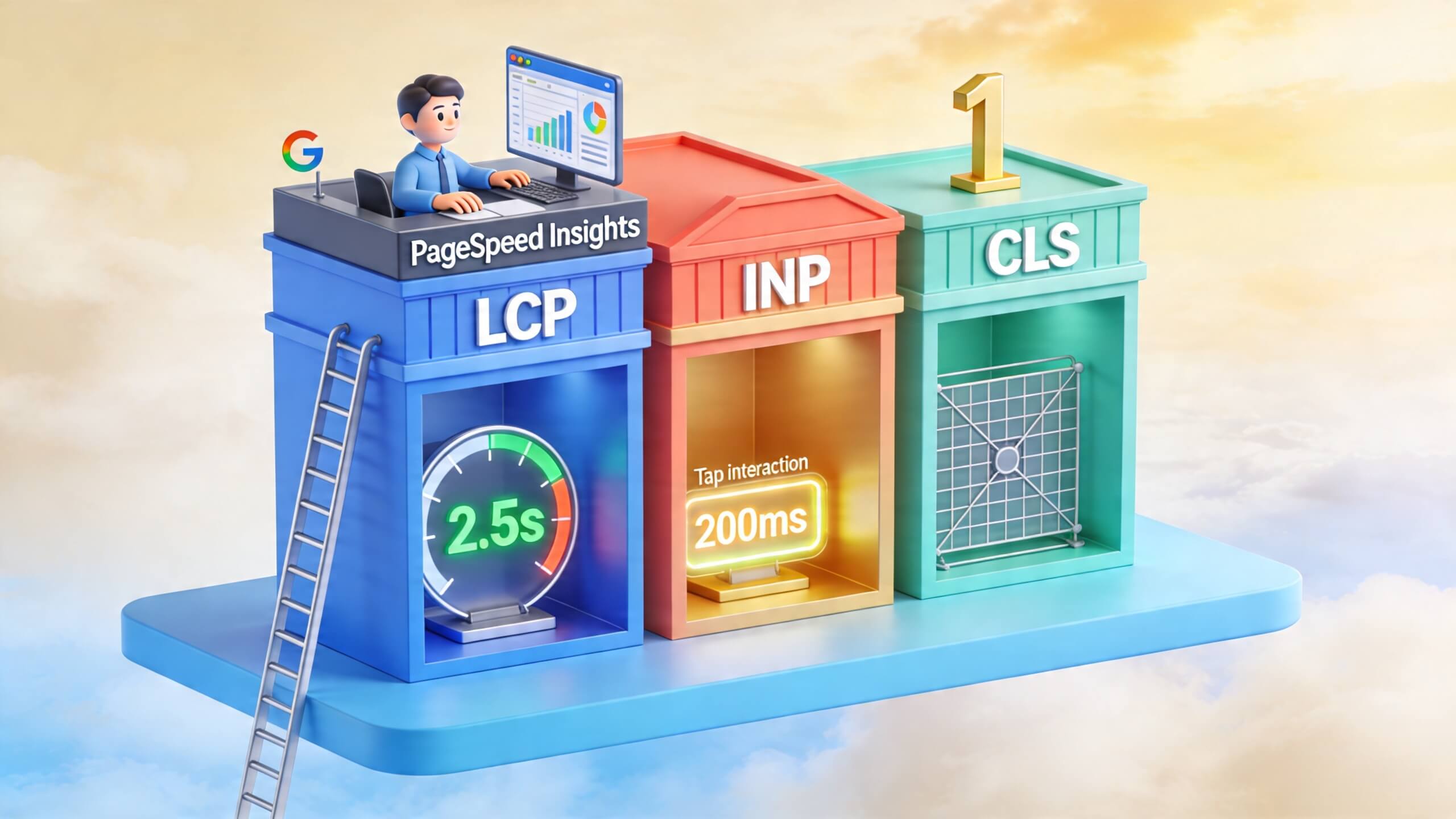
Google’s Core Web Vitals measure page experience: Largest Contentful Paint (LCP) for loading speed, Interaction to Next Paint (INP) for responsiveness, and Cumulative Layout Shift (CLS) for visual stability. Sites that pass these thresholds, combined with mobile-friendliness, HTTPS security, and clean site architecture, have a structural advantage in organic rankings. According to Google’s own documentation, pages that meet Core Web Vitals thresholds see a 24% reduction in abandonment rates. Technical performance is the foundation upon which all other SEO efforts are built.
User Engagement Signals
Evidence from the 2023 Google antitrust trial confirmed that Google tracks user interaction signals through systems like NavBoost. These include whether users click on a result and stay—a positive signal—or quickly return to the search results to try another link, a negative signal known as pogo-sticking. While Google avoids confirming specific engagement metrics as ranking factors, the data strongly suggests that user satisfaction after clicking influences rankings. Pages that keep users engaged with clear navigation, fast loading, and valuable content signal to search engines that they deserve higher positions.
On-Page SEO Techniques to Increase Organic Traffic
On-page SEO covers everything you directly control on your website. These optimizations ensure that search engines can understand, index, and rank your content for the right queries. Each element plays a specific role in improving your organic traffic potential.
Strategic Keyword Research
Effective keyword research is the foundation of organic traffic growth. The goal is to identify queries your target audience actually searches for, assess the competition for those terms, and create content that satisfies the intent behind each query. Tools like Semrush, Ahrefs, and Google Search Console provide data on search volume, keyword difficulty, and the terms your site already ranks for. Focus on finding keywords where search volume and relevance intersect with achievable competition. Long-tail keywords—phrases of four or more words—often present the best opportunities. They have lower search volumes individually but carry stronger intent and face less competition. A query like “best waterproof hiking boots for wide feet” may get fewer searches than “hiking boots,” but the visitor who types that query is far closer to making a purchase.
Search Intent Alignment
Every query has an intent behind it: informational (learning something), navigational (finding a specific site), commercial (comparing options), or transactional (ready to buy). Your content must match the intent. Search your target keyword, study the top five results, and analyze their format, depth, and angle. If the top results are all comparison guides and your page is a product description, you have an intent mismatch that will prevent ranking regardless of your other optimizations. For example, a user searching “how to tie a tie” wants a step-by-step guide, not a product page for ties. Matching intent is the single most important factor in ranking success.
Content Depth and Quality
Thin, surface-level content rarely ranks in competitive spaces. Create comprehensive resources that cover a topic thoroughly, answer related questions, and provide original insights, data, or examples that competitors lack. Businesses that maintain consistent blogs receive 55% more website visitors and 67% more leads than those that do not publish regularly, according to Content Marketing Institute. Quality means accuracy, depth, readability, and genuine usefulness to the reader. A 2,000-word article that answers every possible question about a topic will outperform a 500-word overview every time.
Title Tags and Meta Descriptions
Your title tag is the first thing users see in search results. Include your target keyword, keep it under 60 characters, and make it compelling enough to earn the click. Your meta description—under 155 characters—should expand on the title with a clear value proposition. Pages with keywords in their URLs have an average 45% higher CTR than those without, so keep URLs short, descriptive, and keyword-relevant. For example, a URL like “yoursite.com/best-running-shoes” performs better than “yoursite.com/page?id=123”. These elements directly influence whether users click on your result or scroll past it.
Header Structure and Content Organization
Use a clear heading hierarchy: one H1 for the page title, H2s for major sections, and H3s for subsections. This structure helps search engines understand your content’s organization and helps readers scan the page. Include your target keyword in at least one H2. Write descriptive subheadings that tell readers exactly what each section covers rather than using vague labels. For instance, “How to Choose Running Shoes” is more effective than “Section One.” Good header structure also improves accessibility for users with screen readers.
Internal Linking
Internal links connect your pages to each other, distributing page authority across your site, helping search engines discover and index content, and guiding visitors deeper into your site. Users who navigate through three or more content pieces convert at four times the rate of single-page visitors. Aim for three to five contextual internal links per 1,000 words, using descriptive anchor text that tells the reader what they will find on the linked page. For example, instead of “click here,” use “learn more about on-page SEO techniques.” This improves both user experience and SEO.
Off-Page SEO Strategies for Organic Traffic Growth
Off-page SEO focuses on building your website’s authority and reputation across the broader internet. While you have less direct control over these factors, strategic efforts in link building, digital PR, and brand development pay significant dividends in organic rankings.
Link Building
Acquiring high-quality backlinks from authoritative, relevant websites remains one of the most impactful things you can do for organic traffic. Effective link building strategies in 2024 include creating linkable assets—original research, data studies, comprehensive guides, free tools—guest posting on reputable industry blogs, broken link building where you find dead links on other sites and offer your content as a replacement, and digital PR that earns mentions and links from news publications. The emphasis has shifted from quantity to quality. A handful of links from trusted, topically relevant domains outperforms hundreds of links from low-quality sources. Google’s algorithm is sophisticated enough to distinguish between natural editorial links and manufactured ones.
Guest Blogging and Content Collaboration
Contributing high-quality content to respected industry publications exposes your brand to new audiences and earns authoritative backlinks. The key is targeting sites with genuine readership and domain authority, not mass-produced guest post networks. Focus on publications where your expertise adds real value to their audience. Co-created content, such as joint research, expert roundups, and collaborative webinars, also generates natural link opportunities from all participating parties. This approach builds relationships that lead to ongoing organic traffic benefits.
Brand Building and Digital PR
Unlinked brand mentions, press coverage, and thought leadership visibility all contribute to organic authority. Use tools like Google Alerts or Ahrefs Content Explorer to find instances where your brand is mentioned without a link, then reach out to request one. Publish original research and data that journalists and bloggers want to cite. Contribute expert commentary to platforms like HARO (Help a Reporter Out) and Connectively to earn high-authority backlinks from news publications. Each earned mention builds your brand’s credibility and signals authority to search engines.
Social Media Amplification
Social media shares do not directly influence Google rankings, but they amplify content visibility, attract new audiences, and create opportunities for natural backlinks. When your content gains traction on platforms like LinkedIn, X (formerly Twitter), or Reddit, it reaches people who may link to it from their own blogs, newsletters, or websites. Consistent social engagement also drives branded search queries, which are a positive signal for organic authority. A well-shared piece of content can generate dozens of backlinks over time.
Community Participation
Active participation in online forums, Q&A platforms like Quora, industry-specific communities, and Reddit helps drive referral traffic and positions you as an expert. Provide genuinely helpful answers and insights, with links to your content only where they add real value. This approach builds trust and drives qualified visitors who are already interested in your topic. Over time, community participation establishes you as a go-to resource in your niche, leading to organic traffic growth through word-of-mouth and natural links.
Technical SEO: The Foundation of Organic Visibility
Technical SEO ensures that search engines can effectively crawl, index, and render your website. Without a solid technical foundation, even the best content may never reach search results. This section covers the critical technical elements that support organic traffic.
Site Speed and Core Web Vitals
Page speed directly affects both rankings and user behavior. Google recommends an LCP under 2.5 seconds, an INP under 200 milliseconds, and a CLS score below 0.1. Compress images to modern formats like WebP and AVIF, minify CSS and JavaScript, enable browser caching, implement lazy loading for below-the-fold images, and use a CDN. Test regularly with PageSpeed Insights and address every flagged issue. A slow site not only ranks lower but also drives away visitors, increasing bounce rates and reducing conversion potential.
Mobile-First Optimization
Google uses mobile-first indexing, meaning it primarily uses the mobile version of your site for ranking and indexing. Your site must be fully responsive, with readable text—minimum 16px body font—adequate tap target spacing of at least 48px, and no content hidden behind tabs or accordions that might not render on mobile. Over 60% of global searches now happen on mobile devices, making mobile optimization non-optional. Test your site with Google’s Mobile-Friendly Test tool to identify and fix issues.
Crawlability and Indexation
Submit an XML sitemap to Google Search Console. Use a clean robots.txt file that does not accidentally block important pages. Fix crawl errors, resolve redirect chains, and eliminate duplicate content with canonical tags. A site that search engines cannot crawl efficiently will never reach its organic traffic potential, regardless of content quality. Regularly audit your site for broken links, orphan pages, and indexation issues using tools like Screaming Frog or Sitebulb.
Structured Data and Schema Markup
Implementing structured data (schema markup) helps search engines understand the context of your content and can earn rich results like FAQ dropdowns, review stars, recipe cards, and how-to panels. Rich results occupy more visual space in SERPs and typically earn higher click-through rates than standard listings. Use Google’s Rich Results Test to validate your structured data implementation. For example, adding FAQ schema to a question-and-answer section can result in expandable results that take up more screen real estate and attract more clicks.
Monitoring and Analyzing Organic Traffic in GA4
Tracking your organic traffic performance requires proper setup in Google Analytics 4 and Google Search Console. These two tools together provide a complete picture of how your organic traffic is performing and where opportunities exist.
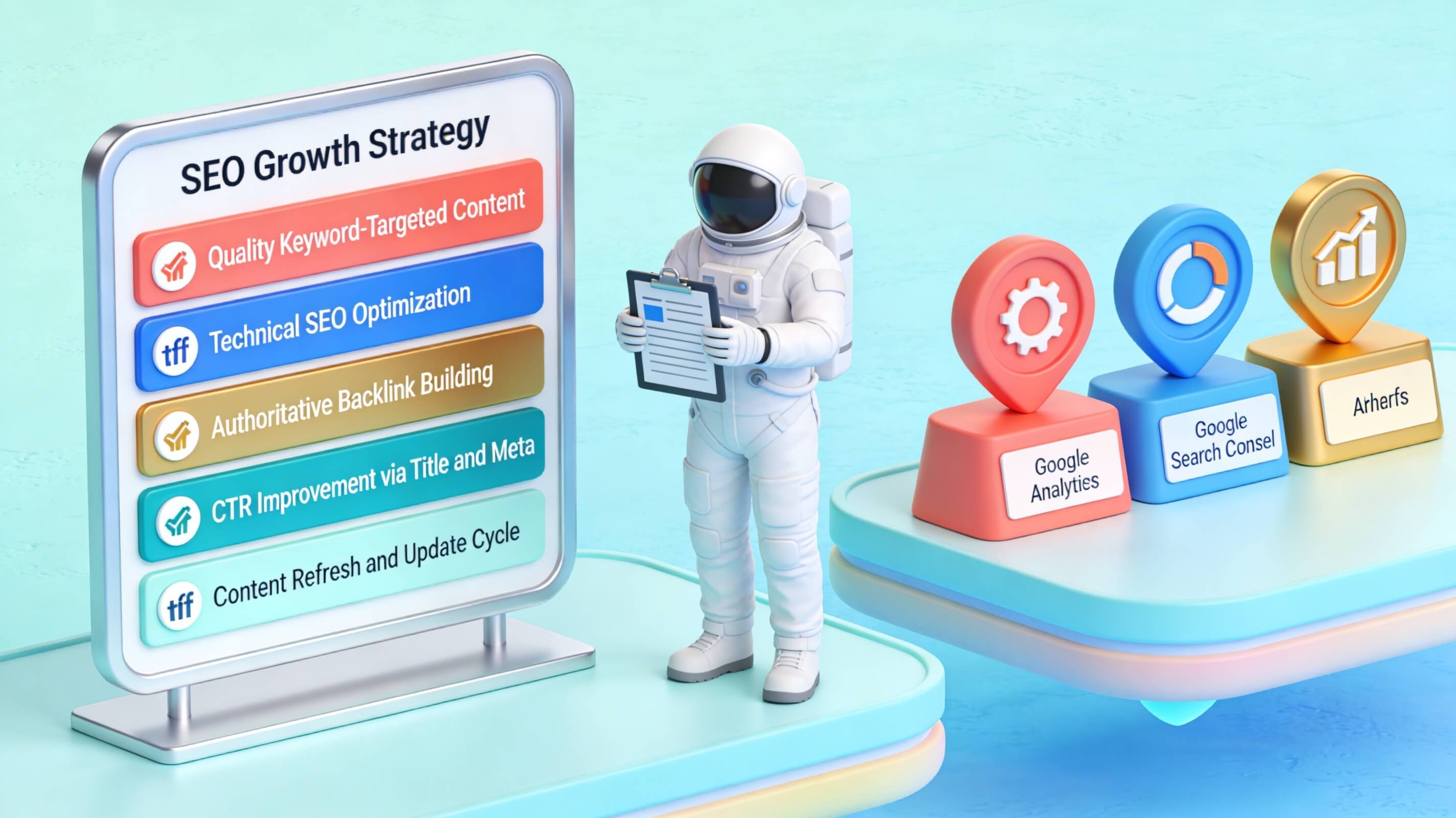
Setting Up Organic Traffic Reports in GA4
GA4 does not prominently display organic traffic in its default reports, but accessing it is
Conclusion
Organic traffic is the lifeblood of sustainable online growth, representing visitors who find your website through unpaid search engine results rather than paid advertising. As we have explored, it is fundamentally different from paid traffic in that it requires consistent effort, strategic planning, and a long-term commitment to quality. While paid traffic can deliver immediate results, organic traffic builds lasting value, credibility, and a loyal audience base that continues to grow over time.
The journey to earning organic traffic begins with understanding how search engines work and what they prioritize: relevance, authority, and user experience. Successful organic traffic strategies hinge on comprehensive keyword research, high-quality content creation, technical SEO optimization, and ongoing performance monitoring. From crafting content that satisfies user intent to ensuring your site is technically sound with proper indexing, structured data, and fast loading speeds, every element plays a crucial role in your search visibility.
It is important to remember that organic traffic is not a one-time achievement but an ongoing process. Search engine algorithms evolve, competitors emerge, and user behaviors shift. Regularly auditing your site, updating old content, building quality backlinks, and monitoring your performance in tools like Google Analytics 4 and Google Search Console will help you maintain and grow your organic traffic over the long term.
Ultimately, organic traffic represents the most valuable form of website visitors because they arrive with genuine interest and intent. They have found your content through their own research, which means they are more likely to engage, convert, and become loyal advocates for your brand. While the path to earning organic traffic requires patience and persistence, the rewards—sustainable growth, reduced reliance on advertising spend, and a trusted online presence—make it an investment worth pursuing for any business or content creator looking to thrive in the digital landscape.
Comments are closed.