
Cart 0

Share
Table of Contents
What is a Good Click Through Rate? A Definitive Guide for 2024 and Beyond
Click-through rate (CTR) is one of the most critical metrics in digital marketing, yet the question “what is a good click through rate” rarely has a simple answer. This percentage—calculated by dividing total clicks by total impressions and multiplying by 100—tells you how effectively your ads, emails, or organic listings capture audience attention. But here is the truth that separates seasoned marketers from amateurs: a “good” CTR varies wildly depending on your channel, industry, audience intent, and even the time of day. For instance, a 0.8% CTR on a display campaign might be exceptional, while the same rate on a Google Search ad would signal a serious problem. In this comprehensive guide, I will draw on over two decades of digital marketing experience to provide you with platform-specific benchmarks, industry breakdowns, and evidence-based strategies that go beyond generic advice. You will learn exactly what constitutes a good click through rate for your specific context, how to improve it systematically, and why chasing CTR without understanding its relationship to conversion quality can actually harm your bottom line. Whether you are optimizing paid search campaigns, email newsletters, or organic content, this guide will equip you with the data and frameworks to make informed decisions that drive real business growth.
Defining Click Through Rate and What is a Good Click Through Rate
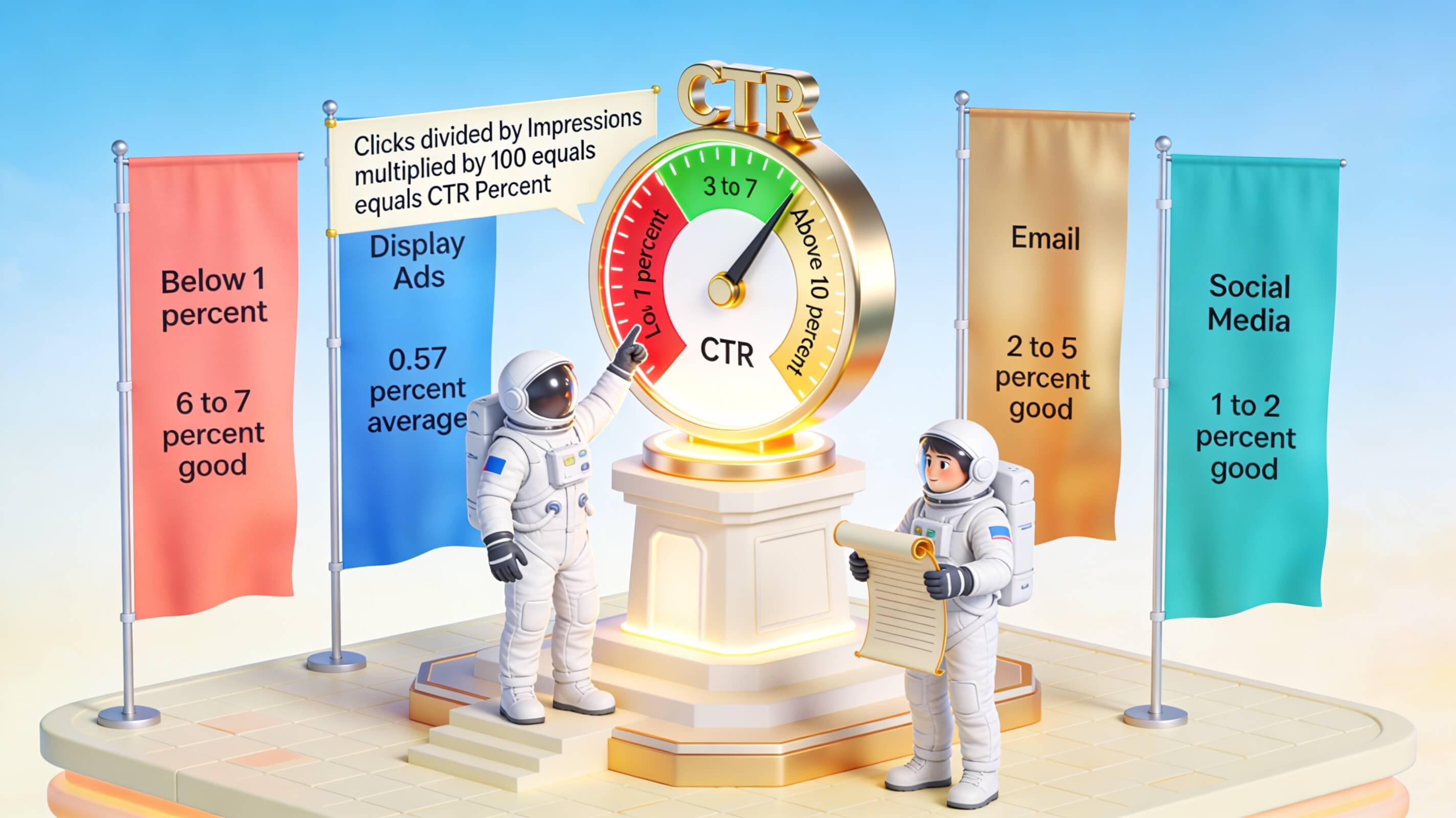
At its core, click-through rate measures the percentage of people who see your digital asset and take the action of clicking on it. The formula is straightforward: (Clicks ÷ Impressions) × 100. If your ad receives 50 clicks from 10,000 impressions, your CTR is 0.5%. But this simple calculation masks enormous complexity. A good click through rate in one context can be disastrous in another. For example, in Google Search campaigns, the average CTR across all industries hovers around 6.42%, according to recent 2024 data. However, display advertising averages just 0.57% because it targets users who are browsing content rather than actively searching for solutions. Email marketing sits somewhere in between, with typical CTRs ranging from 2% to 5%. The key insight here is that context determines everything. When you ask “what is a good click through rate,” you must first specify the channel, the audience, and the campaign objective. A B2B software company running LinkedIn ads should celebrate a 0.7% CTR, while a travel agency running Google Search ads would consider 10% the baseline for success. This contextual understanding prevents the common mistake of applying blanket benchmarks to every campaign, which leads to either false confidence or unnecessary panic.
The significance of CTR extends far beyond vanity metrics. In pay-per-click advertising, higher CTRs directly improve your Quality Score, which in turn lowers your cost-per-click and improves ad position. This creates a virtuous cycle: better CTR leads to lower costs, which allows you to show more ads, which generates more clicks. In organic search, Google uses CTR as a relevance signal—pages that earn higher click-through rates from search results tend to rank better over time. In email marketing, CTR reveals whether your content resonates with subscribers who have already opted in. Across all channels, CTR serves as the gateway metric that determines whether your marketing investment generates meaningful engagement or simply burns through budget. But here is where many marketers go wrong: they optimize for CTR at the expense of conversion quality. A clickbait headline might double your CTR, but if those clicks bounce immediately, you have wasted money and damaged your brand’s credibility. The most sophisticated approach treats CTR as one component of a larger performance framework that includes conversion rate, cost per acquisition, and return on ad spend.
Platform-Specific CTR Benchmarks: What is a Good Click Through Rate by Channel
To answer what is a good click through rate with precision, we must examine each major advertising platform individually. The benchmarks vary dramatically because user intent, ad format, and engagement context differ fundamentally across channels.
Google Search Ads CTR Benchmarks
Google Search consistently delivers the highest CTRs among paid channels because users are actively seeking solutions when they see your ad. Recent 2024 data shows the average search CTR across all industries is 6.42%, representing a 5% increase from previous years as Google has refined its ad formats. However, this average masks enormous variation by industry. Arts & Entertainment leads with an impressive 13.04% CTR, followed by Travel at 10.16% and Sports & Recreation at 9.66%. These industries benefit from high-intent users who are often in the final stages of decision-making—someone searching for “Taylor Swift tickets” or “flights to Paris” is highly motivated to click. On the other end of the spectrum, Attorneys & Legal Services average just 5.30% CTR, while Home Improvement sits at 5.59%. These lower rates reflect longer decision cycles and more competitive landscapes where users may click multiple ads before choosing a provider. Position plays an enormous role in search CTR. Current data reveals that position 1 captures approximately 39.8% of available clicks, while position 2 receives 18.7% and position 3 obtains 8.8%. The drop-off after position 3 is precipitous, with positions 4 through 10 collectively capturing less than 20% of clicks. For search campaigns, a good click through rate is typically 4-8%, but anything above 10% indicates exceptional relevance and creative execution that deserves replication across your account.
Display Advertising CTR Benchmarks
Display advertising operates in a fundamentally different context than search. Users are browsing content, reading articles, or watching videos when your ad appears—they are not actively looking for your product. This explains why display CTR benchmarks are substantially lower, with the average across industries sitting at just 0.57% in 2024. However, this low average masks significant variation by industry and campaign type. Real Estate leads display categories at 1.08% CTR, likely because property images are inherently engaging and home buyers are often in active research mode. Most other sectors cluster between 0.46% and 0.72%, with technology and B2B services typically on the lower end due to longer consideration cycles. For display campaigns, a good click through rate is 0.8-1.5%, while anything exceeding 2% demonstrates exceptional creative execution, targeting precision, or remarketing effectiveness. But here is the critical nuance: display advertising’s primary value often lies in brand awareness and remarketing rather than direct response. A user who sees your display ad and later searches for your brand on Google has been influenced even if they never clicked the display ad. Sophisticated marketers evaluate display CTR alongside view-through conversions, brand lift studies, and assisted conversion data to get a complete picture of performance.
Social Media Advertising CTR Benchmarks
Social media CTR benchmarks reflect platform-specific user behaviors and ad formats. Facebook advertising for traffic campaigns averages 1.57% CTR across industries, but this varies significantly by vertical. Real Estate achieves 2.60%, Arts & Entertainment hits 2.64%, and Travel reaches 2.29%—all benefiting from visually compelling content that aligns with how users browse these platforms. Lead generation campaigns on Facebook demonstrate higher engagement, averaging 2.53% CTR because users can complete forms without leaving the platform. LinkedIn advertising, optimized for B2B audiences, shows different patterns. The median LinkedIn ad CTR averages 0.52% across industries, with Sponsored Content achieving 0.44-0.65% depending on format. Single image ads (0.56%) slightly outperform video (0.44%) and carousel formats (0.40%). However, Message Ads deliver substantially higher engagement at approximately 3% CTR with 30% open rates, reflecting their direct, personalized nature. For B2B marketers, a good click through rate on LinkedIn is anything above 0.5%, while rates exceeding 0.7% indicate exceptional performance. The key difference between social and search CTR is intent: social users are in discovery mode, while search users are in problem-solving mode. This means social CTR benchmarks will always be lower, but the quality of engagement—comments, shares, and brand affinity—can be higher.
Email Marketing CTR Benchmarks
Email marketing CTR measures engagement among subscribers who have opted into communications, creating different dynamics than paid advertising channels. Industry research establishes email marketing CTR typically ranging from 2-5%, though performance varies by email type and industry. General marketing emails—newsletters, announcements, and content-focused communications—typically achieve 2-5% CTR. Promotional emails focused on sales often generate slightly lower 1-3% rates due to more direct commercial intent that some subscribers resist. Transactional emails consistently outperform marketing messages, frequently surpassing 5% CTR as recipients engage with essential information like order confirmations and shipping notifications. The distinction between CTR and click-to-open rate (CTOR) proves particularly valuable in email analysis. While average CTOR for marketing emails ranges 10-25%, this metric isolates content effectiveness from subject line performance. A strong email campaign achieving 6%+ CTR or 20%+ CTOR demonstrates exceptional relevance, personalization, and content quality. For context, a well-segmented B2B newsletter might achieve 3-4% CTR, while a triggered welcome sequence for an e-commerce brand might hit 8-12%. The most important factor in email CTR is list quality—a smaller, highly engaged list will always outperform a larger, disengaged one. Marketers should focus on list hygiene, regular re-engagement campaigns, and progressive profiling to maintain high CTR over time.
Industry-Specific CTR Benchmarks and Variations
Industry context substantially influences what is a good click through rate. Some sectors naturally achieve higher engagement due to audience characteristics, purchase urgency, or competitive dynamics. Recognizing these industry-specific benchmarks enables realistic goal-setting and appropriate performance evaluation.
High-Performing Industries
Several industries consistently achieve above-average CTRs across advertising platforms. Dating and personal relationships lead Google Ads categories with 6.05% average CTR, benefiting from highly motivated audiences actively seeking solutions to pressing personal needs. Arts & Entertainment demonstrates exceptional performance driven by event-oriented campaigns and audience passion for entertainment content. Travel and hospitality sectors achieve strong performance across channels, reflecting consumers’ enthusiasm for vacation planning and visual content’s effectiveness in inspiring travel desires. Real Estate consistently outperforms averages, demonstrating how high-consideration purchases with strong visual components generate engagement. These industries’ success provides benchmarks illustrating CTR potential when targeting, creative, and audience intent align optimally. For example, a travel company running Google Search ads for “cheap flights to Europe” might achieve 12-15% CTR because the user intent is crystal clear and the offer is compelling. The lesson for marketers in other industries is not to feel discouraged by lower absolute numbers but to identify what drives engagement in their specific context and optimize accordingly.
Challenging Industry Categories
Certain industries face inherently lower CTRs due to factors including intense competition, complex decision processes, or broad audience targeting requirements. Technology companies average 2.09% CTR despite substantial advertising investments, reflecting competitive intensity and lengthy B2B sales cycles. Business and industrial services achieve 2.18% rates, challenged by niche audiences and technical products requiring education before purchase consideration. Legal services demonstrate paradoxical performance—4.12% CTR in some analyses yet lower 0.99% in competitive traffic campaigns—illustrating how campaign objectives and geographic competition influence results. Finance and insurance sectors face similar challenges, achieving 5.70% search CTR but struggling with trust barriers and regulatory constraints limiting creative approaches. For marketers in these sectors, what is a good click through rate might sit 20-40% below cross-industry averages while still representing strong relative performance. The key is to benchmark against direct competitors rather than broad averages. A B2B software company achieving 2.5% CTR on Google Search is likely performing well above its peers, even though this would be considered low for a consumer travel brand.
Critical Factors Influencing Click Through Rate Performance
Multiple interconnected factors determine whether campaigns achieve strong CTRs or struggle to generate engagement. Understanding these drivers enables strategic optimization that addresses root causes rather than treating symptoms.
Ad Relevance and Audience Targeting
Relevance represents the foundational CTR driver—your ads must address audience needs, interests, or problems to motivate clicks. Precise audience targeting ensures your ads reach users most likely to find your offerings valuable, dramatically improving CTR compared to broad, untargeted approaches. Demographic targeting, interest-based targeting, and behavioral targeting enable message customization that increases relevance. In search campaigns, keyword targeting particularly influences CTR through match type selection and negative keyword implementation. Exact match keywords deliver highest intent signals but limited reach, while broad match expands impressions but dilutes relevance. The most effective approach uses a combination: exact match for your highest-converting terms, phrase match for related queries, and broad match with smart bidding for discovery. Negative keywords are equally important—they cut wasted clicks by preventing your ads from appearing on irrelevant searches. For example, excluding “free” for a premium product filters out bargain hunters unlikely to convert. Regular negative keyword refinement, ideally on a weekly basis for active campaigns, improves CTR by showing ads exclusively to qualified audiences.

Ad Copy and Creative Quality
Compelling ad copy distinguishes clickable ads from ignored impressions. Effective headlines incorporate numbers, emotional triggers, and clear value propositions that capture attention amid content clutter. Research indicates headlines with numbers perform approximately 36% better than generic alternatives. For example, “7 Proven Ways to Boost Revenue in 30 Days” outperforms vague “Tips for Better Results” through specificity and concrete promises. Call-to-action (CTA) strength significantly impacts CTR. Weak generic CTAs like “Learn More” underperform specific action-oriented alternatives like “Get Started,” “Download Now,” or “Claim Your Discount.” Strong CTAs clarify next steps, set appropriate expectations, and can improve CTR by up to 20% through explicit action guidance. Beyond copy, visual creative quality—image relevance, color contrast, design clarity—influences display and social advertising CTR. Eye-catching visuals interrupt browsing and draw attention to your messaging. The most effective approach tests multiple creative variations simultaneously, using data to identify which elements resonate with specific audience segments.
Ad Position and Placement
Ad position dramatically affects CTR across channels. In paid search, top positions capture disproportionate click volume—position 1 averages 28-35% CTR versus 2-5% for positions 7-10. Even marginal ranking improvements generate substantial traffic increases due to position sensitivity. For display advertising, above-the-fold placements visible without scrolling demonstrate higher CTRs than below-the-fold positions requiring user scrolling. In social media, feed placement generally outperforms sidebar or banner positions as users focus attention on primary content streams. Email placement considers both send timing and link positioning—primary CTA buttons above the fold typically generate higher CTR than buried links requiring scrolling. Testing placement variations through systematic experimentation identifies optimal positions for specific campaigns and audiences. The key insight is that position optimization is not just about bidding higher—it is about understanding where your audience pays attention and ensuring your message appears in those contexts.
Evidence-Based Strategies for Improving Click Through Rates
Systematic CTR optimization follows data-driven methodologies that test improvement hypotheses, measure results, and implement winning variations. The following strategies demonstrate proven effectiveness across channels and contexts.
A/B Testing and Systematic Experimentation
A/B testing represents the foundational optimization methodology that enables evidence-based improvements rather than assumption-driven changes. By creating two ad variations that differ in single elements—headline, CTA, image, or targeting parameter—you isolate variables influencing CTR and identify winning approaches. Testing one element at a time prevents confounding factors that obscure which specific change drove performance differences. Effective A/B testing requires sufficient sample sizes for statistical significance—running tests until adequate impression and click volumes accumulate ensures reliable results rather than random variation. Segment testing by audience characteristics reveals which variations resonate with specific groups, enabling personalization that improves relevance. Continuous testing maintains performance as market conditions, audience preferences, and competitive dynamics evolve. The most sophisticated organizations run concurrent tests across multiple dimensions—headlines, images, CTAs, and targeting—using multivariate testing to identify optimal combinations. However, this approach requires significant traffic volume and should only be attempted after mastering single-variable testing.
Personalization and Dynamic Content
Personalization increases relevance and CTR by tailoring messaging to individual user attributes, behaviors, or context. Email personalization beyond basic name insertion—segment-specific offers, behavior-triggered content, location-based messaging—can increase CTR by 15.6% according to recent research. Dynamic keyword insertion in search ads automatically inserts user search terms into ad copy, increasing relevance perception and CTR. Audience segmentation enables message customization addressing specific segment needs—new customers receive different messaging than repeat buyers; high-value prospects see premium positioning rather than discount emphasis. Location-based personalization incorporates geographic references, local offers, or regional language variations that increase local relevance. The more specifically your ads address individual circumstances, the higher your CTR potential becomes through relevance amplification. However, personalization must be implemented carefully to avoid coming across as intrusive or creepy. The line between helpful and invasive is crossed when users feel their privacy has been violated. Effective personalization uses data that users have explicitly provided or behaviors they have willingly engaged in, rather than inferred information that might surprise or unsettle them.
Ad Extension and Enhanced Feature Utilization
Ad extensions in search advertising—sitelinks, callouts, structured snippets, location extensions—expand your ad real estate, provide additional information, and improve CTR. Extensions increase ad visibility, pushing competitors down the page while offering multiple click pathways that increase overall engagement. Sitelink extensions enable direct navigation to specific site sections, callout extensions highlight unique value propositions, and structured snippets showcase product categories or service types. Utilizing all relevant extensions maximizes visibility and CTR improvement opportunities. Extensions also contribute to Quality Score calculation, creating compounding benefits through position improvements. In organic search, rich snippets achieved through structured data markup—star ratings, product prices, FAQ expansions—similarly increase visibility and CTR beyond standard text listings. The implementation of structured data is one of the highest-leverage SEO activities because it directly impacts how your listing appears in search results. Pages with rich snippets can see CTR improvements of 20-30% compared to standard listings, simply because they stand out visually and provide more information at a glance.
The Relationship Between CTR and Quality Score
In Google Ads and similar platforms, CTR directly influences Quality Score, which subsequently affects ad positioning, cost-per-click, and overall campaign efficiency. Understanding this relationship reveals how CTR optimization compounds through multiple performance dimensions, creating powerful leverage for improved ROI.
Quality Score synthesizes three primary components: expected click-through rate, ad relevance, and landing page experience. Expected CTR—the platform’s prediction of how likely your ads are to be clicked—constitutes the largest Quality Score factor, directly reflecting your historical CTR performance. Ads consistently achieving high CTRs earn improved expected CTR ratings, boosting Quality Scores that unlock better ad positions and reduced costs. This creates a virtuous cycle: high CTR improves Quality Score, which improves ad position, which further increases CTR through better visibility. Conversely, low CTR depresses Quality Score, worsening position, which further reduces CTR through diminished visibility. Breaking negative cycles requires strategic intervention: improving ad copy, tightening keyword targeting, or implementing negative keywords to improve relevance among remaining impressions.
The cost implications are substantial. Advertisers with Quality Scores of 8-10 often pay 30-50% less per click than competitors with scores of 3-5 targeting identical keywords, even when achieving better ad positions. This cost efficiency advantage compounds over campaign lifetimes—higher CTR generating better Quality Score producing lower CPC enabling increased traffic volume within identical budgets. Return on ad spend improvements from CTR optimization therefore exceed direct traffic increases. A campaign improving CTR from 3% to 6% doesn’t merely double traffic—Quality Score improvements might reduce CPC by 25%, effectively generating 2.67x click volume (doubling from CTR improvement plus additional 33% from cost reduction) from identical spending. These compounding effects make CTR optimization among the highest-leverage activities in paid search management.
Common CTR Optimization Mistakes to Avoid
While pursuing CTR improvements, marketers should avoid common pitfalls that undermine campaigns or generate low-quality traffic that fails to convert despite strong click volume. The most critical mistake involves pursuing clicks without ensuring conversion alignment. Clickbait tactics—sensational headlines, misleading promises, or irrelevant targeting—can artificially inflate CTR while generating worthless traffic that never converts. High CTR with poor conversion rates indicates messaging misalignment between ads promising one thing and landing pages delivering another. Optimization should balance CTR and conversion rate, recognizing that slightly lower CTR generating highly qualified traffic often produces superior ROI than high CTR attracting unqualified browsers. Monitoring metrics beyond CTR—bounce rate, time on site, conversion rate—reveals whether CTR improvements enhance business outcomes or merely generate vanity metrics without commercial value.
Insufficient testing discipline represents another common error. Testing multiple variables simultaneously creates analytical confusion preventing clear attribution of performance changes. Changing headlines, images, and targeting concurrently when CTR improves leaves uncertainty about which factor drove improvement, complicating replication in other campaigns. Single-variable testing isolates causation, enabling confident scaling of proven tactics. Premature test conclusions represent another error—ending tests before statistical significance accumulates produces unreliable results influenced by random variation rather than true performance differences. Test duration should account for traffic volume and required confidence levels, typically running until campaigns accumulate hundreds of clicks per variation at minimum. Finally, ignoring device and segment differences can mask critical optimization opportunities. Analyzing aggregate CTR across all devices, locations, and audience segments obscures segment-specific performance requiring different approaches. A campaign showing 4% average CTR might hide that mobile achieves 6% while desktop languishes at 2%, suggesting device-specific optimization opportunities that aggregate analysis misses.

Future CTR Trends and Emerging Considerations
Digital advertising’s evolution continuously reshapes CTR dynamics through new ad formats, platforms, and user behaviors requiring adaptive strategies. Artificial intelligence increasingly influences CTR through algorithm-powered ad creation, bid optimization, and audience targeting. Responsive search ads allowing Google to dynamically test up to 15 headlines and 4 descriptions identify winning combinations faster than manual testing
Conclusion
Understanding what constitutes a good click-through rate is essential for any digital marketer, but the answer is never a single, universal number. As this article has explored, CTR benchmarks vary dramatically by industry, ad platform, ad format, and target audience. A 2% CTR might be exceptional for a display campaign but disappointing for search ads, while a 6% CTR could be average for retail but outstanding for B2B software. Rather than fixating on arbitrary targets, the most effective approach is to establish your own baselines through consistent measurement and then focus on continuous, data-driven improvement.
Key takeaways include the importance of compelling ad copy, strong calls-to-action, precise audience targeting, and strategic use of ad extensions. The pitfalls of testing without proper statistical significance, ignoring segment-specific performance, and prematurely ending tests cannot be overstated. These errors undermine the reliability of your data and can lead to misguided optimization decisions. Additionally, the future of CTR is being shaped by AI-driven ad creation, responsive search ads, and evolving user behaviors across devices and platforms. Marketers who embrace these tools while maintaining rigorous testing methodologies will be best positioned to improve their CTR over time.
Ultimately, a good click-through rate is one that contributes positively to your campaign’s overall return on investment. CTR is a leading indicator of relevance and engagement, but it must be evaluated alongside conversion rates, cost per acquisition, and revenue. The goal is not to chase a vanity metric but to optimize the entire customer journey from impression to conversion. By focusing on relevance, testing systematically, and adapting to emerging trends, you can achieve CTRs that are not just good—but effective in driving real business results. Remember: the best CTR is the one that helps you meet your specific marketing objectives, whatever that number may be for your unique context.