Cart 0

Share
Table of Contents
Coursera Google Data Analytics: Your Complete Guide to the Professional Certificate
Data skills are among the most sought-after capabilities in the modern job market, and the Coursera Google Data Analytics Professional Certificate offers one of the most accessible on-ramps into the field. Designed and built by Google, this self-paced online program teaches the technical and analytical skills employers actually use—SQL, R programming, Tableau, and data visualization—without requiring a computer science degree or prior industry experience. Whether you are looking to pivot into a data career, add analytical credentials to your existing role, or simply understand how data-driven decisions get made, this certification gives you a structured, employer-recognized path to get there.
This guide covers everything you need to know about the Coursera Google Data Analytics certification: what it includes, how long it takes, what it costs, which career paths it opens, and how it compares to other learning options available today.
What Is the Coursera Google Data Analytics Professional Certificate?
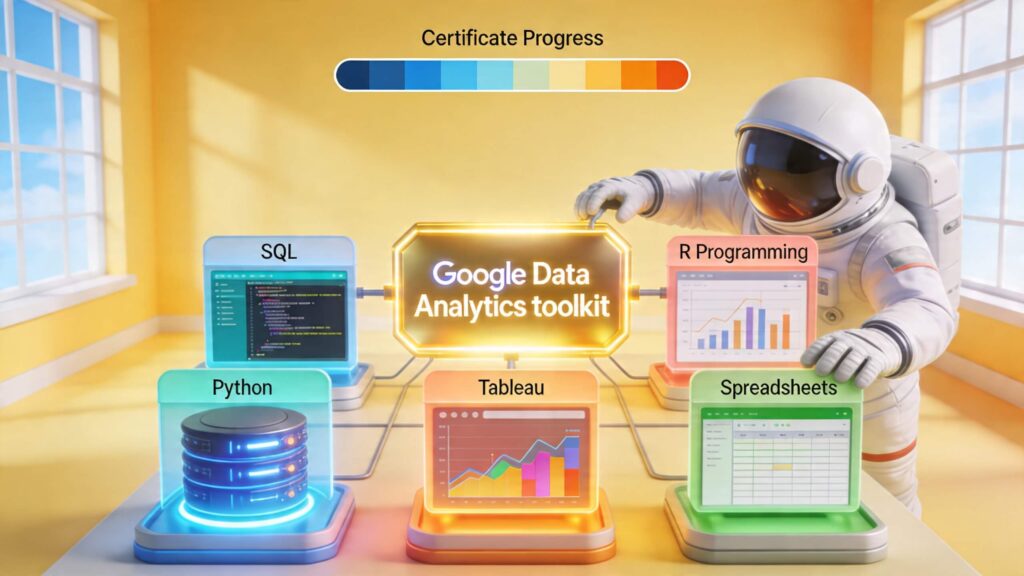
The Coursera Google Data Analytics Professional Certificate is a beginner-level program offered directly through Coursera’s Google Data Analytics enrollment page, developed entirely by Google and designed for people with no prior experience in data analysis. It consists of eight to nine courses that walk learners through the full data analysis lifecycle—from asking the right questions and preparing raw data to cleaning it, analyzing it, and sharing insights through visualizations. The program uses hands-on tools including Google Sheets, BigQuery (SQL), Tableau, and R, giving learners practical experience with industry-standard software rather than just theoretical knowledge.
Google positions this program as a replacement for a four-year degree for entry-level data roles. It has attracted over 2.4 million enrollees since its launch, making it one of the most popular professional certificates on Coursera. The curriculum is structured progressively, so each course builds on the previous one. You start by learning what data analysts actually do, then move into hands-on data preparation, cleaning, analysis, and presentation skills. The program concludes with a capstone project that you complete independently and can include in your portfolio to show employers real, applied work.
Key Features at a Glance
| Feature | Details |
|---|---|
| Courses included | 8–9 courses covering foundations, data preparation, cleaning, analysis, and visualization |
| Estimated duration | Approximately 6 months at 10 hours per week (self-paced) |
| Tools taught | Google Sheets, SQL (BigQuery), R programming, Tableau |
| Prerequisites | None required; basic spreadsheet familiarity is helpful |
| Credential awarded | Google Data Analytics Professional Certificate (shareable on LinkedIn and resume) |
| Cost | Approximately $49 per month; financial aid available |
As documented in Datamation’s review of top Coursera data analytics certifications, the Google program covers data cleaning, data ethics, data visualization, SQL, Tableau, and R—a breadth of practical skills rarely found together in a single entry-level program at this price point.
Course-by-Course Breakdown
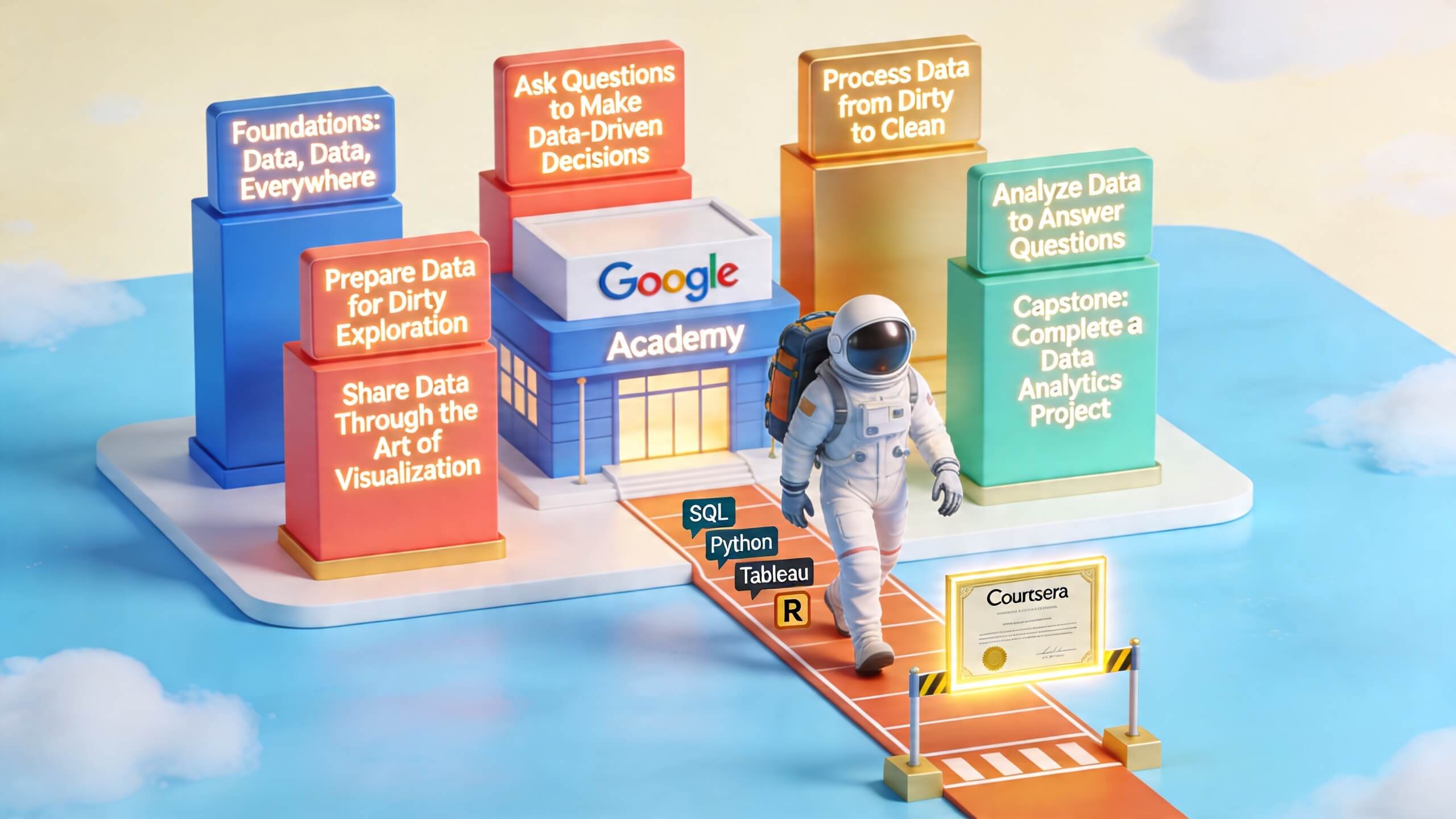
The Coursera Google Data Analytics program is divided into eight core courses, each covering a distinct phase of the data analyst workflow. Understanding what each course teaches helps you set realistic expectations and plan your study schedule effectively.
- Foundations: Data, Data, Everywhere – Introduces the data analyst role, the types of questions analysts answer, and the tools used throughout the program. Sets context for everything that follows.
- Ask Questions to Make Data-Driven Decisions – Covers the structured thinking frameworks analysts use to frame problems, identify stakeholders, and communicate findings. Emphasizes the SMART question framework.
- Prepare Data for Exploration – Teaches data types, data collection methods, database structures, and the basics of organizing data using Google Sheets and SQL.
- Process Data from Dirty to Clean – Focuses on identifying errors, inconsistencies, and gaps in datasets and applying cleaning techniques in both spreadsheets and SQL. This is where practical data-wrangling skills are built.
- Analyze Data to Answer Questions – Introduces analytical methods including sorting, filtering, aggregating, and calculating using SQL and spreadsheet formulas to extract insights from structured data.
- Share Data Through the Art of Visualization – Covers data visualization principles and how to use Tableau and other tools to create dashboards, charts, and reports that communicate insights clearly to non-technical audiences.
- Data Analysis with R Programming – Introduces R syntax, data structures, and the tidyverse package ecosystem. Learners write real R code to clean, transform, and visualize data.
- Google Data Analytics Capstone: Complete a Case Study – Puts all acquired skills to work in an independent case study project that serves as a portfolio piece for job applications.
Each course contains a mix of video lectures, readings, discussion prompts, graded quizzes, and hands-on activities using real or simulated datasets. As reviewed by Rebel’s Guide to PM in their hands-on program review, learners who commit to hands-on practice—not just watching videos—come away from the program with enough practical competency to discuss data workflows confidently in an interview and handle entry-level analytical tasks independently.
Coursera Google Data Analytics: Cost and How to Enroll
The Coursera Google Data Analytics program operates on a subscription model rather than a flat fee. As of 2024, the monthly cost is approximately $49 per month for the individual certificate subscription, which means the total you pay depends entirely on how quickly you complete the program. A learner who finishes in two months pays roughly $98. Someone who takes six months at a relaxed pace pays around $294. The faster and more consistently you study, the less you ultimately spend.
Coursera also offers Coursera Plus at approximately $59 per month or $399 per year, which grants unlimited access to thousands of courses including all Google certificates—a better option if you plan to complete multiple programs or supplement the data analytics certificate with related courses in Python, machine learning, or business intelligence. As detailed in Data with Sarah’s cost breakdown, financial aid is available for learners who qualify, making the program accessible to those who cannot afford even the monthly subscription rate.
Enrollment is straightforward: create a Coursera account, navigate to the certificate page, and start a free trial before committing to a subscription. The trial gives you access to most course materials so you can evaluate the teaching style and curriculum structure before paying anything. Many learners discover the free trial is enough to confirm whether data analytics is the right career direction for them before making a financial commitment.
What Skills Does the Certification Build?
The Coursera Google Data Analytics program builds a portfolio of foundational skills that map directly to entry-level data analyst job descriptions. Rather than teaching abstract theory, the curriculum emphasizes applied technique—skills you can demonstrate in a portfolio project and explain in a technical interview.
The core skills taught throughout the program include:
- Data cleaning and wrangling – removing duplicates, handling null values, standardizing formats, and transforming raw data into analysis-ready tables using SQL and R.
- SQL querying – writing structured queries to retrieve, filter, sort, join, and aggregate data from relational databases, using Google BigQuery as the primary platform.
- R programming fundamentals – data manipulation with the tidyverse package, exploratory data analysis, and creating visualizations with ggplot2.
- Data visualization – building charts, dashboards, and story-driven presentations in Tableau and Google Sheets that communicate findings to both technical and non-technical stakeholders.
- Data ethics and integrity – understanding privacy, security, and fairness considerations in working with data, which is increasingly important as organizations navigate data governance regulations.
- Analytical thinking and problem framing – translating business questions into data problems, identifying appropriate data sources, and choosing the right analysis approach.
These skills align with what many employers look for in junior data analyst roles, as reflected in job postings across platforms like LinkedIn, Indeed, and Glassdoor. The program does not teach advanced machine learning, predictive modeling, or Python—areas covered in the separate Google Advanced Data Analytics Professional Certificate, which is the natural next step for learners who want to go deeper into data science.
Career Outcomes: Jobs and Salaries After Certification
One of the most important questions anyone asks before investing time in a certificate program is: will this actually help me get a job? For the Coursera Google Data Analytics Professional Certificate, the outcome data is encouraging. Coursera reports that approximately 75% of Google Career Certificate graduates note a positive career outcome within six months of completing the program, as highlighted by Merit America’s analysis of the certification’s impact, which also cites a study showing that program alumni experienced an average annual wage increase of $24,000 after completing the credential.
Salary expectations after earning the Coursera Google Data Analytics certificate vary by role, experience level, and geography. According to salary data from ZipRecruiter’s Google Data Analytics Certificate salary report, the average annual salary for holders of this credential in the United States is approximately $81,518, with the top 75th percentile earning around $96,500 and top earners reaching $112,000 or more. These figures reflect a range of roles that the certificate qualifies candidates for, from entry-level data analyst positions to more specialized business intelligence or marketing analytics roles.
Three career paths are particularly well-suited to graduates of this program:
- Data Analyst – the most direct application of the certification’s skills, with salaries typically ranging from $50,000 to $85,000 for entry-level positions in the United States.
- Business Intelligence Analyst – a role that focuses heavily on dashboarding and reporting, leveraging the Tableau and SQL skills taught in the program, with salaries ranging from $65,000 to $95,000.
- Marketing Analyst – using data to understand campaign performance, customer behavior, and market trends, with entry-level salaries typically between $45,000 and $80,000.
The certification also signals genuine employability to smaller companies and startups that need data-capable team members but may not have the budget to hire senior data scientists. Many graduates land their first data role not at a Fortune 500 company but at a mid-sized business where their certification and capstone portfolio project together demonstrate enough practical ability to justify a hire.

The Data Analytics Specialization: Going Deeper
For learners who want a more structured and comprehensive mastery of data analytics beyond the Professional Certificate, the broader Coursera data analytics specialization ecosystem offers several complementary programs. Coursera hosts analytics specializations from top universities including IBM, the University of Michigan, and the University of Illinois at Urbana-Champaign, each approaching data analysis from a slightly different angle.
| Program | Provider | Core Skills |
|---|---|---|
| Google Data Analytics Professional Certificate | SQL, R, Tableau, data cleaning, visualization | |
| Google Advanced Data Analytics Professional Certificate | Python, statistical analysis, machine learning, predictive modeling | |
| Applied Data Science with Python | University of Michigan | Python, Pandas, NumPy, data visualization, machine learning basics |
| Data Analysis with Python | IBM | Python, Pandas, data wrangling, exploratory analysis |
| Data Mining Specialization | University of Illinois at Urbana-Champaign | Pattern discovery, text retrieval, clustering, visualization |
A well-rounded approach for someone new to data analysis is to complete the Coursera Google Data Analytics Professional Certificate first to build foundational skills, then follow it with the Advanced Data Analytics certificate to add Python and machine learning. This progression takes roughly 12 months total at a reasonable pace and produces a skill set competitive enough for a wide range of mid-level data roles, not just entry-level positions.
Is the Coursera Google Data Analytics Certificate Worth It?
The short answer is yes—with important caveats. As comprehensively assessed in Careery’s detailed Google Data Analytics certificate review, the program’s strongest advantages are its affordability, the credibility the Google brand name carries with employers, its well-structured progressive curriculum, and its flexibility for people balancing learning with work or family commitments. It consistently earns positive reviews for the quality of its video instruction and the practical relevance of its hands-on exercises.
The limitations are equally worth understanding. The program is explicitly entry-level—it will not make you a machine learning engineer or a senior data scientist. Learners who already have professional experience with SQL or data visualization may find parts of the curriculum too basic and should consider starting with the Advanced certificate instead. And as with any online certificate, the credential alone is rarely sufficient to land a job; you also need a portfolio project, some comfort with common interview questions, and ideally some additional applied practice beyond the coursework itself.
That said, the value proposition is hard to argue with. At a total cost between $100 and $300 depending on your pace, the Coursera Google Data Analytics Professional Certificate delivers structured, expert-developed training in a field where entry-level salaries average $81,000 per year. For a career changer or recent graduate looking for a clear, affordable, and recognized way into the data industry, the program represents one of the best investments available in the online learning market.

Google Data Analytics Training Beyond the Certificate
Coursera and Google together offer a broader ecosystem of training resources that complement the Professional Certificate and support continued growth after completion. The Coursera Google Data Analytics program serves as the foundation, but learners who want to maximize their career impact should treat it as a starting point rather than a final destination.
Google’s own free tools support ongoing skill development outside of formal coursework. Google’s Skillshop platform, available at skillshop.withgoogle.com, offers free training in Google Analytics 4, Google Ads, and related tools, with certifications that complement the Coursera program and signal proficiency to employers who rely on Google’s product ecosystem. For analysts who want to go further with SQL, platforms like Mode Analytics and BigQuery Sandbox offer free environments to practice queries against real datasets.
Community engagement accelerates learning significantly. Participating in Kaggle competitions—Google’s data science community and competition platform—exposes you to practical problems, diverse datasets, and feedback from experienced practitioners. As noted in the program review roundup from Open2Study’s certification review, learners who supplement the Coursera coursework with Kaggle practice and personal projects tend to feel more confident in interviews and better prepared for the realities of working with messy, real-world data than those who rely on the coursework alone.
How to Maximize Your Results from the Program
Getting the most out of the Coursera Google Data Analytics certification requires more than simply completing the videos and passing the quizzes. The learners who successfully transition into data careers treat the program as a launchpad rather than a destination, using it to build a portfolio, develop interview skills, and connect with the data community.
Here are practical strategies that maximize your return from the program:
- Start your portfolio early. Do not wait until the capstone to begin documenting your work. Save your cleaning scripts, SQL queries, and Tableau dashboards from early exercises and publish them in a GitHub repository or Tableau Public profile. Employers reviewing entry-level applications are looking for evidence of applied work, and more examples are always better than fewer.
- Practice SQL independently. The program introduces BigQuery, but platforms like W3Schools’ SQL tutorial and HackerRank’s SQL challenges let you reinforce and extend your querying skills beyond what the coursework covers. SQL is the single most in-demand technical skill for data analyst roles, and extra practice here pays dividends in interviews.
- Engage with the data community. LinkedIn, Reddit’s r/dataanalysis community, and Kaggle forums are all spaces where you can ask questions, share your progress, and learn from experienced practitioners. Building even a small professional network during your studies dramatically improves your job search outcomes.
- Customize your capstone to your target industry. Choose a dataset and business question for your capstone project that relates to the industry you want to work in. A healthcare-focused analysis is more compelling to a healthcare employer than a generic retail dataset, even if both demonstrate the same technical skills.
- Use Coursera’s employer consortium. Google and Coursera have built relationships with over 150 employer partners who actively look for Professional Certificate graduates. Check the Coursera platform for job placement resources and employer matchmaking tools included with your subscription.
Comparing the Certificate to Alternative Paths
The Coursera Google Data Analytics program is one of several routes into a data career, and understanding how it compares to the alternatives helps you make an informed decision about where to invest your time and money.
| Learning Path | Cost | Time | Employer Recognition |
|---|---|---|---|
| Coursera Google Data Analytics Certificate | $100–$300 | 2–6 months | High for entry-level roles; Google brand widely recognized |
| Data analytics boot camp | $5,000–$20,000 | 3–6 months | Varies widely by provider; career support is stronger but cost is significantly higher |
| Bachelor’s degree (computer science or statistics) | $30,000–$150,000+ | 3–4 years | Very high for advanced roles; required for some research and senior positions |
| Self-taught (free resources only) | $0 | Highly variable | Lower without a recognized credential to anchor your portfolio |
For most career changers and early-career professionals without a data-focused degree, the Coursera Google Data Analytics path offers the best balance of cost, speed, structure, and employer recognition. Boot camps deliver more intensive career support and networking, but at a cost 20 to 50 times higher. A computer science or statistics degree remains the gold standard for senior and research roles, but it requires years of commitment that many working adults cannot make.
Conclusion
The Coursera Google Data Analytics Professional Certificate has become one of the most trusted entry points into the data industry precisely because it delivers practical, employer-relevant skills at an accessible price, backed by the credibility of one of the world’s most recognized technology companies. It will not make you a data scientist overnight, but it will equip you with the foundational SQL, R, Tableau, and analytical thinking skills needed to pursue entry-level data analyst roles with genuine confidence.
For anyone serious about building a career in data analytics, this certification is a smart and well-proven first step. Pair the coursework with independent practice, a portfolio that reflects your target industry, and active engagement with the data community, and the combination positions you far ahead of candidates who only list the credential on their resume without demonstrating the skills behind it.