
Cart 0


Share
Table of Contents
Competitor Backlinks: Analyzing Strategies for Competitive Edge
Every strong search ranking is built, at least in part, on the foundation of a well-constructed backlink profile—and nowhere is that principle more actionable than when you turn your analytical lens on the sites already outranking you. Studying competitor backlinks is not imitation; it is intelligence gathering at its most commercially productive. When you understand exactly which domains are choosing to link to your strongest competitors, which pages on their sites earn the most editorial endorsement, what anchor text patterns define their authority narrative, and which link building tactics are generating their most valuable acquisitions, you gain a map of the competitive terrain that no amount of internal guesswork can replicate. According to research published by Ahrefs’s comprehensive link building research, pages ranking in the top position on Google have, on average, 3.8 times more backlinks than those ranking in positions two through ten—making the backlink gap between you and your top-ranking competitors one of the most quantifiable and addressable performance gaps in your entire SEO strategy. This guide covers the full methodology: why competitor backlinks matter strategically, how to conduct a rigorous backlink analysis, how to identify and prioritize link building opportunities from what you find, how to build and execute outreach campaigns that convert those opportunities into real acquired links, and how to build the monitoring infrastructure that keeps your strategy continuously informed by fresh competitive intelligence.
Why Competitor Backlinks Are Your Most Valuable SEO Intelligence
The case for analyzing competitor backlinks begins with a simple observation: your competitors’ backlink profiles are a pre-validated, real-world dataset of link building opportunities that have already been confirmed to exist and to deliver value in your specific competitive environment. When a high-authority domain in your industry links to a competitor’s content, it is demonstrating two things simultaneously: first, that this domain is willing to link to content in your topic area from a site with your competitor’s characteristics; second, that your competitor’s content was compelling enough to earn that editorial endorsement. Both data points are directly useful to you. The first tells you the domain is a viable target for your own outreach. The second tells you something about what type of content, framing, or value proposition earns links from that domain. As the link gap analysis methodology documented by Moz’s competitor backlink analysis guide demonstrates, the most efficient link building campaigns are those built on the intersection of domains that link to multiple competitors but not yet to your site—because these represent the highest-probability targets: proven link givers in your space who already know your topic area and have demonstrated willingness to link to competing content, but have simply not yet been given a compelling reason to link to yours.
Beyond opportunity identification, competitor backlink analysis surfaces the strategic logic behind your competitors’ authority. Sites with strong domain authority do not acquire it randomly—they have typically deployed deliberate, consistent link building strategies over months or years. Analyzing their profiles reveals those strategies: which content formats generate the most backlinks for sites in your niche, which outreach angles have historically proven effective with gatekeepers in your industry, which link types (editorial mentions, resource page inclusions, guest post bylines, data citations, niche directory listings) constitute the bulk of their authority, and which domains function as the highest-authority linkers in your competitive ecosystem. This strategic intelligence shapes not just your target list but your entire content and outreach approach—helping you invest production resources in content formats and topics that have a demonstrated track record of earning links in your market, rather than guessing.
Conducting a Rigorous Competitor Backlink Analysis
A useful competitor backlink analysis is not a one-time audit but a structured, repeatable process with clearly defined stages. Executing it correctly requires the right tools, a clear framework for evaluating what you find, and a disciplined approach to converting raw data into prioritized action.
Step 1 — Identify Your True Search Competitors
Your search competitors—the sites your backlink analysis should focus on—are not necessarily the same as your business competitors. They are the sites currently occupying the organic search positions you are targeting for your most commercially important keywords. A direct business competitor who ranks poorly for your target terms has a backlink profile that tells you little about what it takes to rank for those terms. A tangentially related site that consistently outranks you for your core keyword cluster has a backlink profile that is highly relevant to your strategy even if you would not consider them a head-to-head business rival. Use Google searches for your five to ten most important target keywords and note which domains consistently appear in the top five organic positions. These are the sites whose competitor backlinks deserve the most attention. Aim to identify three to five primary search competitors whose profiles you will analyze in depth, covering a range of authority levels—the strongest sites that represent your aspirational benchmark, and moderately stronger sites that represent your near-term competitive target where link gap closure is realistic within your current program timeline.
Step 2 — Pull Full Backlink Profiles with the Right Tools
No single backlink database covers the entire web with equal comprehensiveness, which is why professional-grade competitor backlink analysis benefits from cross-referencing data from multiple tools. Ahrefs’s backlink checker tool maintains one of the largest and most frequently updated backlink indexes available, crawling the web continuously and surfacing new and lost links with relatively short lag times. SEMrush provides strong competitor gap analysis features that directly surface domains linking to multiple competitors but not to your site. Majestic’s Site Explorer offers its proprietary Trust Flow and Citation Flow metrics that provide an independent quality evaluation framework. Moz’s Link Explorer contributes Page Authority and Spam Score data. For each competitor, export their full referring domain list and filter to domains with meaningful authority scores—typically domain authority above 30 to 40, depending on the authority level of your own domain and the competitiveness of your niche. The raw data volumes from comprehensive backlink exports can be large; the analysis value comes from systematic filtering and prioritization rather than attempting to evaluate every link individually.
Step 3 — Evaluate the Competitor Link Profile Structure
Before diving into individual link opportunities, assess the high-level structure of each competitor’s backlink profile to understand the strategic shape of their authority. The key dimensions to evaluate are captured in the following framework:
| Profile Metric | What to Look For | Strategic Implication |
|---|---|---|
| Total referring domains | Number of unique root domains linking to the competitor | Defines the breadth of their link profile and the scale of outreach required to close the gap |
| Domain authority distribution | How high-authority vs. low-authority their linking domains are | High concentration of strong domains = quality-focused strategy; diffuse distribution = volume-focused strategy |
| Link velocity trend | Rate of new referring domain acquisition over the past 12 months | Accelerating acquisition = active link building program; flat or declining = opportunity to close gap with focused investment |
| Anchor text distribution | Ratio of branded, generic, and keyword-rich anchors | Heavy exact-match keyword anchors = potential over-optimization risk; healthy branded distribution = natural, sustainable profile |
| Top linked pages | Which pages on their site attract the most backlinks | Reveals what content formats and topics earn the most editorial endorsement in your niche—direct content strategy signal |
| Link type distribution | Editorial vs. resource page vs. guest post vs. directory vs. forum links | Reveals the tactical mix driving their authority and the channels where your outreach should focus |
This structural assessment gives you the strategic context needed to interpret individual link findings meaningfully. A competitor with 300 referring domains concentrated in high-authority media and trade publications requires a very different competitive response than one with 1,200 referring domains spread across a mixture of niche directories, guest post sites, and low-authority blogs—even if their overall domain authority score is similar. As the backlink profile evaluation criteria detailed in SEMrush’s competitor analysis methodology guide confirm, understanding the quality composition of a competitor’s backlink profile is as strategically important as understanding its quantity when determining what type of link building investment will most effectively close the competitive gap.
Identifying and Prioritizing Link Building Opportunities
The most operationally valuable output of competitor backlink analysis is a prioritized list of specific domains that represent your best near-term link acquisition opportunities. Converting raw backlink data into that actionable target list requires a systematic filtering and scoring process that separates high-probability, high-value targets from the noise in large exported datasets.
The Link Gap Analysis: Finding Your Highest-Priority Targets
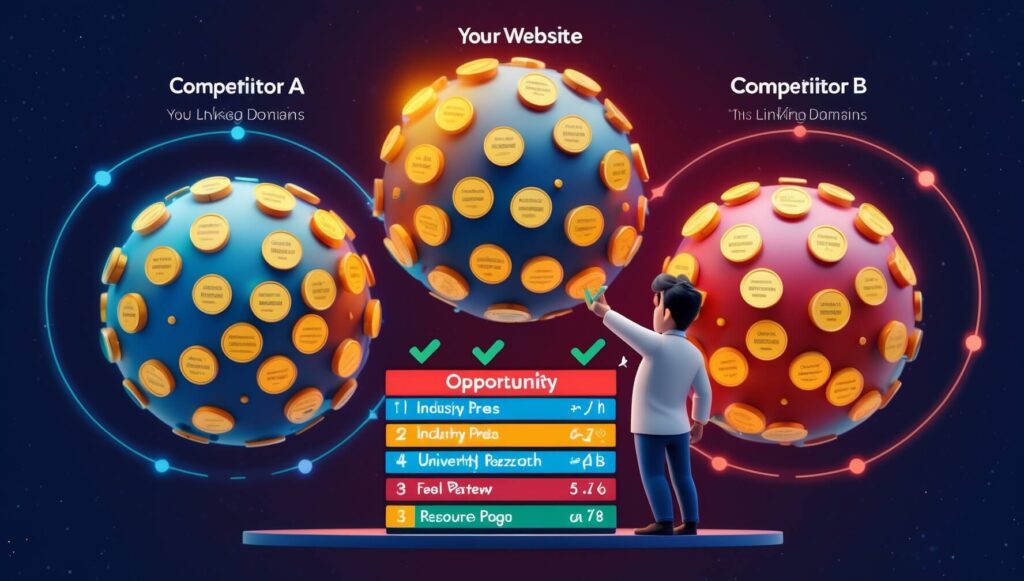
Link gap analysis identifies domains that link to one or more of your competitors but have no existing link to your site. These represent your most direct competitive backlink opportunities because the linking behavior is already established—you are not trying to persuade a domain to link to content in your topic area for the first time; you are trying to earn a similar endorsement to one they have already given to a competing site. Most professional backlink tools provide automated link gap reports: in Ahrefs, the “Link Intersect” feature surfaces domains linking to up to five competitor URLs but not your own. In SEMrush, the “Backlink Gap” tool provides the same functionality with its own scoring overlay. Export the full intersection list and score each domain on a simple prioritization matrix that weights domain authority, topical relevance to your content, the number of competitors the domain has already linked to (higher = stronger signal of willingness to link broadly in your niche), and the realistic likelihood of successfully earning a link through the available outreach path. The domains scoring highest across all four dimensions are your Tier 1 outreach priorities—targets where the expected value of a successful outreach is highest and the effort is most likely to produce results.
Content Gap Analysis: Understanding Why They Earned the Link
For each high-priority target domain identified through the link gap analysis, examine which specific page on your competitor’s site earned the link and study what made that content linkable. Was it a comprehensive how-to guide that became a go-to reference in your niche? A data-driven original research piece that provided statistics other writers cite? A free tool or calculator that delivers immediate practical value? An opinion piece by a recognized expert that sparked industry discussion? Understanding the content type and value proposition that earned each link is essential because it tells you what you need to create to earn a similar link from the same domain—and often reveals patterns across multiple domains that define the content formats most consistently rewarded with editorial endorsement in your specific market. This is where competitor backlink analysis directly informs your content strategy: rather than creating content based on intuition or internal preference, you are creating content modeled on demonstrated link-earning performance in your own competitive environment.
Resource Page and Roundup Opportunities
A specific and highly productive link building opportunity type that competitor backlink analysis frequently surfaces is resource page links—pages on high-authority sites that curate and link to the best external resources on a specific topic for their audience. When you identify that a competitor has earned a link from a resource page on a high-authority domain in your niche, that resource page is an immediate outreach opportunity: the page’s curator has already demonstrated both the practice of linking to external resources and the willingness to link to content from sites with your competitor’s profile. If your content is more current, more comprehensive, or better presented than the competitor’s content already included, a well-crafted outreach email making that case has a genuinely high probability of earning a resource page addition. As the resource page link building methodology from Backlinko’s resource page link building guide confirms, resource pages represent one of the highest conversion rate outreach targets in link building precisely because the curator’s willingness to maintain an external linking page means they are actively receptive to strong additions—unlike cold outreach to sites with no existing pattern of linking to external resources.
Why Competitor Backlinks Are a Strategic Intelligence Asset
Understanding why your competitors rank where they rank requires understanding the full composition of their authority—and in Google’s ranking model, a substantial portion of that authority derives from the quality and quantity of domains linking to their content. When you study competitor backlinks, you are not simply cataloguing where they have placed links; you are reverse-engineering years of relationship building, content strategy, digital PR work, and outreach effort that their current search positions are built on. This intelligence is valuable in ways that extend well beyond simple imitation.
First, competitor backlink data reveals the specific types of websites that consider your industry’s content link-worthy. A technology SaaS company studying its top three competitors might discover that 40% of their highest-authority backlinks come from developer documentation sites, industry newsletters, and university research program pages—a distribution that would not be obvious from keyword research alone and that directly informs which outreach targets will be most receptive to link requests. Second, it exposes content gaps: if a competitor has earned 300 backlinks to a comprehensive industry benchmark report that you have no equivalent for, that single content gap represents a significant and addressable backlink deficit. Third, it surfaces the specific weaknesses in competitors’ profiles—low-quality link sources, thin anchor text diversity, reliance on a small number of domains—that represent opportunities to build a comparatively stronger and more resilient link profile. As the strategic backlink intelligence framework from Moz’s guide to competitive backlink analysis details, the organizations that gain the most from competitor backlink research are those that treat it as a systematic, recurring practice rather than a one-time audit—because the link building landscape shifts continuously, and the opportunities visible today may close or intensify within a matter of months.
Identifying Your True Backlink Competitors
An important preliminary step that many SEO practitioners skip is distinguishing between your business competitors and your actual competitor backlinks competitors—the websites competing with you specifically in organic search for the keywords that matter most to your traffic and conversion goals. These two categories overlap substantially but are not identical. A regional competitor with strong offline brand recognition may have minimal organic search presence and therefore negligible backlink relevance to your SEO strategy. Conversely, a large industry publication that does not compete with your business commercially may be ranking above you for your most valuable keywords and therefore represents a critical backlink analysis target.
The most reliable method for identifying true backlink competitors is keyword-based SERP analysis: compile a list of the 20 to 30 keywords that represent the highest combined search volume and commercial intent for your business, record the top five to ten organic results for each, and identify which domains appear most consistently across all of those SERPs. The domains that appear most frequently are your genuine organic search competitors regardless of their business model, and their backlink profiles are the ones most directly relevant to understanding what it takes to rank for your target keywords. Most professional SEO platforms—including SEMrush’s backlink analytics and competitor discovery tools—automate this process with competitor discovery features that identify which domains overlap most significantly with your organic keyword footprint, providing a data-driven starting point for deciding whose backlink profiles to prioritize in your analysis.
How to Conduct a Thorough Competitor Backlink Analysis
A rigorous competitor backlinks analysis moves through several sequential stages, each building on the previous to construct a progressively richer picture of the competitive backlink landscape. Skipping stages or conducting the analysis superficially produces an incomplete picture that can lead to misdirected link building investments.
Step 1 — Build a Complete Backlink Profile for Each Competitor
Begin by pulling the full backlink dataset for each competitor using a professional backlink index tool. The three platforms with the largest and most frequently updated backlink indexes—Ahrefs, SEMrush, and Majestic’s Site Explorer backlink analysis tool—each maintain billions of indexed links crawled from across the web, providing the raw data needed for meaningful analysis. For each competitor, export the full list of referring domains (not just individual backlinks—multiple links from the same domain count as a single referring domain for authority purposes), the domain authority or domain rating scores of those referring domains, the specific pages on the competitor’s site receiving the most backlinks, the anchor text distribution across all their backlinks, and the follow/nofollow ratio of their link profile. This raw data is the foundation of everything that follows; the quality of your analysis is only as good as the completeness of the data you start with.
Step 2 — Analyze the Key Metrics That Define Link Profile Quality
With raw data in hand, shift from data collection to structured analysis by evaluating each competitor’s backlink profile across the dimensions that most strongly correlate with search authority and ranking power.
| Metric | What It Measures | Why It Matters for Your Analysis |
|---|---|---|
| Total referring domains | Number of unique root domains linking to the competitor’s site | The single strongest predictor of domain authority; more diverse linking domains generally correlates with stronger rankings |
| Domain Authority / Domain Rating | Composite score (Moz DA or Ahrefs DR) predicting ranking potential based on link profile strength | Benchmarks your authority gap and sets the target profile you need to build toward |
| Authority distribution of linking domains | The spread of DA/DR scores across all domains linking to the competitor | Reveals whether their profile is dominated by a few high-authority links or broadly distributed across many quality domains |
| Anchor text distribution | The breakdown of exact-match, partial-match, branded, generic, and naked URL anchors | Indicates link building approach (natural vs. optimized); heavy exact-match concentration is a manipulation risk signal |
| Top linked pages | Which specific pages on the competitor’s site attract the most backlinks | Reveals which content types and formats their industry finds most link-worthy—a direct guide to your own content strategy |
| Trust Flow and Citation Flow | Majestic metrics measuring link quality (Trust Flow) and link quantity (Citation Flow) | Identifies whether a large link count translates into genuine trust signals or reflects a quantity-focused, lower-quality approach |
| Link velocity trend | Rate of new backlink acquisition over time | Signals whether a competitor is actively investing in link building and in what patterns—sudden spikes may indicate PR campaigns or content launches to analyze |
Analyzing these metrics across all of your identified competitors simultaneously—rather than evaluating each in isolation—reveals the competitive benchmark your site needs to reach in order to compete effectively for shared target keywords. As the competitive link analysis methodology detailed in Backlinko’s comprehensive guide to backlinks and link building confirms, the referring domain count is the metric most consistently associated with ranking position differences between competing pages—making it the primary benchmark to close when setting link building targets.
Step 3 — Identify the Sources Driving Their Strongest Links
Beyond aggregate metrics, the granular identification of the specific high-authority domains linking to your competitors is where the most actionable intelligence emerges. Sort each competitor’s referring domain list by domain authority in descending order and examine the top 50 to 100 linking domains for each. Categorize these sources by type: industry publications and trade press, general news outlets, academic and research institutions, tool review and comparison sites, niche community forums and aggregators, podcast directories and show notes, resource page compilations, supplier and partner directories, and influencer or thought leader personal sites. This categorization reveals not just where your competitors’ strongest links are coming from but which publisher categories have demonstrated receptivity to linking to content in your space—directly informing which outreach target types to prioritize in your own link building campaigns. Pay particular attention to the link sources that appear across multiple competitors simultaneously: if four of your five top competitors all have backlinks from the same five high-authority industry publications, those publications represent proven link-worthy targets that your competitive position genuinely requires you to secure.

Conducting a Gap Analysis: Finding Your Link Building Opportunities
The most immediately actionable output of competitor backlinks analysis is the gap analysis: the systematic identification of high-quality domains that link to one or more of your competitors but not to your site. These gap domains represent pre-qualified link opportunities—publishers who have already demonstrated that they find your industry’s content link-worthy and who have editorial standards your competitors’ content has successfully met. Earning a link from them is a more targeted and efficient objective than cold-prospecting domains with no demonstrated interest in your topic area.
Most professional SEO platforms provide automated link gap analysis features that cross-reference your backlink profile against multiple competitors simultaneously and surface domains that appear in their profiles but not yours, ranked by the authority of those missing domains. Ahrefs’s Link Intersect tool, SEMrush’s Backlink Gap tool, and Moz’s Link Explorer each provide versions of this functionality. When working through the gap analysis output, apply a triage framework that prioritizes opportunities by a combination of factors: the domain authority of the missing linking domain, the thematic relevance of that domain to your content, the number of competitors the domain links to (the more competitors it links to, the more broadly validated the opportunity), and the realistic feasibility of earning a link given the domain’s editorial policies and the content you currently have or can create.
The link gap methodology outlined by Search Engine Journal’s guide to competitor link analysis for link building recommends segmenting gap opportunities into three priority tiers: Tier 1 (high authority, highly relevant, multiple competitors already linked—pursue immediately with targeted outreach), Tier 2 (moderate authority, relevant, one or two competitors linked—pursue with content development or partnership approach), and Tier 3 (lower authority, partially relevant, single competitor linked—monitor and pursue opportunistically as resources allow). This triage prevents the common mistake of treating all gap opportunities as equally urgent and helps concentrate outreach effort where it will generate the greatest ranking impact per hour of investment.
Decoding Competitor Content Strategies Through Their Backlinks
The pages on your competitors’ sites that attract the most backlinks are a direct, empirically validated signal of what content their industry’s publishers consider worth citing—and therefore a data-driven guide to what content you should be creating to generate equivalent link velocity. When you examine the top-linked pages across your competitor set, look for patterns in content type (original research, comprehensive guides, free tools, data visualizations, opinion essays, listicles), content format (long-form text, interactive content, downloadable resources, video), topic focus (specific subtopics that consistently attract more links than others), and content age (whether the most-linked pieces are recently published or older evergreen resources that have accumulated links over time).
Original research and data studies consistently attract exceptional backlink concentrations in virtually every industry because they provide a citation-worthy factual source that other writers and publishers can reference, link to, and build on. If your competitors have published annual industry surveys, proprietary data analyses, or original research reports that are attracting hundreds of referring domains, the ROI case for creating a competing or complementary research asset is strong and clearly validated by market evidence rather than content team intuition. Free tools—calculators, assessment generators, template libraries, audit checklists—represent another category of competitor content that reliably attracts sustained, compounding backlinks because they provide ongoing utility that publishers reference repeatedly rather than just once. As the content-for-links research summarized in Siege Media’s data-driven link building strategy guide demonstrates, original research assets generate backlinks at rates 6–10x higher than standard informational blog content—a performance differential that should directly influence how content investment is allocated in any serious link building strategy.
Building Your Outreach Strategy Using Competitor Backlink Intelligence
Identifying link opportunities through competitor backlinks analysis is only valuable if it translates into successful outreach. The intelligence gathered creates the targeting precision; effective outreach execution determines the conversion rate of that targeting into actual backlinks. A structured outreach approach built on competitor backlink research is significantly more efficient than generic outreach because every target has been pre-qualified as link-receptive by their existing relationship with a competing site.
For each high-priority gap domain identified in your analysis, research the specific editorial context of the link they provided to your competitor: what page of theirs contains the link, what is the subject of that page, what anchor text did they use, and what was the likely editorial motivation for including the link (resource recommendation, citation of a data point, expert quote, product comparison, directory listing). This context is the foundation of your outreach message—a personalized, contextually relevant pitch that acknowledges their existing content and proposes a specific way your content adds value to it is exponentially more likely to earn a positive response than a generic link request. The practical outreach framework from HubSpot’s link building and digital PR guide consistently shows that personalization—demonstrating that you have actually read the target page and can explain specifically how your resource complements or improves it—is the single most impactful variable in outreach conversion rates, outweighing factors like email length, subject line formulation, and follow-up timing.
The specific outreach tactics most effective for converting competitor backlink intelligence into placements include: broken link building (identifying cases where the linking domain links to a competitor page that has since been removed or redirected, and offering your equivalent content as a replacement), resource page addition (identifying competitor links on curated resource lists and requesting inclusion of your comparable or complementary resource), expert contribution (identifying publications that regularly feature competitor content and pitching your own expert commentary or bylined contribution), and citation updating (identifying competitor links in content citing outdated statistics or information and offering a more current resource from your site as a replacement citation). Each tactic leverages the competitive intelligence differently but all share the common thread of using competitor backlink data to pre-qualify targets before investing outreach effort.

The Best Backlink Analysis Tools for Competitor Research
The quality of your competitor backlinks analysis depends significantly on the tools you use to collect and process backlink data. The leading platforms each have distinct strengths that make them more or less suitable for specific analysis tasks.
- Ahrefs — Widely regarded as having the largest and most frequently updated backlink index, Ahrefs provides the most comprehensive referring domain data, the most accurate Domain Rating scores, and the most powerful content gap analysis features. Its Site Explorer tool is the primary interface for competitor backlink research, providing referring domain lists, top-linked pages, anchor text analysis, and link velocity data in an integrated dashboard. The Ahrefs backlink checker tool also offers a free version that provides a quick overview of any site’s top backlinks.
- SEMrush — Offers the most comprehensive integration of backlink analysis with keyword research, SERP tracking, and content marketing tools—making it the strongest choice for practitioners who want a single platform covering all competitive intelligence dimensions. Its Backlink Gap tool automates multi-competitor gap analysis and its Authority Score metric provides a reliable proxy for domain link authority.
- Moz Link Explorer — Provides reliable Domain Authority scores that remain widely referenced benchmarks across the SEO industry, along with spam score assessments that help identify toxic link risks in competitor profiles. The Link Intersect feature directly enables gap analysis across multiple competitor domains.
- Majestic — Uniquely valuable for its Trust Flow and Citation Flow metrics, which provide the most nuanced assessment of link quality beyond simple authority scores. Trust Flow measures the quality of links received based on proximity to trusted seed sites; Citation Flow measures the raw quantity of links. High Trust Flow relative to Citation Flow indicates a genuinely high-quality link profile; the reverse suggests a quantity-focused, lower-quality approach.
- Google Search Console — Provides authoritative first-party data on the links Google has indexed pointing to your own site—essential for benchmarking your current profile and understanding exactly which of your links Google recognizes and values, even if its competitor research capabilities are limited compared to third-party tools.
For practitioners with limited budget, the free tier of Google Search Console’s link reporting features combined with the free version of Ahrefs’s backlink checker provides a workable foundation for basic competitor research. For serious competitive backlink intelligence work at scale, a paid subscription to at least one of the major platforms is a professional necessity rather than an optional enhancement.
Performing a Backlink Audit on Your Own Profile
Competitor backlink analysis is most productive when conducted alongside a thorough audit of your own backlink profile. Understanding your current link profile’s strengths, weaknesses, and toxic elements provides the baseline context needed to prioritize gap-closing efforts and avoid investing in link building for pages that already have strong profile support.
A comprehensive backlink audit should identify and address several categories of link profile issues. Toxic backlinks—links from domains with very low trust scores, heavily penalized sites, irrelevant foreign language directories, or obvious link scheme participation—can suppress rankings and, in severe cases, trigger manual penalties from Google’s webspam team. Any toxic links that cannot be removed through direct outreach to the linking domain should be submitted to Google’s Disavow Tool for managing unwanted backlinks, which instructs Google to disregard those links when evaluating your site’s authority. The audit should also assess anchor text concentration: a profile where more than 25–30% of anchors use exact-match commercial keywords is a red flag for algorithmic or manual over-optimization penalties, and a diversification strategy for future link building is warranted. Additionally, identify your highest-authority existing backlinks and ensure that the pages receiving those links have strong internal linking to pass authority effectively through to your most commercially important pages—a frequently neglected optimization that extracts more ranking value from existing backlinks without requiring new acquisition.
Monitoring Competitor Backlinks Continuously
A one-time competitor backlink analysis provides a valuable snapshot but rapidly becomes outdated in a dynamic search landscape where your competitors are actively building new links, publishers are constantly updating their content, and Google’s assessment of link value evolves with algorithm updates. The practitioners who sustain long-term competitive advantage from backlink intelligence treat monitoring as a continuous practice rather than a periodic project.
Most professional SEO platforms offer automated backlink monitoring alerts that notify you when specific competitor sites gain significant new referring domains, when a domain you have been targeting as a link prospect adds a link to a competitor, or when your own backlinks are lost or changed. Setting these alerts for your top three to five competitors creates an early warning system for competitive link building activity that allows you to respond quickly—reaching out to newly identified link sources before they have linked to every competitor in your space, or escalating effort on content types that competitors are using to generate new link acquisition. The monitoring best practices detailed in SEMrush’s comprehensive backlink audit and monitoring guide recommend conducting a full competitive backlink analysis quarterly, supplemented by continuous automated monitoring alerts that flag significant changes in real time between full analysis cycles.
Staying Compliant with Google’s Link Building Guidelines
Learning from competitor backlinks is entirely legitimate and strategically valuable—but the method of acquiring comparable links must remain within Google’s Webmaster Guidelines to avoid the penalties that can result from manipulative practices. Google’s guidelines explicitly prohibit purchasing links intended to pass PageRank, participating in link exchange schemes, using automated link building programs, and creating pages or content solely to serve as artificial link sources. Any link building tactic that would not be defensible as an organic, merit-based editorial endorsement carries a penalty risk that can dramatically outweigh its short-term ranking benefit.
The most important principle for compliant link building informed by competitor analysis is to focus on earning the same types of links your competitors have—through the same channels and relationship types—by creating content that genuinely merits those links rather than by artificially replicating the surface appearance of their link profile. If a competitor has earned links from a major industry publication through an expert contribution program, the compliant approach is to pitch your own expert contribution to that publication, not to pay someone to insert a link in an existing article. If a competitor has earned links from comparison and review sites through genuine product merit, the compliant approach is to pursue organic review relationships through product outreach, not to pay the review site for favorable placement. This merit-based approach is not just safer from a penalty standpoint—it produces higher-quality, more durable links from publishers with genuine editorial standards, which deliver stronger and more sustained ranking benefits than any link scheme could provide. As the white-hat link building compliance guidance from Google’s official link spam and best practices documentation makes clear, the links that provide long-term search value are those that represent genuine editorial endorsements from publishers who chose to link because your content merited citation—and the most reliable path to those links is consistently creating content that genuinely deserves them.
Putting It All Together: A Systematic Competitor Backlink Strategy
The full value of competitor backlinks analysis is only realized when the insights generated at each stage of the process are integrated into a coherent, consistently executed link building strategy rather than treated as isolated analytical exercises. The process described throughout this guide is not a sequence you complete once and archive—it is a repeating cycle that continuously informs content investment decisions, outreach prioritization, partnership development, and competitive positioning as the search landscape evolves around you.
The strategic integration begins with establishing your competitive baseline: documenting your current backlink profile metrics and your gap relative to competitors for each target keyword cluster. This baseline becomes the benchmark against which all link building progress is measured. From there, the content strategy implications of your analysis feed directly into editorial calendar planning—identifying the specific high-link-value content assets your site is missing and prioritizing their development. The gap analysis output feeds into your outreach target list, organized by priority tier and enriched with the editorial context research needed to craft personalized, conversion-optimized outreach. Continuous monitoring feeds into a monthly or quarterly competitive intelligence review that updates your gap analysis, identifies new competitor link acquisition patterns worth responding to, and tracks your progress toward closing the authority deficit. As the integrated competitive SEO framework from WordStream’s data-driven link building strategy guide demonstrates, organizations that execute this integrated cycle consistently—rather than conducting occasional one-off analyses—build compounding authority advantages over time that become increasingly difficult for competitors to overcome. The competitive edge from systematic competitor backlinks analysis is not a one-time gain from a single clever tactic; it is the cumulative result of consistently making better-informed link building decisions than the competition, month after month, over the long term.