
Cart 0


Share
Table of Contents
AI Natural Language Processing: Revolutionizing Content Creation
AI Natural Language Processing is no longer a niche technology reserved for research labs or giant tech firms. In 2024, it sits at the center of modern content strategy, customer communication, and digital product design. From drafting blog posts and summarizing reports to powering virtual assistants and search experiences, AI NLP helps machines interpret language in ways that feel increasingly useful and human. For marketers, publishers, and business owners, that shift matters. It means faster workflows, sharper audience insights, and content that can be tailored with far more precision than traditional manual processes allow. It also means new responsibilities around accuracy, privacy, and bias. The real value of AI Natural Language Processing is not that it replaces human creativity, but that it expands what creators can do with the time and information they have. Leading organizations, including IBM and Google Cloud, describe NLP as a core layer in making data and communication more actionable. As the technology matures, understanding how it works and where it fits is essential for anyone producing content at scale.
Understanding AI Natural Language Processing
At its core, AI Natural Language Processing is the field that enables computers to read, interpret, generate, and respond to human language. It blends computer science, linguistics, and machine learning to turn messy text or speech into structured meaning. That includes grammar, intent, sentiment, entities, topics, and context.
Earlier NLP systems relied heavily on fixed rules. They could perform narrow tasks, but they struggled with ambiguity and variation. Modern systems use machine learning and large language models trained on enormous datasets. This shift allows better performance on real-world language, including slang, incomplete sentences, and domain-specific phrasing.
The practical goal is simple: make language usable for software. Whether the input is a support ticket, a product review, a transcript, or a search query, AI Natural Language Processing helps systems determine what the user means and what action should follow.

How AI NLP Works in Practice
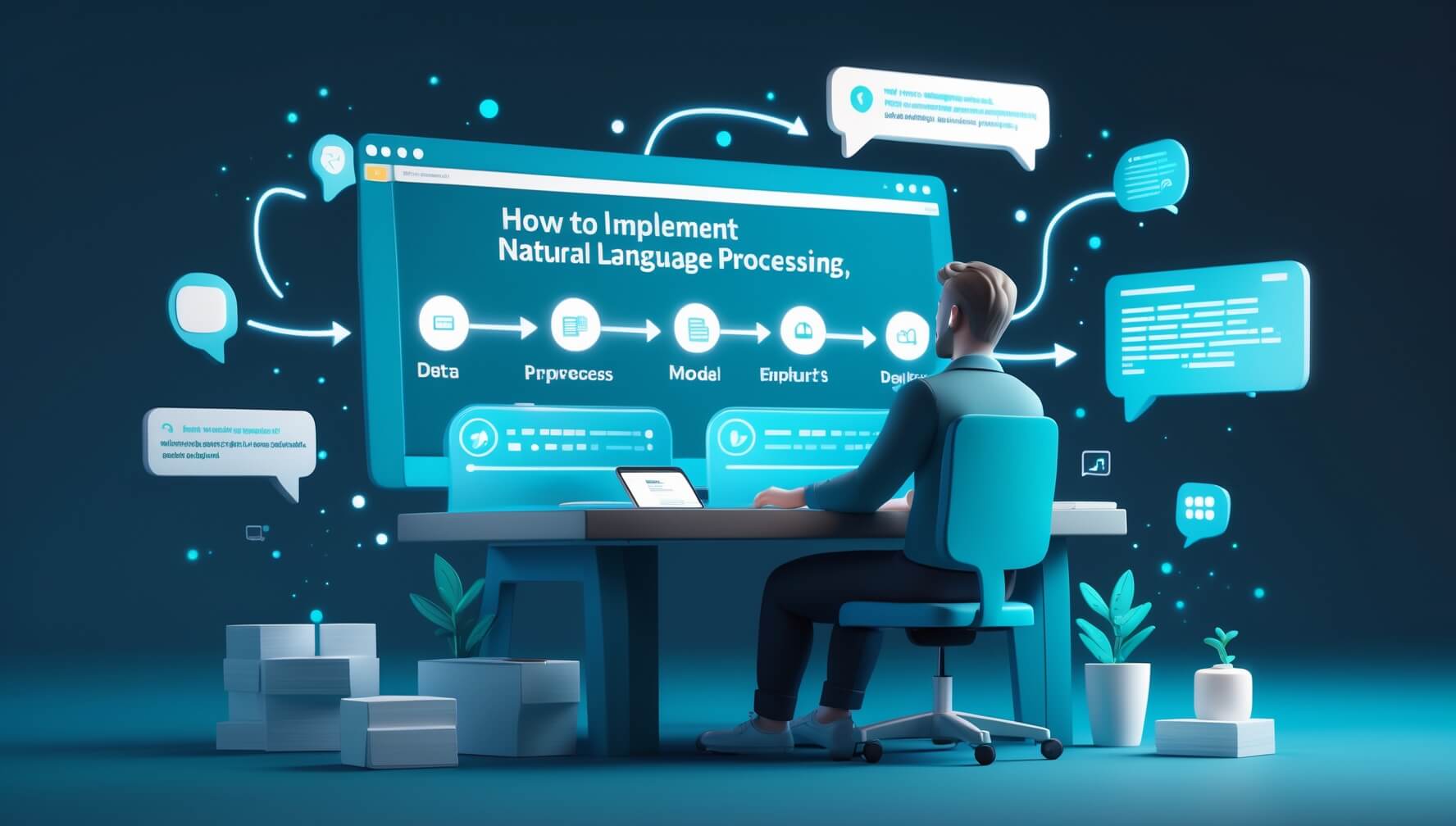
Most NLP workflows follow a sequence. First, the system ingests text or speech. Next, it breaks language into tokens, identifies sentence structure, and maps relationships between words. Then it applies models to classify meaning, extract entities, summarize content, or generate responses.
Modern pipelines often combine statistical methods with transformer-based architectures. The transformer model introduced in research from arXiv changed the field by improving how systems track context across long passages. That matters because meaning in language depends on more than individual words. It depends on surrounding terms, sequence, tone, and intent.
For content teams, this means tools can now suggest headlines, cluster keywords, rewrite passages, and identify gaps in coverage with much better contextual awareness than older software.
Why Businesses Are Investing in AI Natural Language Processing
Businesses adopt AI Natural Language Processing because language is everywhere. Customer emails, chat logs, social posts, product reviews, contracts, knowledge bases, and internal documents all contain value, but that value is hard to unlock manually.
NLP turns unstructured communication into usable signals. A retailer can detect recurring complaints from review text. A publisher can identify emerging themes from search behavior. A SaaS company can route tickets by intent instead of keyword alone. A marketing team can analyze hundreds of campaign comments in minutes.
According to guidance and tooling trends across platforms like Microsoft Azure, the strongest use cases combine automation with human review. That model reduces repetitive work while keeping judgment where it belongs. The result is usually lower cost, faster turnaround, and more consistent communication.
Core Techniques Behind NLP Development
Sentiment Analysis
Sentiment analysis classifies language by emotional tone, often as positive, negative, or neutral. Brands use it to monitor reactions to launches, campaigns, and support interactions. It is useful, but imperfect. Sarcasm, mixed sentiment, and cultural nuance still trip up many systems.
Named Entity Recognition
Named entity recognition identifies people, places, organizations, dates, products, and other specific references. In content operations, this supports tagging, indexing, fact extraction, and internal linking. It also improves search and recommendation systems.
Topic Modeling
Topic modeling groups related terms and themes across large document sets. Editors use it to understand what audiences discuss most often and where content depth is missing. This can guide editorial calendars and content refreshes.
Text Summarization
Summarization condenses long content into a shorter version while preserving key information. Newsrooms, research teams, and marketers use it to speed up review cycles. It is especially valuable when teams must process large volumes of reports or transcripts quickly.
AI NLP and Smarter Content Creation
This is where AI Natural Language Processing has had its most visible impact. Content creation used to involve long cycles of research, drafting, editing, optimization, and repurposing. NLP now supports each stage.
Writers can use AI-assisted tools to outline articles, identify related questions, simplify dense text, and adapt tone for different channels. SEO teams can cluster semantically related keywords instead of chasing exact-match phrases. Editors can summarize webinars into blog posts, convert long articles into social copy, and generate metadata faster.
That does not mean quality happens automatically. Strong content still depends on expertise, first-hand experience, and editorial standards. Search guidance from Google Search continues to emphasize helpful, people-first content. AI NLP is most effective when it supports a clear point of view rather than manufacturing generic text at scale.

Real-World Applications Across Industries
The reach of AI Natural Language Processing extends far beyond blog writing.
- Customer support: Chatbots classify intent, answer common questions, and escalate complex issues.
- Healthcare: NLP extracts meaning from clinical notes and supports documentation workflows, with oversight.
- Finance: Firms analyze earnings calls, filings, and customer messages for risk and trend detection.
- Media: Publishers automate summaries, tagging, and archive search.
- E-commerce: Product review analysis reveals quality issues and buyer priorities.
- Legal: Contract review tools identify clauses, entities, and anomalies in large document sets.
Research organizations such as NIST and academic resources from Stanford continue to shape best practices around trustworthy AI and language systems. That matters because the highest-value applications are usually the ones tied to decisions, not just convenience.
Intelligent Chatbots and Conversational AI
One of the clearest examples of AI Natural Language Processing in action is the intelligent chatbot. Early bots relied on rigid scripts and keyword triggers. Today’s systems can maintain context across multiple turns, detect user intent, and personalize responses based on prior interactions.
For businesses, that means support can be available around the clock without forcing customers through endless menus. Good conversational AI reduces wait times and handles repetitive requests consistently. It can answer order questions, book appointments, surface documentation, and collect lead information.
Still, the best chatbot experiences are carefully scoped. They know when to answer, when to ask for clarification, and when to hand off to a human agent. Poorly designed bots create friction fast. NLP improves the language layer, but service design determines whether the experience feels helpful or frustrating.
How Machine Learning Improves Language Comprehension
Machine learning made modern NLP far more adaptive. Instead of hard-coding every rule, developers train models on examples. The model learns patterns in phrasing, syntax, and usage, then applies those patterns to new inputs.
This is especially useful for ambiguity. Consider the word “apple.” In one sentence it refers to fruit; in another, a company. Context resolves the difference. Advanced models are better at making those distinctions because they evaluate surrounding language, not isolated terms.
That same capability helps with intent detection, semantic search, and content recommendations. It also improves multilingual tasks. Resources from Hugging Face show how quickly open-source models and benchmarks have expanded, giving teams more options for fine-tuning systems to specific domains.
Challenges That Still Limit NLP Performance
Despite the progress, AI Natural Language Processing still faces real constraints. Language is nuanced, contextual, and culturally shaped. Models can miss irony, overgeneralize from training data, or generate plausible but incorrect statements.
Three challenges stand out.
- Ambiguity: Words and phrases often have multiple meanings.
- Context: Meaning can depend on prior sentences, speaker identity, or situational knowledge.
- Data quality: Biased, outdated, or noisy training data leads to weak outputs.
Domain specificity is another issue. A model trained mostly on general web text may struggle with medical, legal, or technical content. That is why expert review remains essential in high-stakes settings. AI NLP can accelerate work, but it should not be treated as infallible.
Ethical Considerations and Responsible Use
As AI Natural Language Processing becomes more embedded in products and publishing workflows, ethics cannot be an afterthought. Bias is one of the biggest concerns. If a model is trained on skewed data, it may reproduce stereotypes or unfair patterns in classification and generation.
Privacy is equally important. Language data often includes personal or sensitive information. Organizations need clear consent policies, secure storage, and thoughtful retention practices. Guidance from the FTC reinforces the need for transparency when businesses collect and use consumer data.
There is also the question of disclosure. If AI helps generate content, summarize reviews, or answer support questions, users should not be misled about what is automated and what is human-reviewed. Responsible deployment builds trust. Short-term efficiency gains are not worth long-term credibility loss.
Future Trends Shaping 2024 and Beyond
Several trends are pushing the field forward in 2024. Multimodal systems are combining text, image, and audio understanding in the same workflow. That opens new use cases for search, accessibility, and media production. Multilingual performance is also improving, making AI Natural Language Processing more useful for global teams and regional markets.
Personalization is becoming more precise as models connect language signals with user behavior, though this must be balanced with privacy expectations. Retrieval-augmented generation is another major shift. Instead of relying only on model memory, systems pull from trusted documents at response time, which can improve accuracy for enterprise knowledge and current information.
For content teams, the likely future is not full automation. It is a hybrid model where AI handles extraction, transformation, and first-draft support while humans provide strategy, verification, and voice. That balance will separate strong brands from content farms.
Conclusion
AI Natural Language Processing has changed the economics and possibilities of content creation. It helps organizations understand language at scale, automate repetitive editorial tasks, improve customer interactions, and uncover insights hidden in massive volumes of text. For creators, it can speed up research, sharpen optimization, and make repurposing far more efficient. For businesses, it turns everyday communication into a source of intelligence.
But the real story is not automation alone. The strongest results come when AI Natural Language Processing is paired with human expertise. Editors still need to verify facts, shape narratives, and protect brand voice. Product teams still need to define where chatbots should stop and humans should step in. Leaders still need governance around privacy, bias, and transparency.
In 2024, the opportunity is clear. Teams that use NLP thoughtfully can create better experiences and better content without sacrificing quality. They can move faster while staying relevant, useful, and credible. The technology will continue to evolve, but the winning approach is already visible: use AI to handle the heavy lifting, and use human judgment to make the output worth reading. That is how AI Natural Language Processing truly revolutionizes content creation.

Permalink
Permalink