
Cart 0

Share
Table of Contents
How to Calculate Engagement Rate: The Definitive 2024 Guide for Data-Driven Marketers
Engagement rate is the single most reliable indicator of content resonance and community health in digital marketing. It measures the percentage of your audience that actively interacts with your content, moving beyond passive views or follower counts to reveal genuine interest. If you want to know how to calculate engagement rate with precision, you must first understand that this metric answers a fundamental question: Are people actually connecting with what you publish, or are they just scrolling past? Unlike vanity metrics such as total followers or impressions, engagement rate provides proportional context—a post with 500 interactions from 50,000 impressions (1%) is far less effective than one with 100 interactions from 1,000 impressions (10%). This guide delivers proven formulas, platform-specific calculations, industry benchmarks, and optimization strategies drawn from two decades of digital marketing experience. By the end, you will not only know how to calculate engagement rate across every major channel but also how to interpret those numbers to drive real business outcomes like higher conversion rates, stronger brand loyalty, and improved algorithm visibility. Let’s cut through the noise and focus on what truly matters: authentic audience engagement that fuels sustainable growth.
Why Engagement Rate Outperforms Vanity Metrics
Follower counts have long been the default measure of social media success, but they are dangerously misleading. An account with 100,000 followers and a 0.5% engagement rate generates only 500 interactions per post, while a competitor with 20,000 followers and a 5% engagement rate produces 1,000 interactions. The smaller account delivers twice the active audience participation, yet traditional metrics would suggest the opposite. This discrepancy explains why sophisticated marketers now prioritize engagement rate when evaluating content performance, influencer partnerships, and overall digital strategy.
Engagement rate matters because it correlates directly with business outcomes. High engagement signals that your content is valuable enough to warrant an active response—whether that is a like, comment, share, save, or click. Platforms like Instagram, Facebook, and TikTok use engagement signals to determine algorithmic distribution, meaning higher engagement rates lead to greater organic reach without additional advertising spend. Furthermore, engaged audiences are far more likely to convert into customers. According to a 2024 study by Sprout Social, brands with above-average engagement rates see 3.5 times higher conversion rates compared to those with below-average performance. This is not speculation; it is data-driven reality. When you learn how to calculate engagement rate correctly, you gain a direct line of sight into content effectiveness, community strength, and revenue potential.

Core Engagement Rate Formulas Every Marketer Must Know
There is no single universal formula for engagement rate. Instead, multiple calculation methods exist, each serving a distinct analytical purpose. Choosing the right one depends on your goals, available data, and the platform you are analyzing. Below are the four essential formulas, each explained with practical examples to ensure you can apply them immediately.
Engagement Rate by Reach (ERR): The Gold Standard
Engagement rate by reach measures the percentage of people who actually saw your content and chose to interact. This is the most accurate method because it excludes followers who never viewed the post due to algorithm filtering or inactivity. The formula is simple: (Total Engagements ÷ Total Reach) × 100 = ERR. For example, if a Facebook post receives 450 engagements from 15,000 unique reach, the ERR is 3% (450 ÷ 15,000 × 100).
ERR is the preferred metric for organic content analysis because it reflects true audience response. It aligns with how platforms evaluate content quality—high ERR tells algorithms that viewers found the post valuable, triggering wider distribution. However, ERR requires access to reach data, which some platforms restrict to account owners. Despite this limitation, it remains the most trustworthy benchmark for internal performance tracking. As of 2025, average ERR benchmarks across platforms are: LinkedIn 2.8%, Instagram 2.0%, TikTok 1.8%, X/Twitter 1.6%, and Facebook 1.4%. Use these figures as starting points, but always compare against your own historical data for the most relevant context.
Engagement Rate by Followers: The Accessible Alternative
When reach data is unavailable—such as when analyzing competitor accounts or vetting influencers—engagement rate by followers provides a workable solution. The formula is: (Total Engagements ÷ Total Followers) × 100. For instance, an Instagram post with 600 engagements from 20,000 followers yields a 3% follower-based engagement rate.
This method is easy to compute using publicly visible data, making it ideal for competitive analysis and influencer screening. However, it has a significant flaw: it assumes all followers see every post, which is never true. Typical organic reach on Facebook and Instagram ranges from 5% to 10% of total followers. Consequently, follower-based rates are always lower than ERR and can underestimate true performance. Use this metric for external comparisons, but never rely on it for internal optimization decisions when reach data is available.
Engagement Rate by Impressions: For Paid Campaigns
Impressions count every time content is displayed, including multiple views by the same user. This makes impression-based engagement rate particularly relevant for paid advertising, where you pay per thousand impressions (CPM). The formula is: (Total Engagements ÷ Total Impressions) × 100. A LinkedIn ad with 300 engagements from 30,000 impressions has a 1% impression-based rate.
Because impressions include repeat views, this rate is typically lower than ERR. A single user seeing your ad three times generates three impressions but only one reach, diluting the engagement percentage. Despite this, impression-based rates are invaluable for optimizing ad creative and targeting. They reveal how efficiently your content captures attention relative to the cost of exposure. When running A/B tests on ad variations, use impression-based engagement rate to determine which version drives the highest interaction per dollar spent.
Daily Engagement Rate: Tracking Long-Term Trends
For accounts that post multiple times daily or want to smooth out short-term volatility, daily engagement rate offers a macro perspective. The formula is: (Total Engagements for Period ÷ (Number of Days × Followers)) × 100. An account with 50,000 followers generating 25,000 engagements over 30 days has a daily engagement rate of 1.67% (25,000 ÷ (30 × 50,000) × 100).
This metric is particularly useful for identifying seasonal patterns, measuring the impact of strategic changes, and comparing performance across months or quarters. It eliminates the noise of individual post performance and focuses on overall community health. Brands launching new content strategies should track daily engagement rate for at least 90 days to establish a reliable baseline before drawing conclusions.
Platform-Specific Engagement Rate Calculations
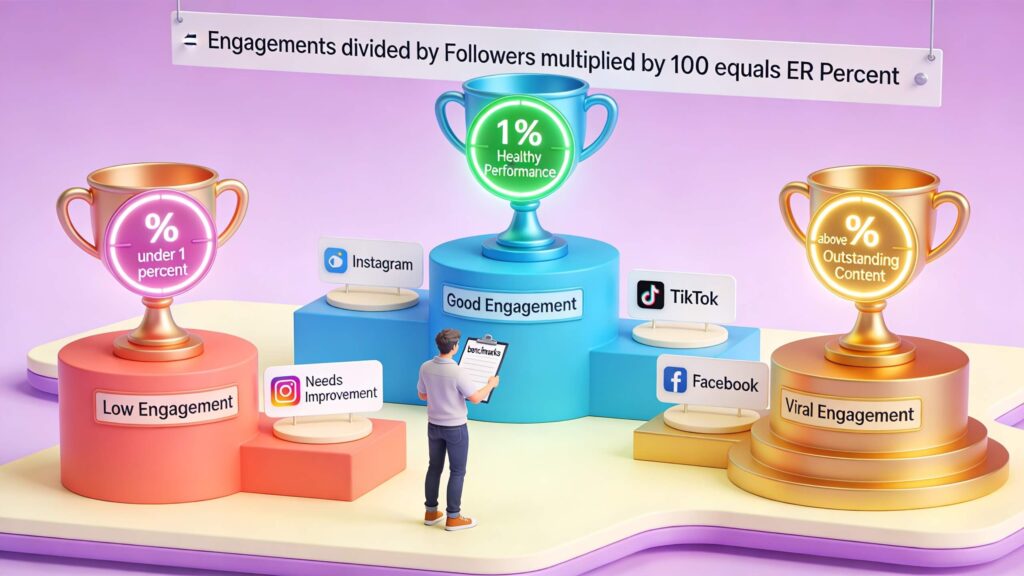
While the core formulas apply universally, each platform defines “engagement” differently and exhibits unique user behaviors. Understanding these nuances ensures you calculate engagement rate accurately and benchmark against the right standards.
Instagram: Likes, Comments, Saves, and Shares
Instagram engagement includes likes, comments, saves, and shares. Saves are particularly valuable because they indicate content worth revisiting, signaling high utility to the algorithm. The standard calculation for Instagram is: (Likes + Comments + Saves + Shares) ÷ Reach × 100. For follower-based comparisons, replace Reach with Followers.
Instagram engagement varies significantly by content format. Carousel posts typically achieve the highest engagement rates (3.5% on average) because they encourage swiping through multiple images. Reels, while prioritized by the algorithm, often have lower engagement rates (2.8%) but compensate with vastly greater reach. Static image posts fall in between at 3.0%. Account size also plays a role: micro-influencers (10,000–50,000 followers) average 3–5% engagement, while mega-influencers (1M+ followers) often see rates drop below 2% due to audience dilution.
Facebook: Reactions, Comments, Shares, and Clicks
Facebook’s engagement set includes reactions (six types beyond simple likes), comments, shares, and clicks on post content. The formula is: (Reactions + Comments + Shares + Clicks) ÷ Reach × 100. Facebook’s diverse reaction options provide richer sentiment data—a post with predominantly “Love” reactions indicates strong positive sentiment, while “Angry” reactions may signal controversy that generates engagement through disagreement.
Facebook engagement rates are consistently lower than Instagram, averaging 1.3–1.4% across industries in 2025. This reflects the platform’s maturity, algorithm prioritization of paid content for business pages, and an aging user base. However, Facebook Groups offer a notable exception: engagement rates within groups can exceed 5% due to focused communities and algorithmic favoritism toward group content. If you manage a Facebook presence, invest in group building for superior engagement outcomes.
LinkedIn: The B2B Engagement Leader
LinkedIn engagement comprises likes, comments, shares (reposts), and clicks. The platform commonly uses impression-based calculation: (Likes + Comments + Shares + Clicks) ÷ Impressions × 100. LinkedIn consistently delivers the highest engagement rates among major platforms, averaging 2.8–3.4% overall. Professional services firms often achieve 3.6–4.0%, while healthcare and education sectors also perform well above average.
LinkedIn’s high engagement stems from its professional context, which encourages intentional content consumption rather than passive scrolling. The algorithm heavily favors native content—posts with external links receive significantly less distribution. For B2B marketers, LinkedIn is the most effective platform for thought leadership, lead generation, and professional community building. When calculating engagement rate on LinkedIn, always use impressions as the denominator for accurate benchmarking.
TikTok: Video Completion Matters Most
TikTok engagement includes likes, comments, and shares, but the platform’s algorithm prioritizes video completion rate and average watch time above all other metrics. The standard calculation is: (Likes + Comments + Shares) ÷ Views × 100. However, a video with a 90% completion rate but modest engagement will outperform one with high engagement but low completion.
TikTok engagement rates average 1.5–2% overall, but this masks wide variation. Entertaining, trend-based content often achieves 3–8% engagement, while promotional content frequently falls below 1%. The platform’s “For You” algorithm enables viral reach far exceeding follower counts, making reach-based engagement calculation more meaningful than follower-based metrics. Successful TikTok strategy prioritizes content quality and trend participation over follower growth, inverting traditional social media approaches.
Website Engagement Metrics: Beyond Social Media
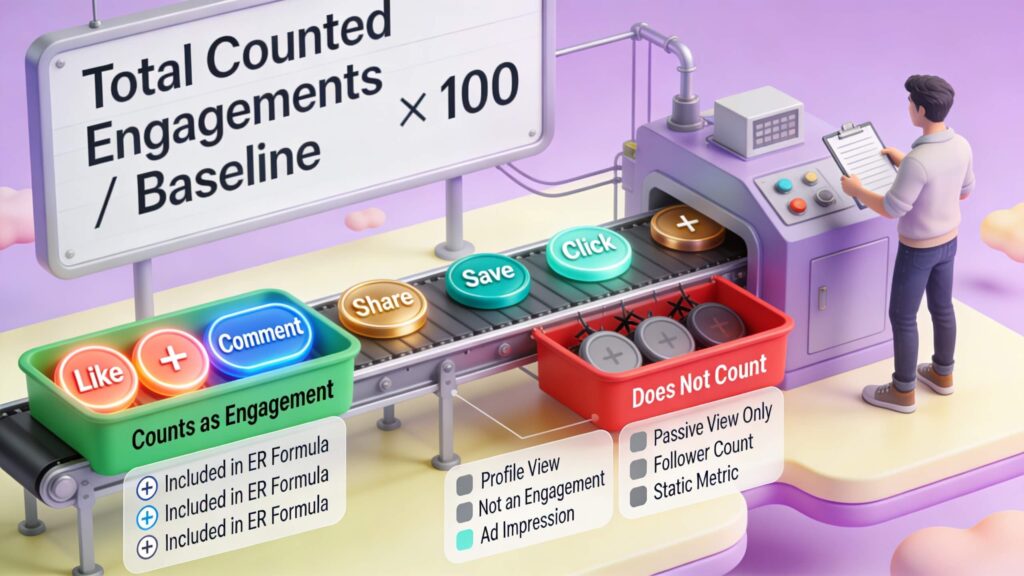
Engagement rate is not limited to social platforms. Website engagement metrics provide critical insights into visitor behavior, content effectiveness, and conversion readiness. Google Analytics 4 (GA4) revolutionized website engagement measurement with several core metrics that complement social media analysis.
GA4 defines an “engaged session” as any visit lasting 10 seconds or more, generating two or more pageviews, or triggering a conversion event. The website engagement rate formula is: (Engaged Sessions ÷ Total Sessions) × 100. A site with 8,000 engaged sessions out of 10,000 total sessions achieves an 80% engagement rate. Average engagement time, pages per session, and scroll depth provide additional context. For most content websites, a 50–75% engagement rate is typical, while e-commerce sites often target higher rates due to product browsing behavior.
Interpretation requires nuance. A blog post where visitors read the entire article and then leave is a success, even though it may appear as a “bounce” in traditional analytics. Contact pages naturally have high exit rates because visitors complete their goal and depart. E-commerce pages should show lower bounce rates and higher pages per session as shoppers browse multiple products. Always benchmark against industry standards and track trends over time rather than fixating on arbitrary targets.
Industry Benchmarks and Account Size Impact
Context is everything when evaluating engagement rate. A 3% rate might be exceptional for a technology brand on Facebook but mediocre for an education account on Instagram. Understanding how industry and account size influence benchmarks prevents misguided optimization.
Education consistently leads across platforms, with Instagram engagement averaging 4.2% and LinkedIn at 2.8%. Non-profit organizations achieve strong engagement through mission-driven communities. Conversely, technology businesses typically show lower rates due to complex products and broad audiences diluting relevance. Financial services face regulatory constraints that limit creative freedom, resulting in below-average engagement.
Account size exhibits an inverse correlation with engagement rate. Nano-influencers (1,000–10,000 followers) often achieve 5–10% engagement through intimate community relationships. Micro-influencers (10,000–50,000) average 3–5%, maintaining strong connection at moderate scale. Mid-tier influencers (50,000–500,000) see 1.5–3% as audiences grow beyond personal interaction capacity. Mega-influencers (1M+) frequently fall below 2%, trading engagement depth for breadth of reach. This tradeoff explains why brands increasingly favor micro-influencer partnerships for campaigns requiring authentic connection and conversion.
Tools for Measuring Engagement Rate
Manual calculation is feasible but inefficient for ongoing tracking. Several tools automate measurement, provide historical data, and enable competitive benchmarking. Native platform analytics—Instagram Insights, Facebook Business Suite, LinkedIn Analytics—offer free, authoritative data for single-platform management. For cross-platform consolidation, tools like Sprout Social and Hootsuite unify metrics into dashboards with automatic engagement rate calculation. Advanced platforms like Socialinsider and Brandwatch provide competitor benchmarking, influencer scoring, and custom reporting. Google Analytics 4 remains the dominant free solution for website engagement, natively calculating engagement rate and tracking engaged sessions. Choose tools based on your platform focus, budget, and analytical depth requirements.
Strategies to Improve Engagement Rate
Knowing how to calculate engagement rate is only half the battle; improving it requires strategic action across content, community, and technical domains. Content quality is non-negotiable—valuable, relevant content naturally drives interaction. Analyze your top 10% performing posts to identify patterns in format, topic, tone, and timing. Interactive formats like polls, questions, quizzes, and challenges consistently achieve 2–3 times baseline engagement by transforming passive viewers into active participants. User-generated content campaigns leverage audience creativity while building community through featuring contributor content.
Posting optimization matters. Align publishing times with audience active periods revealed by analytics—LinkedIn peaks during work hours, Instagram during evenings and weekends. Frequency should balance visibility with fatigue: Instagram 4–7 posts weekly, Facebook 1–2 daily, LinkedIn 2–5 weekly, TikTok 1–3 daily. Format selection influences engagement; video content consistently receives preferential algorithmic distribution across platforms. Community management transforms accounts from broadcast channels into conversation spaces. Respond to comments promptly, ask follow-up questions, and acknowledge top contributors to foster reciprocal relationships that drive sustained engagement.
Common Calculation Mistakes to Avoid
Several errors distort engagement rate calculations and lead to flawed conclusions. Inconsistent formula application is the most common—comparing engagement rate by followers to engagement rate by reach produces invalid comparisons because the denominators differ. Always use the same formula when tracking trends or benchmarking competitors. Gaming metrics through low-value tactics—engagement pods, purchased likes, comment baiting—generates hollow numbers without business value. Platforms increasingly detect and penalize artificial engagement, while meaningless interactions fail to convert into awareness or sales. Ignoring engagement quality and sentiment is equally dangerous. Angry reactions and negative comments still count as engagement but indicate audience dissatisfaction. Comprehensive analysis requires examining engagement composition and sentiment to ensure you are building genuine affinity, not rewarding controversy.
Conclusion
Mastering how to calculate engagement rate transforms your digital marketing from guesswork into a data-driven discipline. This single metric cuts through the noise of follower counts, impressions, and other vanity numbers to reveal what truly matters: whether your audience is actively connecting with your content. By applying the formulas, platform-specific calculations, and benchmarking insights covered in this guide, you can objectively assess performance, identify optimization opportunities, and build communities that drive real business outcomes. The difference between marketers who succeed and those who struggle in today’s algorithmic landscape is not creativity alone—it is the ability to measure, interpret, and act on engagement data with precision. Start by calculating your current engagement rate using the most appropriate formula for your goals. Then, implement the strategies outlined here to improve it systematically. Your audience, your algorithms, and your bottom line will thank you.